I thought it was about time I gave myself permission to write about things that weren’t all that important.
We’re living through such Unprecedented Times when so many Serious Things are happening every hour, I think I started to feel like it would be irresponsible to write about things that were not directly related to the end of the republic or the plague.
But honestly, who cares what I think?
I don’t mean that in a self-deprecating way. Okay, yes I do, but I also mean to say that plenty of other smart and good-hearted folks already have this covered. There are times when I do feel like my particular perspective on current events is valuable. But, you know, not all the time.
And at the same time, I have a lot of big thoughts about things that simply aren’t existentially consequential. Lately, though, I guess I’ve felt like it would be almost inappropriate to talk about anything frivolous, like superhero TV shows or gadgets, let’s say. Since no one is currently paying me to publish my thoughts on unimportant things (oh please someone pay me to do that), it sort of felt rude to do so—almost gauche.
I wrote about how cool it is that when I needed my iPad to serve as my primary personal computer, it unexpectedly filled that role really damn well. Read that too!
I also posted some fake news! Let me explain. I am experimenting with coming up with fictional news articles, not satire per se, like The Onion, but just things that aren’t true. Maybe it’s funny, maybe it’s not.
I don’t really know why I’m doing that, but the idea was inspired by a piece in Current Affairs by Nathan J. Robinson, “The Truth Is Paywalled But The Lies Are Free.” My fake articles fall are published in a fake publication I call Free Lies.
I wrote a sonnet about a TV show that’s been on for a while.
I have really been enjoying the “Arrowverse” shows, Arrow, The Flash, and Supergirl. They’re so much fun, in large part because they so gleefully embrace their inherent silliness and absurdity.
I‘m hoping to get fully caught up with all of the shows in that universe before I watch the big Crisis on Infinite Earths crossover event, so I was overdue to get started on Legends of Tomorrow, which debuted in 2016. So I watched the two-part pilot.
And it’s pretty dopey. I may or may not trudge through the whole series, but the pilot was definitely rougher than the shows off of which it is spun. Maybe it’ll get better.
I was looking for an excuse to write a sonnet. And I thought it would be fun to pick a subject that wasn’t all that important. And “Legends of Tomorrow” fits so well into a line of iambic pentameter. Although, it turns out I didn’t actually use the title in the actual sonnet, but NO MATTER.
Here you go. A two-part, non-rhyming sonnet. About a TV pilot. About superheroes. You’re welcome.
Let’s put aside the fact that Snart and Mick Are not endowed with any superpowers; But only have the fancy guns they stole From heroes on another show. The team To which they’ve been conscripted has been told By some time-hopping malcontent that none Of them have value on their own, and must Abscond into the past to thwart the plans Of some immortal fascist demigod Before he murders billions decades hence. It’s only then that these fantastically Empower’d also-rans will find a sense Of worth. I think that’s just a bit absurd.
There’s Ray, a supergenius billionaire Who built a suit combining powers of Mans Both Iron and Ant. The odd couple that forms Into a human conflagration? Holy crap! The oft-respawning duo with the wings Would seem to me to be a pretty damn Big deal. And Sarah Lance! She once was dead! And now she’s not! And smashing many heads. It takes a special kind of asshole to convince These Legends that they’re both of no import Yet also indispensable. Come on. I simply can’t believe how easily they’re duped. (And what was up with Martin drugging Jax?) They’d have been fine if they had just stayed put.
I took some time off last week, which was desperately needed, and it gave me some extra time to do more extracurricular writing. So that’s good!
I know it’s a cliche, but good lord it’s hard to actually relax into vacation time. I don’t think I really nailed it until the last two days. In the first few days, I wasted a lot of energy fretting over what I “ought” to be doing with my free time. But I can report that I did manage to come out the other end of this mini-vacation (entirely at home) feeling just slightly more grounded. Probably because I worked through a lot of my personal angst in public, which you can now enjoy! Lucky you!
Oddness can be forgiven if it comes with a superpower. You can be weird, sub-ordinary, if you truly excel at something. But not if you’re “just okay” at a few things.
Those of us who are weird and just-okay at things can be envious of the ordinary. Astounding no one, but not disappointing anyone either.
I wrote about the utility of letting go of hope. Not embracing hopelessness, though:
Maybe I can’t get free of the fetters I’ve fitted myself with, nor the ones that the culture has clapped onto me, because I maintain a delusion that meaning, peace, and validation will still be given to me by Someone Else, by some force Out There. Maybe by shedding hope, I empower myself to provide it on my own.
I think natural selection and I need to have a talk. I need to thank it for getting us all this far, what with the conscious brains, the opposable thumbs, and whatnot. And then I need to tell it, honestly, that its time with me is over, because it’s holding me back from, well, evolving.
Are people just getting together and hocking mucous-globs into each other’s mouths?
And finally, I came up with a little speculative fiction about what might happen if we just let the Trump cultists believe that Trump is going to be president for however long they want to believe it, in a sort of MAGA-Matrix:
It is 2023. Joe Biden is embroiled in several lawsuits over his attempt to steal the 2020 election. Hunter Biden is in prison in Moscow. Kamala Harris is still out there, working with AOC, Antifa, and George Soros (now 93 and obviously being kept alive with some kind of secret pharmaceuticals or cybernetic implants) to foment a revolution and take over the country.
I won’t always have this much extra time and energy to put out this much Quality Content, but I’m glad I did. I hope you are too!
As always, if you find this stuff valuable, you can toss some currency my way. It’s totally okay if you don’t!
The United States is politically held hostage by tens of millions of people living in a delusional version of reality. No matter the facts staring them in the face, just a little less than half of the electorate seems to believe in an alternate universe in which Trump won the election, left-wing terrorists are destroying our cities, COVID is a hoax or an exaggerated flu, and white Christians are the most oppressed group in history.
So I had a thought.
Information silos, filter bubbles, and algorithms can obviously make millions of people believe almost anything. So if what the Cult of Trump needs is to live in a fake reality, well, maybe we can just let them. And then the rest of us can carry on with actual reality.
I turned this thought into a bit of speculative fiction.
* * *
After a hard day at work, Rick plops down on the couch and flips through his phone to see what’s new.
He’s a father of three, but two of the kids are grown and out of the house, and the other is out with friends. His wife, Danielle, is making dinner, which she always does unless she’s not feeling well.
Rick scrolls through his social media feeds and gets updated on some of the latest headlines. The border wall had just been completed, and the pictures were stunning. 30-foot high partitions, black as midnight, effectively invisible in the dark, but reflective so that the sun blazed in the eyes of anyone who looked at it from the right angle. Smooth, unscalable, and a true monument to America’s force of will against invaders. President Trump would be there tomorrow afternoon for a ceremony celebrating this achievement.
It’s a good time for this kind of morale boost, as China has made more threats against the United States, promising to choke the American economy while making incursions into our Pacific territory. And who knows when they might release another virus. The president has been undeterred, however, and Rick is reassured when he hears Trump call China’s bluff. You just try it, thinks Rick. See what Donald does.
It is 2023. Joe Biden is embroiled in several lawsuits over his attempt to steal the 2020 election. Hunter Biden is in prison in Moscow. Kamala Harris is still out there, working with AOC, Antifa, and George Soros (now 93 and obviously being kept alive with some kind of secret pharmaceuticals or cybernetic implants) to foment a revolution and take over the country. (No chance, thinks Rick.) Black rioters have nearly destroyed several major Democrat-run cities, so they are now being occupied by federal agents who are arresting criminals, guarding property, and saving the lives of innocent Americans. The president has forced Twitter to shut down for censoring conservatives, which is against the Constitution. Facebook has learned its lesson and now treats conservative voices fairly.
As he scrolls through his feed, Rick almost skips past a headline that said something about someone on Fox News saying something about Joe Biden. He reverses the direction of his thumb swiping to find the item. And there it is. The post reads, “Fox News Guest Says Joe Biden is Currently President!” Rick chuckles out loud.
“What’s so funny?” Danielle asks from the kitchen.
It is stupid. Everyone knows that Fox News went off the rails back in 2020, and really couldn’t be trusted anymore, except for a few hosts like Hannity and Tucker. But what kind of delusional nonsense was this? Why would anyone say that Joe Biden was actually president right now? Some kind of hangover from the 2020 election debacle? The facts are the facts! Trump won the election, even though Democrats tried to steal it with loads of fake votes. But President Trump refused to concede, vowed to keep fighting, and eventually (and inevitably) triumphed in the courts. Thank you, Justice Barrett!
Some say that Trump is thinking about running for a third term. That would be just fine with Rick.
Danielle coughs from the kitchen. And then again, and emits a little bit of a groan.
Rick calls out, “You okay, honey?” Danielle had been under the weather ever since they went to that basketball game Danielle’s nephew was playing in. It was actually a really good game, and the place was packed! She probably picked up some bug going around.
“I’ve been better,” she responds. “I’ll lay down after dinner.”
Rick makes a mental note to check her temperature, and maybe his own. He’s not feeling so great either, but he’s never been one to admit when he’s sick.
Then he remembers what he was looking at. Right, that dumb Fox News person who said Biden’s the president. Rick taps on the item.
The post had been deleted.
That’s weird. Fake news never really goes away, does it? You just have to keep vigilant, and only trust the sources that you know for sure are giving it to you straight.
Rick thinks back to the border wall, and he smiles. Yeah, he thinks, Trump is doing a fantastic job in his second term. A third term would be just fine by him.
I’m not talking about the theory of evolution as a scientific concept, I mean I am having some strong feelings about what a pain in the ass natural selection is to me, right now.
If you’re new to my writing, let me just give you a quick status report: my sense of self is kind of garbage. I’m not currently experiencing existential anguish, per se (but, you know, catch me on a different day and see what you get), but I am wrestling with a crisis about who I am and why I bother existing.
And a lot of that hinges on a deep, aggravating need for validation. I need other people to justify my existence for me. It’s a big reason why I was a professional actor, why I write, why I make music, and why I do pretty much anything else not directly related to my own survival or the well-being of those I love. I need to be told by The World that I belong.
For the last few years, I’ve been able to pin some of the blame for this on my autism, having been diagnosed with Asperger’s at the age of 39. As you might imagine, someone with my particular neurological quirks might grow up developing a sense of alienation. That’s what happens when you 1) feel like you’re not the same as everyone else, and 2) are constantly told you are not the same as everyone else, often in very painful terms.
So of course I seek validation now! I’ve been conditioned over several decades to expect to be an outcast, to believe that any sense of belonging I do manage to experience is temporary and tenuous at best, and that I am not capable of judging for myself whether or not I possess sufficient value as a person to continue existing.
Damn you, autism!
The thing is, the need to feel belonging with a tribe is not particular to the neurodivergent. It’s hard-wired into humanity as a whole at the deepest levels. Many humans achieve this belonging rather easily (or so it seems to me). They provide value to their families and communities, they receive the benefits of being a part of those families and communities, and they are validated for playing their part in those social systems. They don’t have to think about it.
But threaten that belonging, cause someone to feel like their place in the tribe could be reduced or taken away, and see what atavistic shit comes up.
For someone like me, that sense of threat is ever-present, and I feel it on every level: I feel like humanity on Earth doesn’t want me, and I also assume I am perpetually on the edge of being rejected by the people Iove. Any minute now, they’re going to decide they’ve had it.
So maybe I feel this kind of alienation and anxiety more often or more severely than most, but all of us have it in us. We’re supposed to! It’s how early humans survived through our time as nomadic hunter-gatherers.
It was Robert Wright, in Why Buddhism is True, who clarified this point for me, that this anxiety over other’s opinions of us is all natural selection’s fault:
Why would natural selection design organisms to feel discomfort that seems so pointless? Maybe because in the environment of our ancestors it wouldn’t have been pointless; in a hunter-gatherer society, you’re pretty much always performing in front of people you’ll see again and whose opinions therefore matter. My mother used to say, “We wouldn’t spend so much time worrying about what other people think of us if we realized how seldom they do.” She was right; our assumption that people give much thought to us one way or the other is often an illusion, as is our unspoken sense that it matters what pretty much everyone we see thinks of us. But these intuitions were less often illusory in the environment of our evolution, and that’s one reason they’re so persistent today.
That’s right, natural selection wants us to be insecure.
There’s so much else that natural selection “wants” us to do that is ultimately harmful to us now. And it seems to me that so much of what we think of as human civilization and progress is really a big species-wide struggle against natural selection and all the things it pushes us to do against our own interests, from the desire to eat too much sugar to the urge to decimate nearby tribes and take their resources. Self-doubt is just one more thing.
I think natural selection and I need to have a talk. I need to thank it for getting us all this far, what with the conscious brains, the opposable thumbs, and whatnot. And then I need to tell it, honestly, that its time with me is over, because it’s holding me back from, well, evolving.
I need to remember that my ache for belonging, while exacerbated by my autism and other quirks, ultimately stems from an instinct that no longer serves its purpose, and that I am free to let it go. To be at peace with who I am and where I am, I think I to kick natural selection out of the tribe.
I am trying to disconnect without isolating. I am trying to find meaning without validation. I am trying to unburden without irresponsibility. I am trying to be aware without being overwhelmed. I am trying to be at peace without being passive. I am trying to matter without having to ask whether I matter. I am trying to fit in without being too ordinary. I am trying to stand out without jutting. I am trying to have hope without being crushed by it.
Maybe it’s that last one that needs to go.
Derrick Jensen wrote a few years ago in praise of giving up on hope. He’s talking about this in the context of his struggle to defend the natural world from decimation by humanity. To me, it applies universally. It’s not even about rejecting hope, but simply not dealing with it one way or the other. Once hope becomes irrelevant, Jensen says:
…you realize you never needed it in the first place. You realize that giving up on hope didn’t kill you. It didn’t even make you less effective. In fact it made you more effective, because you ceased relying on someone or something else to solve your problems … and you just began doing whatever it takes to solve those problems yourself.
This is not the same as hopelessness. Hopelessness implies defeat, pessimism, resignation to things getting worse. This is something else.
Here’s the part that’s both the most appealing about this idea and the most frightening:
When you give up on hope, something even better happens than it not killing you, which is that in some sense it does kill you. You die. And there’s a wonderful thing about being dead, which is that they — those in power — cannot really touch you anymore. … The socially constructed you died. The civilized you died. The manufactured, fabricated, stamped, molded you died. The victim died.
And who is left when that you dies? You are left. Animal you. Naked you. Vulnerable (and invulnerable) you. Mortal you. Survivor you. The you who thinks not what the culture taught you to think but what you think. The you who feels not what the culture taught you to feel but what you feel. The you who is not who the culture taught you to be but who you are.
As someone who has wasted so much precious life trying to define himself through others’ perceptions, who could not find any value in himself without the explicit approval of everyone else, this is tantalizing and bewildering.
Later, I began to take a more nuanced view. While I must still learn to accept my unmasked, unfiltered self, there is still power to be had with intentional masking, endowing myself with aspects of an identity in order to achieve the things my unmasked self might seek. One can adapt without self-deception. One can modulate one’s behavior without imprisoning oneself. One can augment, and those augmentations are under the control of the “true” self.
But whether one is masking, passing, augmenting, retrofitting, or what have you, I wonder now if it’s hope that is still an ingredient of falseness. Maybe I can’t get free of the fetters I’ve fitted myself with, nor the ones that the culture has clapped onto me, because I maintain a delusion that meaning, peace, and validation will still be given to me by Someone Else, by some force Out There. Maybe by shedding hope, I empower myself to provide it on my own.
“When you quit relying on hope,” writes Jensen, “and instead begin to protect the people, things, and places you love, you become very dangerous indeed to those in power.”
In my case, “those in power” are the imaginary blessings from an amorphous other. That’s what I’ve allowed to have power over me, the wish, the hope, that at some point I’d prove myself worthy to be One of You, worthy to belong to this world.
Maybe if I give up on hope, the ache for validation, the yearning to matter, will ease.
I grew up under a strange and rather painful contradiction. Those who loved me told me I was special, that I had greatness in me. My peers told me I was garbage, that I was beneath them. As a result, I spent a lot of energy just trying to pass as ordinary, hoping that my latent greatness would get its chance to shine later on.
I guess I’m still doing that, except now it’s with the awareness that there’s a lot less “later on” left, and coming to terms with the possibility that the greatness is really more like “just-okay-ness.”
Think of how young you were when you first thought you had to be the hero of your own story. I must have been barely older than a baby. My father called me maverick. It made me feel like a rebel. I wanted to be a star. I had to win at all costs. And yet: when was the last time anyone ever told a man to be ordinary? Think of the difference that would make, to begin to dismantle our need to be heroes, to finish things, to consider ourselves defined by accomplishment…
While no one is encouraged explicitly to be ordinary, it’s pretty obviously and vigorously implied. But I do not think we are ever encouraged to be extra-ordinary. We are told to excel, to achieve, to be great. Great, but not different. Be the same as everyone else, but be better at it.
What if you’re decidedly extraordinary, as in un-ordinary, but not quite great? Oddness can be forgiven if it comes with a superpower. You can be weird, sub-ordinary, if you truly excel at something. But not if you’re “just okay” at a few things.
Those of us who are weird and just-okay at things can be envious of the ordinary. Astounding no one, but not disappointing anyone either.
No one should feel pressured to be ordinary. But nor should anyone feel like a failure for not being great. What we should encourage in others, and aspire to for ourselves, is to be at peace with who we already are, and utterly free to discover what we might be.
We may discover more ordinariness. We may discover greatness. We may discover flaws and deficits. But whatever we find, we should be free to feel we are enough.
There were more than 160,000 new coronavirus cases today in the United States. In the span of 24 hours, a number of people equal to the population of Alexandria, Virginia were revealed to be infected. Yesterday, they hadn’t been counted yet. These cases, all 160,000-plus, are new today.
Tomorrow, there will probably be just as many new cases, if not more. These will all be from people who already have it, whether they know it or not, but will be counted anew tomorrow. We don’t know how it will compare to today, but it’s a safe bet that it’ll be another Alexandria, more or less. In one day.
What the hell is going on? What are people doing? I know there are more than enough deniers and reckless people who simply don’t care to keep this disease spreading. I get that people are being idiots and refusing to take basic precautions, having close indoor gatherings even when they know they shouldn’t. But 160,000 new cases in just one day?
Are people just getting together and hocking mucous-globs into each other’s mouths? Are people going around in public licking doorknobs and other people’s faces? Is there an explosion of meetings where thousands of people get together for casual, serial French kissing with arbitrary partners?
I get that we in the United States are screwing up this pandemic, I really do. But how can it be this bad?
And at what point does it become inevitable that we’re all going to get it? Are we already there?
This project of producing newsletters and media at a somewhat regular clip, is still new to me, and I’m still trying to find the right mix of elements that make it really click. For my first video-cast-pod-thing, I chose to read a piece I’d written a couple of years back about how hard it is to put in the time, effort, and emotion into all this creative work, all the while knowing that it will reach only a handful of people. Of course one can’t know this for certain, but it’s a solid bet!
I think the cold reality of irrelevance has hit me a little harder this week, as the election receded from the top of my mind and I took a little time off work. When a room opened up in my brain, it was quickly furnished with feelings of futility.
I began reading How to Disappear by Akiko Busch this past week, and in the introduction she says, “It has become routine to assume that the rewards of life are public and that our lives can be measured by how we are seen rather than what we do.” As someone who grew up being utterly ostracized for how he was seen, and then later became a professional actor, and then later got into nonprofit communications, I think I’ve been conditioned to measure my value by how I am seen. I’m not sure I’d know any other way.
We’re all feeling fragile right now. The slow-moving coup in process makes it feel like we’re watching an asteroid that’s going to slam into us in a couple of months, and all we can do is watch it get imperceptibly closer day after day. The foundational things we’ve relied on to tell us who we are as a people look like they’re about to crumble. If they do, we won’t know who we are anymore. If they don’t, we’ll still know that we aren’t quite what we thought we were. We’re all facing an identity crisis.
So maybe none of us can settle our minds enough to find meaning within (or nearby) rather than without.
In my favorite novel, Neal Stephenson’s Anathem, the protagonist Erasmas, a sort of monk-scholar in training, is given an urgent bit of wisdom from his mentor, Orolo.
“That is the kind of beauty I was trying to get you to see,” Orolo told me. “Nothing is more important than that you see and love the beauty that is right in front of you, or else you will have no defense against the ugliness that will hem you in and come at you in so many ways.”
Maybe if our identities weren’t so wrapped up in these performative digital spaces, we’d be handling things better right now. Maybe if I were better able to see myself as enough, if I were able to love the beauty that is right in front of me, perhaps I could more thoroughly cast out the ugliness in my head that tells me I am not and never will be enough.
But if I do that, then what will I be?
If you’re reading this, I’m so glad you’re here. You are part of a small group, and I appreciate each and every one of you.
More of Paul’s irrelevant-yet-immeasurably-valuable stuff
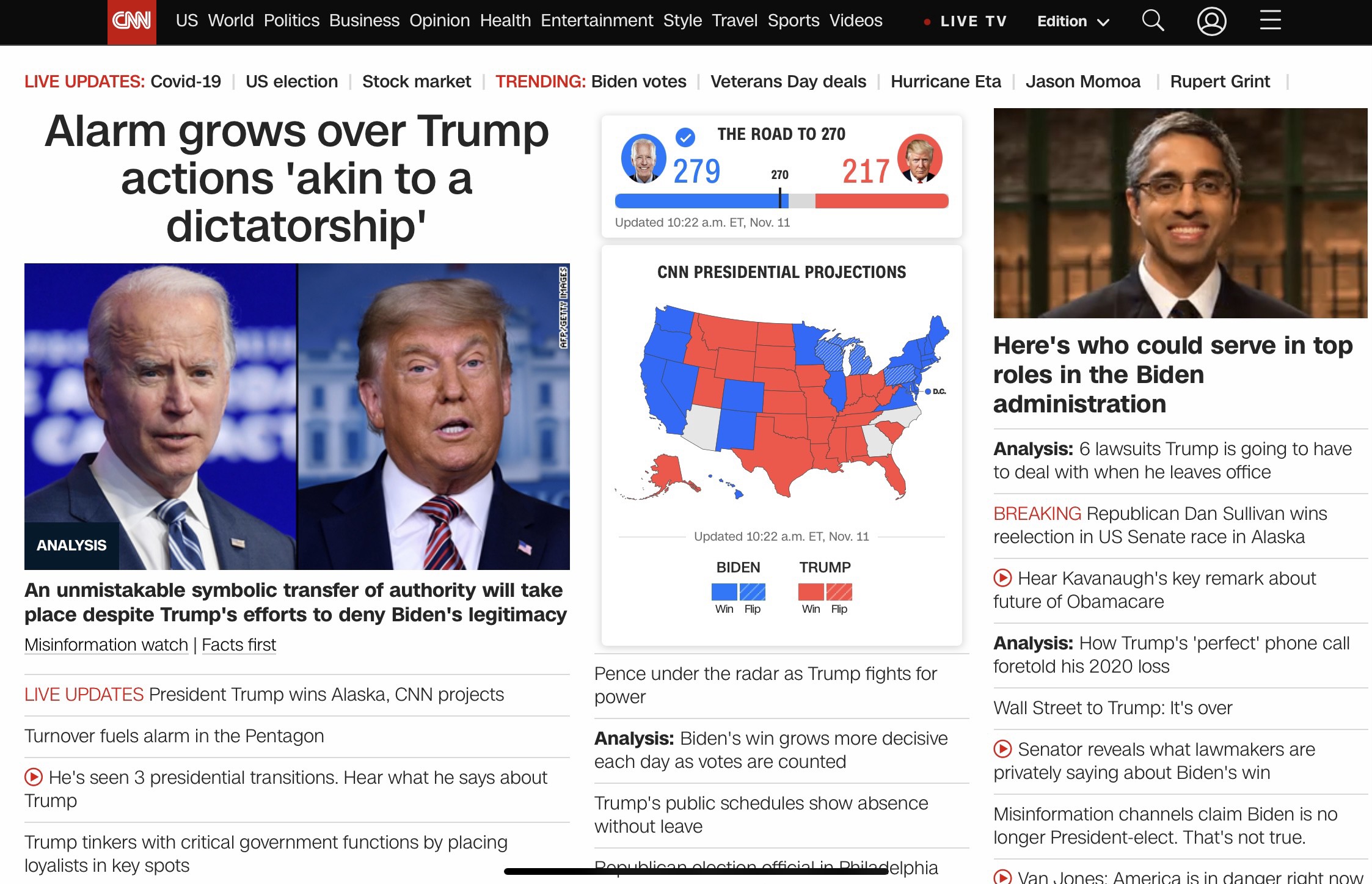
I have a bad habit. When big, anxiety-producing events are taking place (and they always are now), I hop around to different news sites’ homepages to see how they are characterizing the situation. My guts are in a constant, immovable clench as I doomscroll and site-hop for any new development.
Here’s what CNN’s homepage presented its readers this morning:
“Akin to a dictatorship”! That should wake people up, right?
You see, it’s not just news I’m looking for. I’m trying to get a sense of how the major news organizations are presenting the story to their audiences. Republicans are trying to overturn democracy, and I’m hoping that our news outlets are making that clear, right away, without normalizing or both-sidesing.
CNN’s headline, while horrifying, at least told me that a mainstay institution of American news was getting the point across.
But then I remembered that most folks don’t go to news websites directly. Regular people who aren’t obsessed with this stuff don’t constantly refresh the front pages of the Washington Post or the New York Times. If they’re not just getting everything through social media, a lot of them are just opening their browsers and seeing whatever was already set as their default homepage. So how are they covering the coup?
It’s not as reassuring.
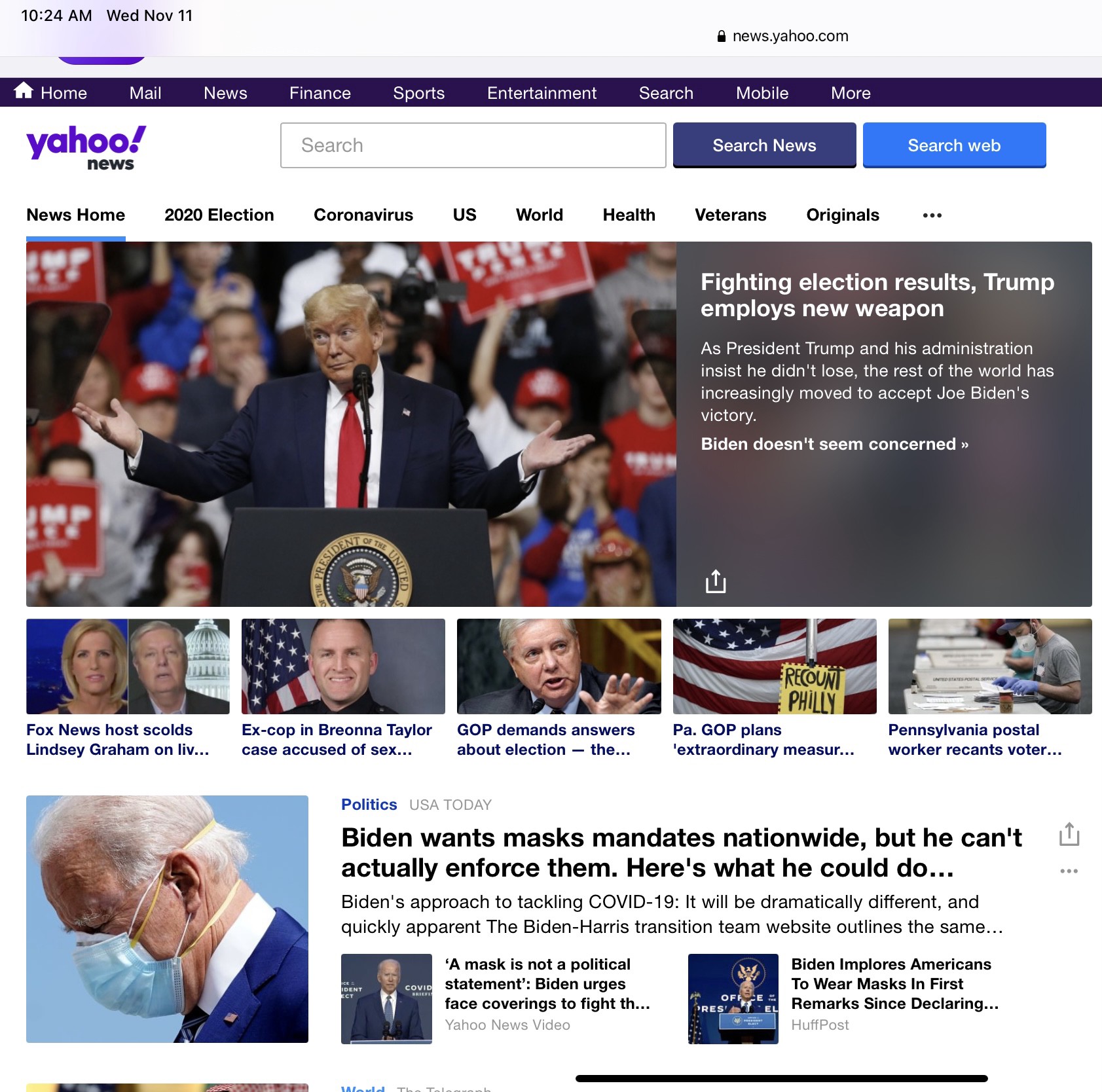
Here’s Yahoo News.
It acknowledges the issue, but it’s framed as an ongoing contest, not a power-grab. Trump has a “new weapon” and insists he didn’t lose. Biden isn’t concerned. Yes, well, I am concerned.
Look further down the page, and what do they choose to highlight? Biden’s mask mandate idea and how he can’t actually enforce it. So right away we get “Trump says he didn’t lose” and “Biden can’t make you wear a mask.” Not encouraging!
Aol.com’s homepage, which is still Yahoo content, at least begins with “State election reports defy Trump’s baseless claims.”
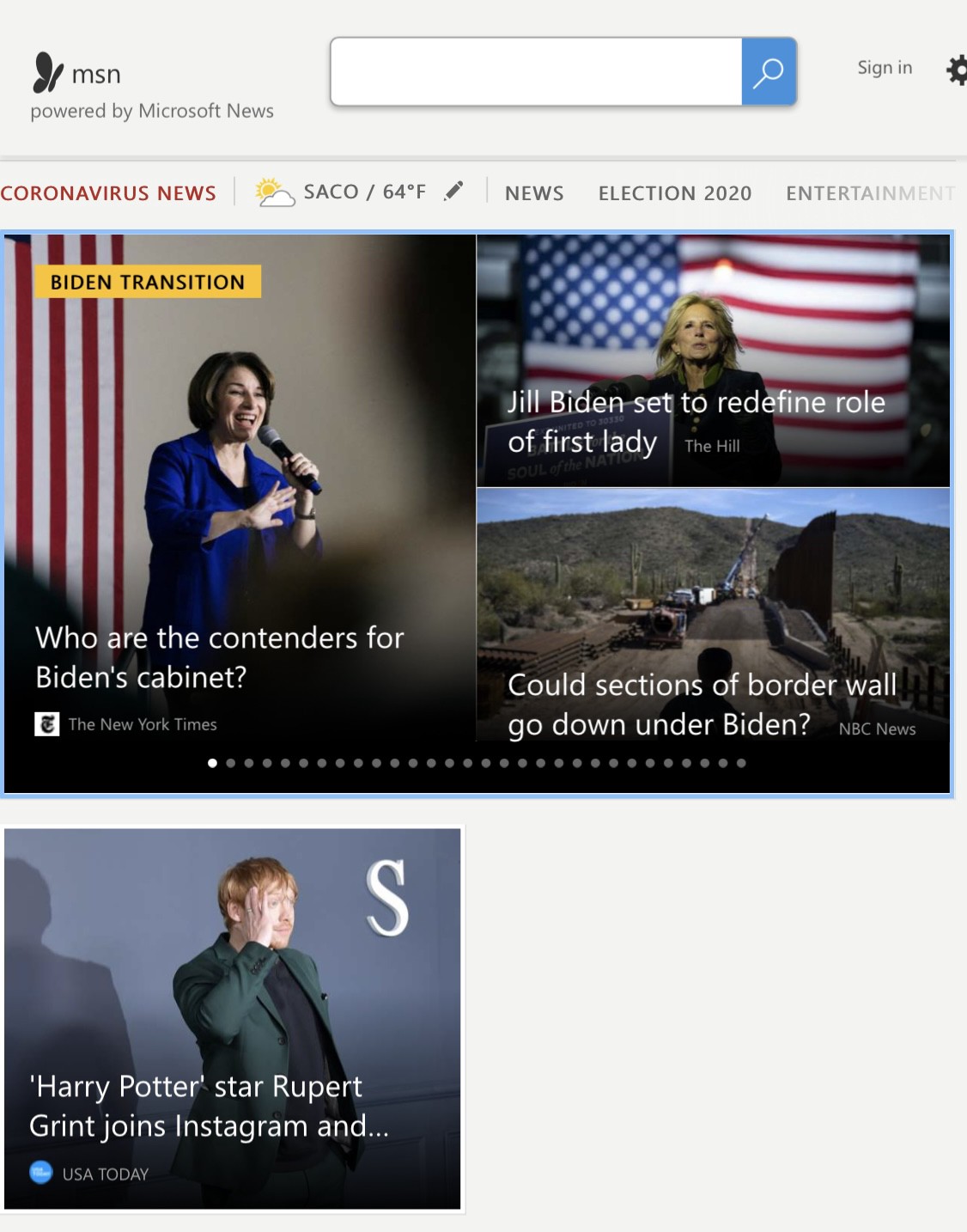
There’s also MSN, which is where millions of Edge and Internet Explorer users will get their first dose of news, and there’s no mention of the coup at the top, but some everything-is-normal coverage of a presidential transition, a little tiny dose of paranoia about Trump’s border wall, and something about the guy who played Ron in the Harry Potter movies.
You get the point. While CNN—correctly, I think—presents the coup as the emergency it is, the news outlets that most regular people will probably get their information from are a mixed bag.
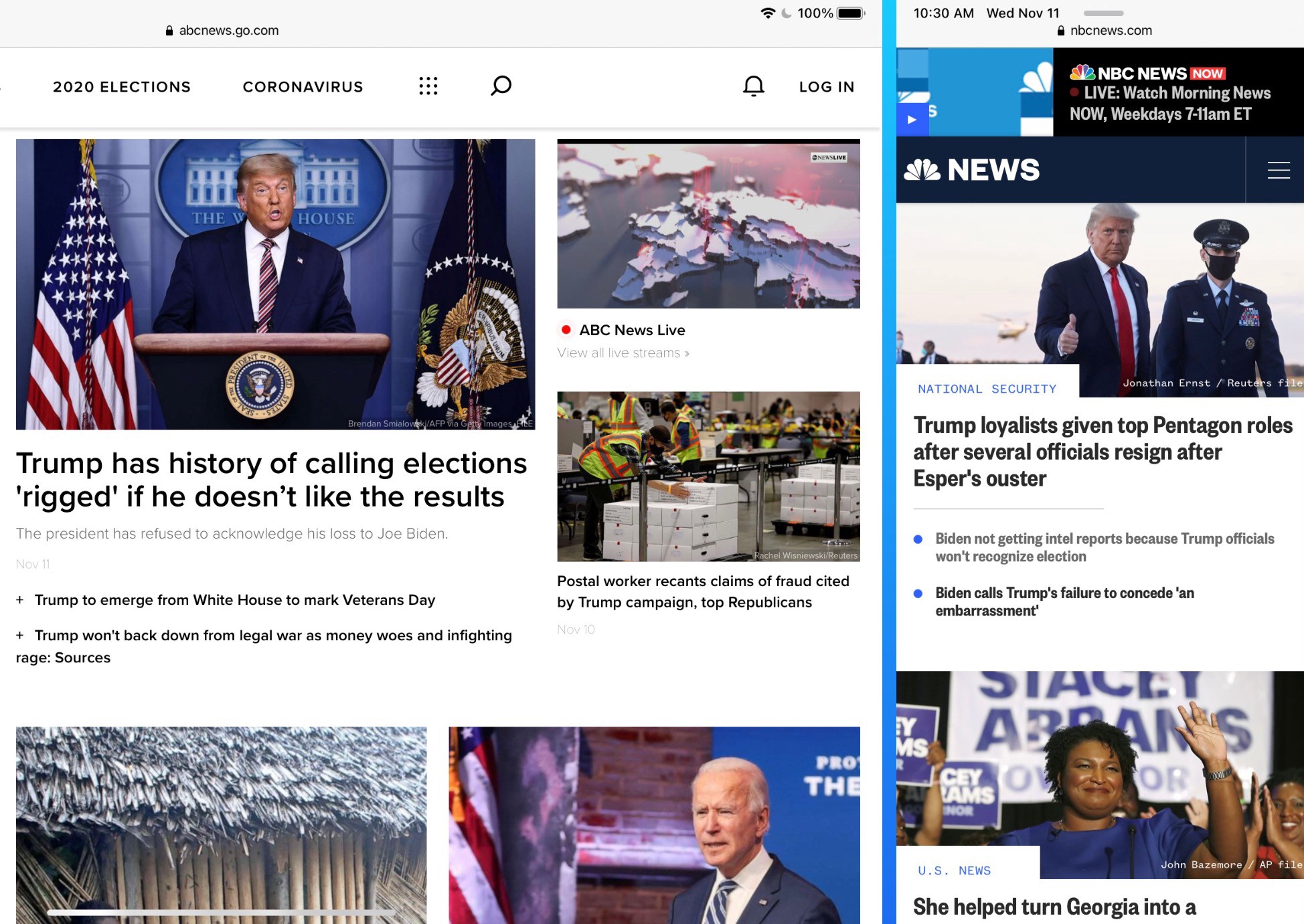
ABC News and NBC News both take the coup more seriously on their respective homepages. ABC gives context to Trump’s bullshit by showing that he always does this (as well as featuring the news of the recanted claims of voter fraud by a postal worker). NBC highlights the personnel massacre at the Pentagon, along with other problems caused by Trump’s recalcitrance. (Plus, further down there’s stuff about how great Stacy Abrams is.)
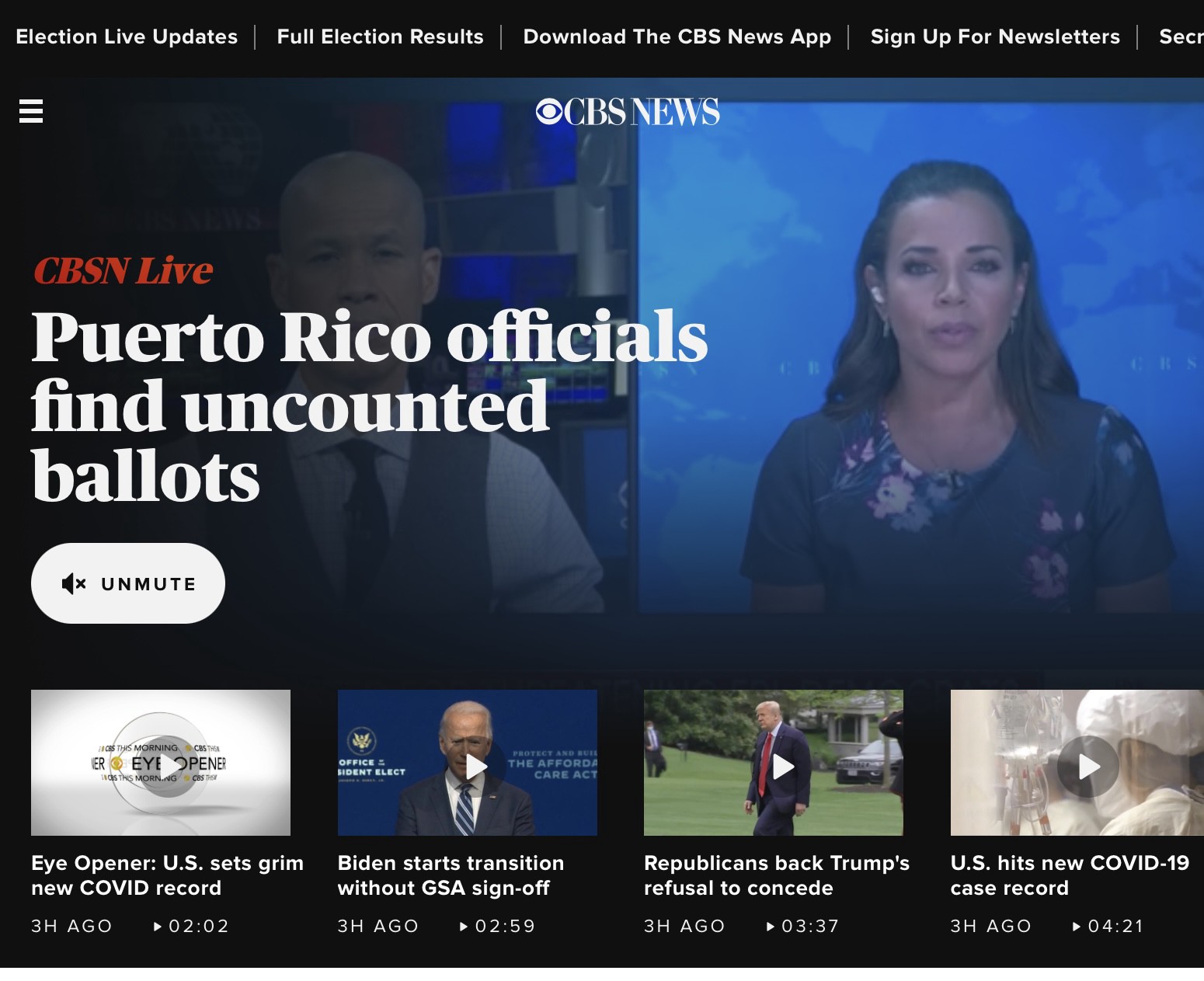
CBS News’s homepage is formatted differently, highlighting whatever they’re talking about on CBSN, which, I assume, nobody watches (I could be wrong). But what did I see when I popped that URL into my browser? BALLOT PROBLEMS!!!
Yes, it’s Puerto Rico. Now, you and I know that Puerto Rico doesn’t vote in the presidential election (and we also know that this is morally wrong). Regardless, any big-splash story about BALLOT PROBLEMZZZ only serves to feed the existing false narrative of a rigged election.
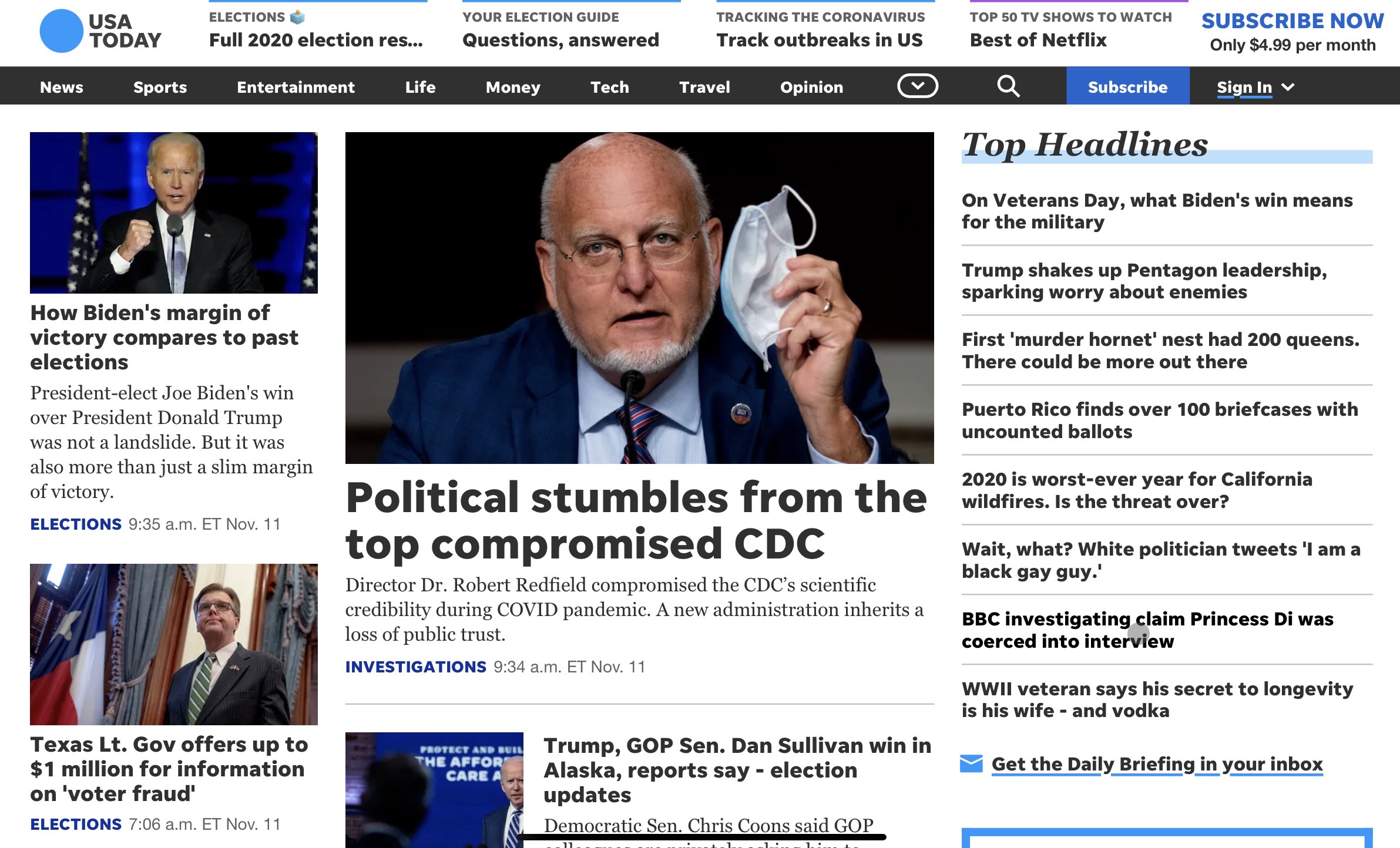
I was also none too pleased to see USA Today’s homepage, which seems to be stoking a lot of small fires without committing to one conflagration.
The CDC is stumbling. The lieutenant governor of Texas is offering a bounty for evidence of election fraud. Trump “shakes up” Pentagon leadership. It’s not at all clear that these things are all part of One Unified Crazy.
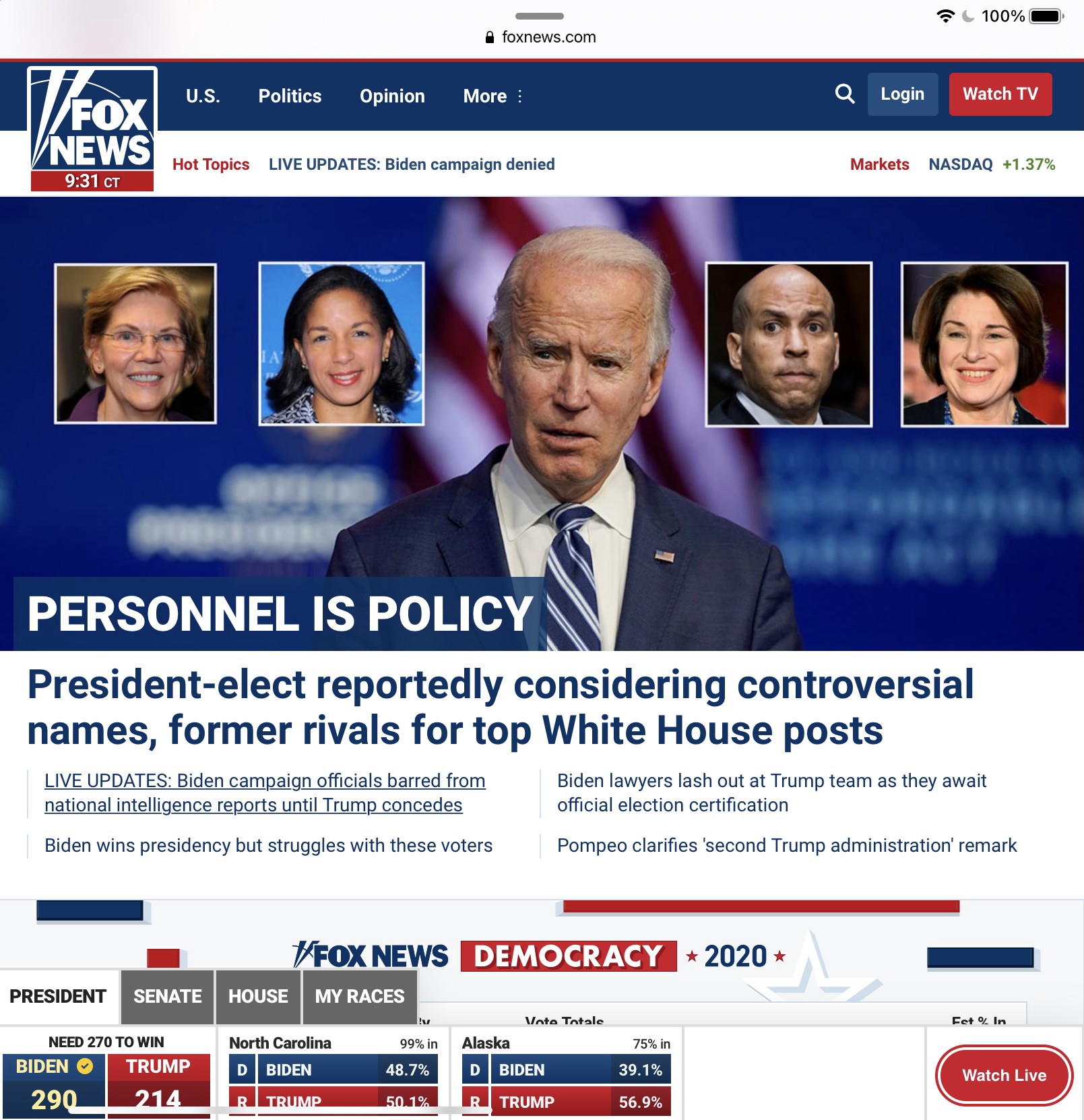
Then I had to look at Fox News, because I am sure plenty of folks do make a beeline to that homepage for their dose of indoctrination. And it was not exactly what I expected.
There’s Fox News calling Biden the president-elect right in its top headline! The propaganda arm of the GOP is saying, yes, this guy is your president-to-be, folks. As weirdly assuring as that is, it’s heavily saturated with reasons to be afraid of this new administration. “Controversial names”!!!
I mean look at those people hovering over Biden’s shoulders like a quartet of devils! There’s that crazy socialist lady Elizabeth Warren! There’s a Black lady right next to her! On the other side of Joe’s head is a Black guy! AND THEN ANOTHER WOMAN. CONTROVERSIAL!!! PERSONNEL IS POLICY!!!
As gross as Fox News is being, it almost feels like a return to normal…where normal isn’t very good to begin with.
When Barack Obama picked Joe Biden to be his running mate in 2008, I was delighted. I had always been enthusiastic about Biden’s as a political figure, and loved his role in the ’08 primary campaign as a no-bullshit happy warrior. (Remember “a noun and a verb and 9/11?” So great. And even better considering how far the subject of that jibe has fallen.)
While Biden’s persona and personal charms probably figured into the Obama campaign’s choice to bring Biden onboard, it wasn’t the main reason. To reassure an electorate that might be wary of an inexperienced, black presidential candidate, they put an elder statesman by his side, someone whose very presence vouched for the qualities of the man at the top of the ticket. There was no doubt that should tragedy strike, the next Vice President of the United States would be ready and more than qualified to take over. Not unlike George W. Bush’s choice to tap Dick Cheney in 2000, Biden would be the adult supervision.
Certainly, Biden’s trademark folksiness would help sell the Obama candidacy to those who might not be quite as excited about diversity and cosmopolitanism, by speaking to them in terms to which they could relate. But these were bonuses. In my opinion, it was all about the picture of the two of them together, the image of the exciting and untested buttressed by the familiar and trusted. The message was that Joe would look after Barack, and make sure the new guy found his footing.
(Honestly, I have difficulty trying come up with a presidential ticket in which the two candidates complemented each other as well as Obama and Biden did — save perhaps Biden and Harris, which I’ll get to in a bit. Bill Clinton and Al Gore are in the ballpark, as two ridiculously intelligent, relatively young southerners with diametrically opposing personalities that somehow clicked electorally. But still, almost all the pairings I can think of felt forced. Pence as a Christian bandaid for Trump. Tim Kaine as the blatantly inoffensive white male for Hillary Clinton. Paul Ryan as a youthful junior-executive sidekick to Romney. Sarah Palin…yeesh. And John Edwards as John Kerry’s personal TV ambulance chaser. God help us.)
It’s now fairly commonplace to see presidents task their VPs with particular portfolios, as a way of 1) communicating the importance of an issue by putting in the hands of the vice president, and 2) giving the poor guy something to do. But think of some of the things President Obama handed to Vice President Biden: Implementation of the Recovery Act after the financial meltdown, saving the auto industry, upgrading workforce training, addressing violence against women, cultivating and maintaining relations with foreign leaders, and the “moonshot” to cure cancer.
These were all caretaking roles. They conveyed a message: People who have been hurt, people whose lives have been upended, people who have lost jobs, people who have been alienated, people who are scared, people who are sick: Joe Biden is going to take care of you.
Now think back to March of this year. Biden’s campaign in the Democratic primaries had been shaky at best, and was being more or less written off, until his blowout victory in South Carolina. Coinciding with the sudden awareness of the threat posed by this “coronavirus” thing, Biden’s victory there seemed to change something in the very air.
Candidates began dropping out before Super Tuesday and endorsing him. I got the sense that they were relieved to do so. The coming general election campaign was likely to be the ugliest and most brutal in generations. The mysterious virus was looming. No one knew what was going to happen. With a sense of foreboding and anxiety that few could not have articulated at the time, the Democratic Party and its electorate turned to a father figure, a figure of stability, normalcy, and comfort. Someone to watch over them and take care of them. That was Joe.
The choice of Kamala Harris as Biden’s own running mate makes even more sense to me now, seen in this light. There was no shortage of brilliant, utterly qualified candidates, but Sen. Harris represented something I think few others could: As a social progressive with a law enforcement background; as a woman of a mixed ethnic background and the daughter of immigrants; as a stepparent in a modern, multi-faith family; and as a woman who pulls no punches for vice presidents, former or current; she is the future. She is, really, the present, but the electorate is not always ready for the present. By choosing her as his second-in-command, Joe Biden sets the stage for her ascension, and the ascension of a whole new generation. And he is trusted to do that.
I think we got Joe Biden at this moment because we are a nation in pain, wracked with fear and anger, unable to nurse our old wounds while triaging the new ones. To replace the current president, who seeks only to inflame every gash and tear every stitch, we need someone who will tend to us, heal us, take care of us.
I don’t think Joe Biden ever thought of himself this way, but this is the burden he’s been given, in his personal and in his public life. Time and time again, he has been asked to take care of us, and he always has. Election Day is about 55 hours away as I write this. If Joe Biden is elected, it will be because we needed him to take care of us one more time.
Perhaps the most disappointing aspect of the Trump era has been how establishment Republicans have rolled over for him, aiding and abetting Trump in every asinine, narcissistic urge, never having the guts to do anything to stop him from laying waste to the republic. Mitt Romney has had his good moments, but they were too few and too late.
Throughout the election, I have nursed a wish that President George W. Bush would put down his paint brush, get in front of a camera, and tell the folks who still love him that Trump needs to go. He’s never done that, even though you know he believes it.
Now, Election Day is nigh, and Trump continues to assert that he will refuse to concede if and when he loses. Lord only knows what he will do with the enormous power he thoughtlessly wields in order to remain in office.
If Trump loses and attempts to deny Biden the presidency, my last hope is that Bush will finally speak up and urge his fellow Republicans to accept the results of the election. He probably won’t.
But just in case he’s thinking about it, but doesn’t know quite what to say, I thought I could do my part as an American, and help our former president out. Here is my draft of what could be President George W. Bush’s address to the nation if President Trump refuses to concede a lost election.
President Bush, I am open to changes. Have your people get in touch.
UPDATE: I made a video for the speech, just to really drive it all home. I am helping!
Address to the nation by former President George W. Bush on the outcome of the presidential election, November 2020.
Let’s get right to it.
One score and none years ago, I was declared the winner of the presidential election because our side was better at whatcha call “political maneuverings.” Me and Al Gore pretty much wound up in a tie, and you can’t have two presidents at the same time, so our guys just did a better job of greasin’ the wheels and workin’ the refs, simple as that.
It wasn’t all above-board, those ballots in Florida where old Jewish folks were accidentally voting for Pat Buchanan was some real sketchy shit, and to give it to ya straight, even we were surprised when the Supreme Court just kinda let me be president. But like I said, it really was just a tie, and I think everyone figured it was just the other team’s turn to be in charge for a while. It weren’t pretty, but the thing got settled and we moved on.
But here’s the real important part, and I probably should have said more about this at the time, but the reason things got settled is because of Al Gore. Listen, Al was sure as hell that he’s the one that won that election. He was positive he’d won Florida, and hell, maybe he really did. “Butterfly ballots”! I mean, goddamn. But both sides filed all their lawsuits, both sides did their PR bullshit on TV, and in the end, those five Justices shut it all down. Al coulda’ kept fighting. I don’t think it’d’a changed anything in the long term, but you never know, and it’s not like we’re talkin’ about a fight over who gets to be employee of the month at a Pep Boys. This is the presidency. It doesn’t get any bigger’n that.
So think about what Al must’ve been feeling. He believed he’d won more votes in Florida. He believed the Supreme Court was screwin’ him over because they liked me better. That’s probably true! And what’s for sure true is that Al won more votes than me overall. He beat me by about a half a million in the national popular vote — and don’t think I didn’t feel that sting for the next four years, til I definitively kicked Kerry’s ass in ’04. Now, winning the popular vote doesn’t mean shit if you don’t win enough’a them electoral votes, and he knew that, but you just know it all had to be makin’ him nuts.
I mean, imagine, you’ve been the Vice President of the United States for eight years, you’re the smartest guy you know and you’re not only sure you’d be a better president than the guy you’re running against, but you know you’d be way better than the skirt-chasin’ hillbilly who’s shadow you been stuck under for a decade. You run your race, you win more votes than the other guy, and then it all comes apart because of a bunch of technicalities and bullshit.
But listen. After all that, even though he believed in his heart that he was being wronged, he stopped, he put the best interests of the country ahead of his own, and he opened wide to take an enormous bite of the biggest shit sandwich ever served in American history. On December 13, in the year of our lord 2000, Al Gore went in front of those cameras and told the American people that it was over, and that I was his president.
I mean, holy shit.
Now while you think about that, then look at where we are today. There’s no technicalities. There ain’t no tie. Everyone knows that Joe Biden beat the pants off of Donald Trump. Yeah, sure, there are a bunch of mail-in votes that ain’t been counted yet in Pennsylvania or whatever. But come the hell on. Trump lost this election the second he told folks to think about injecting themselves with bleach. I mean, you all know I said some stupid shit when I was president, and even I spat out my O’Doul’s when I heard that one. Mike Murphy says that the country has been tryin’ to cough up Trump like a hairball, and I’m tellin’ you this election was the cat’s final hork. But now the hairball is trying to haul its soggy ass back into the cat’s mouth. That’s just gross.
And it just ain’t gonna fly.
A lotta folks who supported me back in the day also supported Trump. I get it. I ain’t exactly excited about Biden bein’ president. But the race is over. Biden won it, plain as day.
Trump is tellin’ you that he’s been robbed, that the election was fixed by some Deep State antifa pizza parlor tinfoil hat shit. He wants to make you scared and angry. But that’s because he’s scared and angry.
He’s humiliated. You best believe I had my doubts about whether I belonged in that Oval Office, but deep down, Donald Trump knows he sure as shit never shoulda been there. And now he can’t stand the idea of lettin’ it all go. So he’s pulling every trick he can think of so he can stick around. Too many goddamn people who certainly know better are letting him.
Since he won’t do it, I will. I’m here to tell you, it’s over.
To my fellow Republicans, my fellow conservatives, I know you don’t like the idea of a Democrat in the White House. Lord knows, I don’t either. But the people have spoken, and they have not been subtle about it. Joe Biden won, and he’s gotta get sworn in on January 20, and Donald Trump has to let it go.
Republicans in Congress and in your state governments need to hear from you, right now, that they need to step up, like I’m doing now, and to tell their president to stand down. Don’t let Trump rile you up with a bunch of crazy, made-up conspiracies about a rigged election. Don’t let the cable news folks and the talk radio folks get your blood boilin’ and making you think you been screwed. I know the system’s screwed you over a bunch of times before, but this ain’t one of ‘em.
Joe Biden’s a hell of a good guy. He talks too much, and it makes me tired just thinking about him going on and on about how some guy he met in some town had some damn expression and on and on. But he’s a good man who won fair and square. And if you don’t like what he does, and you do like some of what Trump was doing in terms of policy and what have you, well then you vote for Republicans for Congress in the next election, and you support the next Republican candidate for president with everything you got. Fight like hell, and beat ’em fair and square.
But let’s not do it like this. What Trump is doing now, it’s unseemly. It’s unsportsmanlike. It’s weak.
Remember ol’ Al Gore. He had an honest-to-God claim to say that he’d won that race back in 2000, and that he oughta’ve been president. But he knew that the peaceful transition of power was more important than him being president, and more important even than keepin’ someone whose guts he hated from getting the job instead. He put his country first, and he took it like a man. He took it like an American.
Republicans can take this one too. Donald Trump can’t, so we’ll have to do it for him. God bless you, and God bless the United States of America.
Of course they’re all infected. Honestly, how could we have expected anything else? If you deny the severity of a viciously infectious disease, if you delight in flouting all measures to prevent its spread, and you spend each day interacting with hundreds of people — all of whom agree heartily with your denial and flouting — of course you’re going to get the goddamned virus.
In the course of just a handful of weeks, we’ve had all these “bombshells,” and I know I have been unable to withstand the psychological and emotional shellacking of it all. Less than a month ago, we learned that Trump knew — and personally accepted the fact — that the coronavirus was deadly serious. A few days later, Ruth Badger Ginsburg died, followed by the nomination of Amy Coney Barrett to replace her. A few days after that, the New York Times released its major story on Trump’s taxes, where we learned about his avoidance of taxes and his gobsmacking financial losses and debts. A few days after that, we endured the 90-minute trauma that was the presidential debate, where we learned that Trump was absolutely not going to concede the election if he lost, and that he was encouraging white supremacist violence. A few days after that, we learned that he, his wife, several of people on his staff and in his campaign, two U.S. senators, and others who had been in contact with him, had been infected.
All this we learned. All this shocked us, roiled us, and caused varying degrees of anxiety, horror, and panic.
But I am just now realizing, really, we have learned nothing. And nothing has changed.
Let’s jump back to 2016. You know, how all the polls were wrong and Trump pulled out a surprise victory? The polls weren’t wrong. The results of that election were absolutely in line with what the polls were showing. Nothing weird happened. Voters who leaned Republican voted for the Republican, voters who leaned Democratic voted for the Democrat, and the results for each state more or less wound up well within the margin of error. In terms of consequences, the election of 2016 was monumental. In terms of probabilities, it was unremarkable.
Trump himself is figure of unprecedented abnormality for his position. So his behavior has roiled the collective psyche of the nation, pummeling us all out of any sense of time or orientation. But he is not magic.
The polls for the 2020 presidential election have been almost freakishly stable. For months, Biden has polled just above 50 percent, and Trump just around 42 or so. Even after the aforementioned events of September beat us all about the head, the polls remained eerily static. Why?
It’s pretty easy. It’s really obvious who Trump is now. After four years of him being president, you didn’t need to think too hard about whether you liked how it was going or not. He made it really easy. He faced his most important test in having to deal with a pandemic, and there was no getting around it, so if you were at all on the fence about him, his handling of COVID-19 probably gave you your last push. There’s nothing new to learn. People have settled on their preferences.
But what about this crazy month? Well, no one really thought that Trump didn’t believe the virus was serious. It’s news that he was stupid enough to say so to a journalist while being recorded, but it’s not surprising. Everyone already knew that Trump is a cheat, and that he’s avoided paying taxes. Indeed, he’s boasted about his ability to evade them. It’s also well known that he’s been a colossal failure as a businessman. He’s been siding with white supremacists for ages, publicly. He threatened to contest the election of 2016 if he didn’t win. None of this is new.
And now, he gets COVID-19. It’s “shocking” in the sense that it’s the President of the United States, and that’s just a de facto big-goddamn-deal. But, you know, come on. Of course he was going to get it.
After four years of Mussolini-But-Dumber, people know what they got. If they love it, they love it, and that’s all there is to that. The rest of us — most of us — don’t, and we’re going to vote him out of office. There’s nothing weird about that, either.
We may feel as a nation that we’ve been batted about like a cat toy, but it’s the same cat. It acts like a cat. It doesn’t grow wings or breathe fire.
Just like the 2016 election, the 2020 election just might be (and I can’t believe I’m about to type this) a normal election with an abnormal candidate. A majority of voters will reject the president because he’s done an obviously shitty job and is an obviously shitty person. We know this because this is what the polls say is by far the most likely outcome. 2016 polls showed that Trump’s upset victory was entirely plausible. This time, he could still plausibly win, and it wouldn’t be a miracle if he did, but it’s just not where things are. Putting aside malfeasance, manipulation, or a mustering of forces to hold onto power (and I don’t necessarily doubt those things), this election is, in a way, like any other. It will revert to the mean.
Water seeks its own level. Viruses infect people who put themselves in a position to get infected. People in a shitty situation will choose to get out of it. Trump’s behavior, and now his health, are dangerous unknown factors. But everything else is, I am realizing, obvious.
Here’s a way for me to talk about my response to last night’s debate.
In the parking lot at the grocery store today, I saw a man, who appeared to be in his 60s, returning to his car with his groceries. He was wearing a shirt emblazoned with the Trump campaign logo on the front and “No Basement Joe” on the back.
Adjusting my face mask before walking into the store and catching sight of this fellow, my mind immediately recalled the depravity displayed by Donald Trump the night before at that horror-show of a debate. For a brief moment, my brain struggled to comprehend how anyone—including a presumably sane, sentient human being like the man in the parking lot—could witness the trauma Trump had inflicted on us all and still support him. Worse yet, this man was proudly advertising his continued devotion to the president the fascism-for-idiots he personified on that stage.
And in that moment, I felt hate for that man. To be clear: this was not okay. I know nothing about this person. Merely presuming that this man understands what Trump is and what he represents, I could come to no other conclusion that this man must be evil.
Of course, I have no idea if that’s so. I have no idea what this man is like. I have no idea what he knows and does not know. I know nothing of his life story beyond what could be gleaned by a few seconds passing in a parking lot.
It scares me, that I felt that way. But in noticing that sudden shock of hate in myself, I then considered how deeply and fiercely Trump and his cult have driven their followers to hate, and I became doubly frightened. I experienced a moment of hate, of indignant rage at the moral vacuum I assumed to reside in this stranger’s heart. Just imagine, then, the cauldrons of hate, like geological quantities of magma, seething within those who feel represented by Donald Trump.
For the few seconds that I burned, I struggled to come up with some imaginary scenario in which I might confront this fellow and set him straight. Absurd, of course.
But what about the millions of people, bubbling with hate, and being told to expect their enemies to deny their leader his power—and therefore, in their minds, their power.
I’m very worried about what scenarios they are imagining. I’ve very worried about that.
What I’m also thinking about:
How not to think about everything going on. M.G. Ziegler says, “I think in many ways we can only live through times like these by not stopping to think about them.” I don’t feel like I have that luxury.
So go easy on yourself. Try not to think about the future. Instead, think about the present. How can you win the next hour, the next day? How can you be of most value — to yourself, to your family, to your community, and to the earth itself? You still have the incorruptible capacity to create joy, and catalyze change. No one can take that away from you, no matter how dark they dim the lights.
That’s true. But while one’s capacity might be incorruptible, it is not inexhaustible. And I’m pretty exhausted.
I would ask you, dear reader, to remember the next-to-last thing that social media taught you to be outraged about. I bet you can remember only the last one. …
You can readily see, I suspect, how information overload and social acceleration work together to create a paralyzing feedback loop, pressing us to practice continually [informational] triage … forcing our judgments about what to pay attention to, what to think about, to become ever more peremptory and irreversible. … And all this has the further effect of locking us into the present moment. There’s no time to think about anything else than the Now, and the not-Now increasingly takes on the character of an unwelcome and, in its otherness, even befouling imposition.
“If we’ve learned nothing else from the past decade,” I wrote, “it’s that if Republicans can’t win through persuasion, they’ll simply rewrite the rules. They are eternally controlling Boardwalk and Park Place. It’s written right on the inside of the box, that they shall eternally passeth Go, over and over, forever and ever, amen.”
What I didn’t foresee — and really should have — was how overt the repeal of democracy would be. I think I imagined that most of the foul dealings would happen behind the scenes, in ways that politicos understood, but didn’t penetrate the national consciousness. Even the hypocrisy of the Republican Senate’s position on appointing a successor to Ruth Bader Ginsburg, while obvious, I suspect remains below the radar, and outside the realm of interest, to most Americans. I assume they see it as just another example of politicians being politicians.
But the President of the United States now says that any election that he doesn’t win is invalid. The election itself is moot, and he will use what influence he wields to ensure it. If he needs to use the Department of Justice to challenge the validity of mail-in ballots, he’ll do that. If he needs to disappear voters through the use of secret police, he’ll do it. If he needs to dispatch his cult of gun-toting fanatical ignoramuses to literally block the entrances to polling places, he’ll do it. If he needs to strongarm Republican governors and state legislators into disqualifying unfavorable slates of electors, he’ll do it. For each one of these actions, he has either already announced his intention to carry them out, or his minions have informed the press of the plan. Some of it already has happened.
It’s not a secret conspiracy. It’s out in the open. He intends no transfer of power, of any kind, at any time. Not in January of 2021, and almost certainly not in January of 2025 either.
In that same 2018 piece, I wrote that those who are really paying attention could sense what felt like an emergency. “It is an emergency. I do believe that people are waking up to that simple fact. Many millions of people have come to realize that things have not only gone wrong, but horribly, existentially wrong. The republic is in mortal danger, and the blight will not be contained within our borders. It’s soaking into the Earth’s crust. It’s riding the oceans’ currents. It’s attached to the very molecules we breathe.”
I said that I feared that our better angels are simply no match for our worst demons. But there, I might have been wrong. Not because I have any illusions that Republicans will discover a dormant conscience and put a stop to this madness. Rather, I suspect that our topple into fascism hinges not on the winner in the battle of angels versus demons, but because of the inaction of everyone in between.
Career civil servants will, by and large, do what they’re told. Mainstream news outlets will say and print what is necessary to keep from being shut down. Corporations will require the favor of the regime in order to continue operating and remain neutral. Some in positions of power will make noises about norms and democracy, but it will be just that, noise. You’ve heard it before; it’s the sound of senators tweeting about their “concern” about a grievous outrage and then doing nothing about it.
“Point me to the light at the end of the tunnel, and prove to me that the tunnel hasn’t already caved in,” I wrote then. “Because I can’t see it, and it’s getting harder to breathe.”
I could still be wrong. So I renew my plea from two years ago: If I’m wrong, tell me how.
Otherwise, I don’t know what to do with this, this knowing. I don’t know what happens next. I don’t know what to do now, nor what to do when what’s happened becomes obvious to everyone.







 Near-Earth Object