Near-Earth Object

by pav.alxndr

  • About
  • Music Videos
  • Songs
  • BlueSky
  • Threads
  • Mastodon
  • Twitch
  • Donate

  • Biden’s Promise to Pick a Woman VP: It’s 2020 and it’s the Right Thing to Do

    Photo by Gage Skidmore (CC BY-SA 2.0)

    From the mainstream press, progressives, and the broader reality-based community, most analysis centered on how the pledge, and the individual woman chosen to fulfill that pledge, would help or hurt Biden’s electoral chances. 

    In both cases, it is presumed that the Biden campaign is making a calculation, reaching the conclusion that a commitment to putting a woman on the ticket will, the the aggregate, help his cause. Folks on the right, obviously, purport to know that it is a miscalculation and also somehow discriminatory against poor, poor men. Everyone else, more or less, has focused on the particular factors that motivated the pledge.

    You know them already: Perhaps the campaign is seeking to give a jolt to turnout from women, who favor Democrats; they hope to attract women who may have voted for Trump in 2016 to switch sides at the prospect of electing a woman vice-president; they see a commitment to diversity as something that will unify and energize more left-leaning voters who may not feel great enthusiasm for Biden; it is intended to present to the entire electorate a glaring contrast with Donald Trump, who is known for—and even celebrates—his abuse and dehumanization of women. And so on.

    In all cases, the analysis—be it negative, positive, or neutral—is about tactics. It is taken as given that Joe Biden made this pledge to help him win the presidency, and all that’s left to do is to qualify and quantify that choice.

    I am no grizzled veteran of national political wars, but I have been working in various arenas of national politics for 13 years, including a presidential campaign, and I can tell you with certainty that yes, this pledge was made after weighing all of these tactical factors. But I also do not believe they were decisive. Because what I also can tell you from my experience is that all of the people involved in these mammoth and byzantine political enterprises are human beings. 

    Let’s take a trip way back in time to another era, one that might be unrecognizable today. Hop in our time machine and we’ll set the dial back five whole years, and we’ll set ourselves down in the city of Ottawa in a magical land called Canada. 

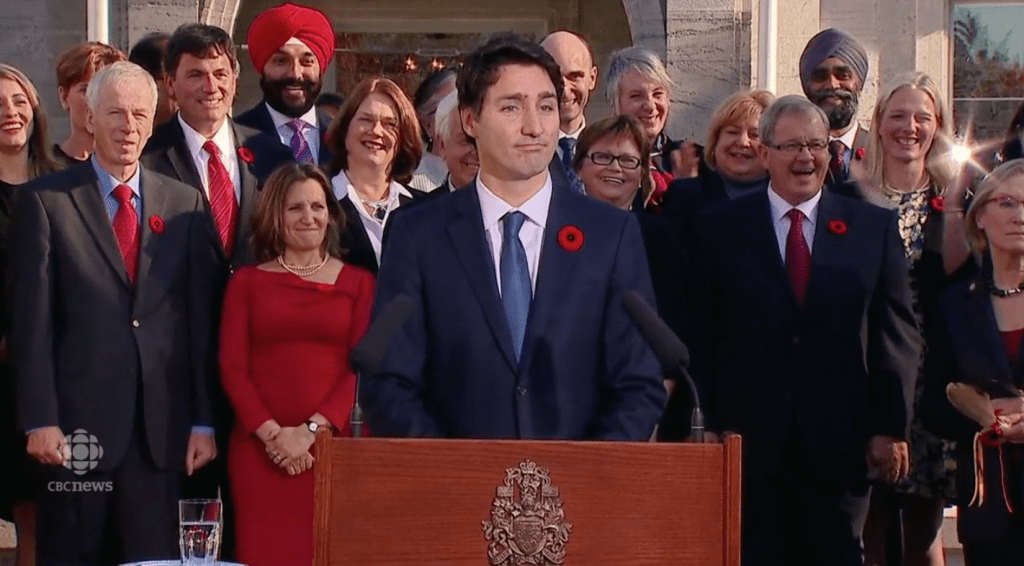
    Standing at a podium before the national press was an impossibly handsome new prime minister, Justin Trudeau, flanked by his newly-appointed cabinet. True to a pledge of his own, Trudeau had assembled a cabinet with 15 men and 15 women.

    “Your cabinet, you said, looks a lot like Canada,” said one reporter. “I understand one of the priorities for you was to have a cabinet that was gender balanced. Why was that so important to you?”

    There is a pause, during which Trudeau somehow manages to simeltaneously deadpan and smolder, as only he can. He responds.

    “Because it’s 2015.”

    And then he gently shrugs.

    Trudeau went on to explain that he had chosen excellent people for an excellent cabinet that represented the country’s diversity of viewpoints, but mentioned not one more word about anyone’s gender. 

    Those who worry about “tokenism” claim to be concerned at the great injustice done to better-qualified candidates for positions being rebuffed for lesser-qualified choices who tick an identity checkbox. But this makes the absurd assumption that there is always one, single “best person” for any given job, one “right answer” among a sea of wrongs. It’s preposterous.

    For any position there exists a wide variety of individuals who might excel, bringing to bear their own unique blend of skills and experiences. The idea that there’s a singular “best person for the job” is a trope, an ideal to which one can aspire, but not some incontrovertible mathematical constant. We’re talking about human beings working within human-created systems. 

    Trudeau’s unspoken message was that he had indeed chosen the “best” people for their respective cabinet positions, and that there were any number of “best people” he might have chosen. For the project of appointing a national cabinet, achieving a gender balance was no hindrance. Trudeau was telling us that because of the wealth of talent available to him, there were no compromises or consolations in ensuring gender parity.

    And by saying, “Because it’s 2015,” he was really saying, “Because it’s the right thing to do.”
    In the Biden campaign’s decision to publicly commit to placing a woman on the ticket, there is no doubt that many surveys were studied, many polls were taken, many consultants were consulted, and the political temperature of many constituencies was taken. This is presidential politics, and politics must be done.

    Joe Biden is also a human being. He leads a campaign made up of human beings. All of them got into politics and government for a reason, and I’m willing to hazard the guess that the vast majority of them did so for the right reasons, imperfect as they all are. And as imperfect as he is, I think Joe Biden is in politics for the right reasons.

    At the March 15 debate on CNN in which this pledge was announced, Biden channeled a bit of Trudeau (though, he could never come close to Trudeau’s unflappable delivery). “My cabinet, my administration will look like the country and I commit that I will, in fact, appoint a — I’d pick a woman to be vice president,” said Biden. “There are a number of women who are qualified to be president tomorrow. I would pick a woman to be my vice president.”

    In other words, to commit to choosing a woman is in no way a limitation. There are myriad women, right now, who would be excellent presidents, and he’s going to pick one of them.

    I can’t know anything for sure about what’s in a man’s heart, but I think Joe Biden has committed to running alongside a woman because he thinks it’s the right thing to do.

    Because it’s 2020.
    June 2, 2020
    2020 presidential election, joe biden, justin trudeau, trump
    essays

  • Twenty-Fifth Fantasy: Which Cabinet Officials Might Vote to Remove Trump from Power?

    I loathe Mike Pence with every fiber of my being. I vehemently oppose just about everything he stands for, and have dedicated most of my professional life to fighting back against that which is made manifest by the unremarkable brain stored within the stony ahead that sits atop the thick neck of Mike Pence.

    And yet if he were to become president right now, I would ecstatically dance in a field of flowers. In slow motion.

    The Trump presidency is an emergency. A crisis unto itself. The death, the suffering, the lies, the bigotry, the abuse, the corruption, the disinformation, the celebration of ignorance, the eagerness for violence, the determination to crush dissent in any form, even on a ballot. This has to stop.

    The impeachment process was one institutional attempt to stop it, but it was doomed to fail from the beginning. But with every passing day, Trump finds new ways to do increasingly unprecedented damage to the republic and exacerbate the destruction he’s already wrought. I keep wishing, without hope, that someone will do something.

    The last institutional remedy that exists, outside of an election that may or may not be the final word, is for the administration itself to fall on its own sword. It’s utterly fantastical to even consider this a possibility, and yet I can’t help but wistfully imagine that somewhere in the deep recesses of Mike Pence’s conscience, he knows that the madness has to end, and that he is the only one who can make that happen.

    I dream of the invocation of the Twenty-Fifth Amendment.

    For the president to be removed from power by his own administration, the vice president needs to consent of a majority of the heads of the cabinet’s “executive departments,” so eight top-level cabinet secretaries have to agree that the nation is sufficiently imperiled by the president to warrant having him stripped of his powers, and for the vice president to become “acting president.”

    As a sort of exercise in hate-fiction, I decided to take a look at the current roster of cabinet secretaries to see if I could get a sense of whether there was even a hint of a possibility that eight of them might join in a revolt with Mike Pence, should he instigate one.

    Of course, he never would. But let’s do this anyway.

    I didn’t bother considering Secretary of State Mike Pompeo, Attorney General William Barr, or Education Secretary Betsy DeVos. These three are so clearly in the tank that to even fantasize about their turning on Trump is to give oneself an aneurysm. Transportation Secretary Elaine Chao I also deigned unworthy of investigation, because if you can be married to Mitch McConnell, there’s no evil that you cannot countenance.

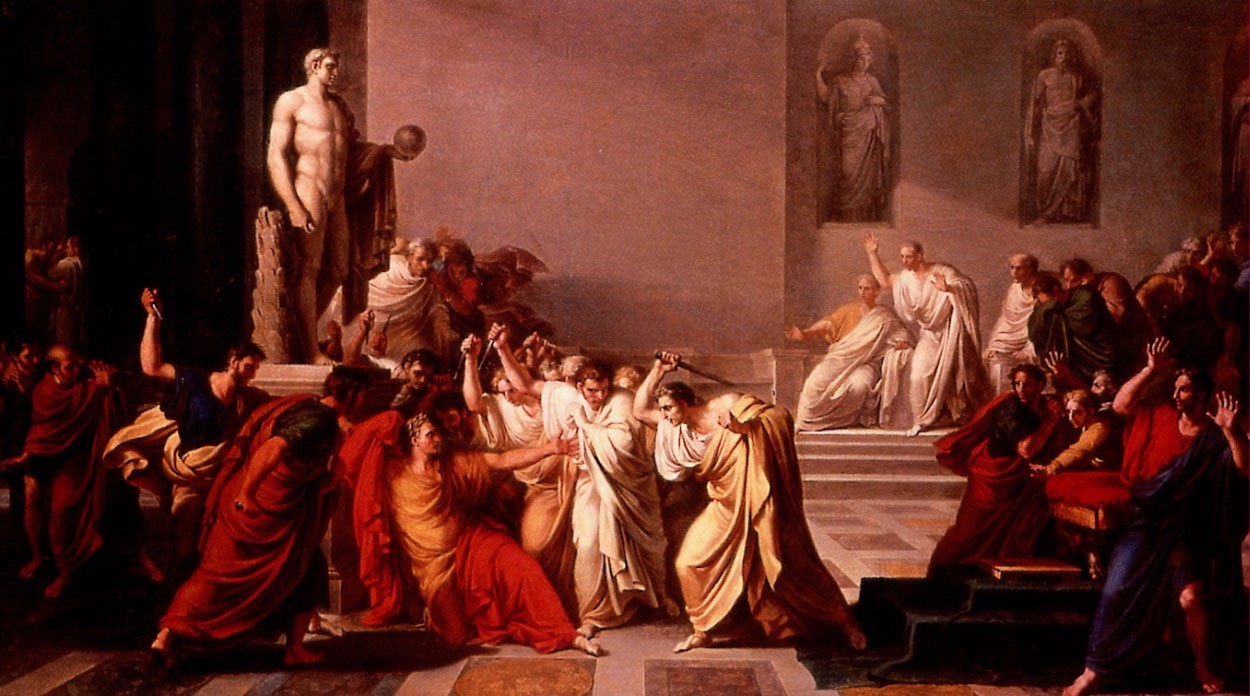
    So let’s look at the rest of the cast of characters, and see if there are any Brutuses or Cassiuses among them. And remember, we’d need eight.


    Secretary of the Treasury Steven Mnuchin: Maybe

    Seemingly generated by a computer algorithm instructed to produce the most comically obvious evil banker stereotype, Steve Mnuchin does not at first blush to be someone who would care enough about the wellbeing of the country to take any extraordinary actions of principle to save it. Trump obviously doesn’t care what Mnuchin does as long as it serves Trump, but I also don’t get the sense that Mnuchin feels any genuine personal loyalty toward the president. Indeed, Mnuchin surely rankled the president when he worked closely with Trump’s arch-nemesis, Nancy Pelosi, to address the economic impact of the coronavirus in the pandemic’s early days.

    This kind of pragmatism makes me suspect that Mnuchin would turn on Trump in a second if he felt that Trump was just bad for business, or that the risk he poses to the accumulation of wealth outweighed the benefits of the wide berth he usually enjoys. Mnuchin could perhaps be moved if Pence made him the right promises.

    Secretary of Defense Mark Esper: Maybe

    Esper does not appear to be much of an ideologue, nor does he seem to be an overt Trump toady, which is what one might have expected as the replacement for the mostly-independent Jim Mattis. As Foreign Policyreported, “Esper has earned Trump’s trust particularly by coming into the job without an agenda and striving to present options that meet the president’s goals.”

    It sounds to me like he just wants to keep his job and not do anything to make the president notice him. But this is frustrating folks in the defense establishment, as the center of power regarding national security has shifted from the Pentagon to the State Department in the person of Mike Pompeo. During the crisis U.S. strikes on Iran, it was noted with some alarm that Pompeo, and not Esper, had been given the spotlight, and in general Esper does not seem to be inclined to speak up or push back.

    As Politico reported in January, “Esper appears to have made the calculation that it’s best to stay behind the scenes in an administration where few people have Trump’s ear, and where anything you say could be easily undermined by a presidential tweet moments later.”

    If Esper won’t even stand up to Pompeo, it’s hard for me to imagine that he’d do anything so bold as to help depose the commander-in-chief. As an official told Foreign Policy, “Esper is seen as an excellent manager, [but] he is not a disruptor, he is not a change agent.” I suppose it’s possible that if there were already seven votes from cabinet secretaries to remove the president, Esper could feel secure in being the eighth. More likely is that he’d wait to be the ninth or tenth so no one could accuse him of being the decisive vote.

    Secretary of the Interior David Bernhardt: No

    Researching this article, I saw a tantalizing headline from a report by the Center for American Progress that read, “David Bernhardt Is President Trump’s Most Conflicted Cabinet Nominee.” Alas, this was not about Bernhardt’s conflicted feelings, but his conflicts of interest as an oil lobbyist and how they make him “vulnerable to corruption.” Vulnerable, you say.

    Bernhardt strikes me as a fairly run-of-the-mill lobbyist/grifter who couldn’t care less one way or the other whether the world burns, as long as the burning is fueled by oil. The fact that you never hear about him merely means that he’s doing what he was put there to do, advance oil industry interests, and whatever happens outside of that is of no interest to him. I doubt Trump even knows what the Interior Department does, which I assume is just fine with its secretary.

    The recent shocks to the oil market aren’t specific enough to Trump to spur Bernhardt to rebellion. My guess is he’ll keep pushing the oil industry agenda from within the administration for as long as he can, or until it’s time to cash out again.

    Secretary of Agriculture Sonny Perdue: No

    Sonny Perdue’s stance on Trump may boil down to what he told the National Press Club in 2017. “I don’t think he wants a sycophant as a secretary. He wants me to give him my best counsel, my best advice, and he wants me to be right about that.”

    This we know, and knew then, to be false. I assume Perdue did as well when he said this out loud to people who also knew it to be false, and knew that he knew.

    Perdue also said that Trump has the “essense of a great leader.”

    Perdue parrots Trump’s climate change denial and has reportedly kept in Trump’s good graces by speaking with expertise but never disagreeing with the president. Just a couple of weeks ago, Perdue was doing a public event with Ivanka Trump.

    Purdue is happy where he is and he’s liked by the president. He’s a no.

    Secretary of Commerce Wilbur Ross: No

    Ross got on the president’s bad side when he couldn’t deliver on Trump’s desires to have the U.S. Census include a citizenship question, and the two have had some other trade-related disagreements. It was reported that Ross’s head was on the chopping block, but so far his head remains intact.

    Ross is a curious case. He and Trump actually go way back to Trump’s casino bankruptcies in the 1990s. “For more than 25 years, the two socialized across marriages and states, with both owning nearby residences in Manhattan and Palm Beach, Florida,” reported NBC News earlier this year. “In June of 2016, Ross, a registered Democrat, endorsed Trump for president, saying, ‘We need a more radical, new approach to government.’”

    His clashes with Trump are belied by his willingness to lie for him. So blatant were his dissemblings, the New York Times did a whole editorial just about that. “Wilbur Ross, the secretary of commerce, appears set on distinguishing himself again as the most compromised member of an administration that at times seems defined by ethical and moral flexibility.” Wow!

    Perhaps most notably, Ross is a primary vector for Trump’s public endorsement of hydroxychloroquine as a COVID-19 treatment. Ross is in too deep. He’s a no, at least until Trump hints at firing him again.

    Secretary of Labor Eugene Scalia: No

    The spawn of Antonin, Eugene Scalia, probably hates his job right now, as unemployment has gotten so bad that graphs about it become art. 

    But as his job gets more complicated, it also becomes more important, and he becomes more powerful, as he holds the fates (and checks) of millions of Americans. I’ve seen nothing to suggest any conflict with the president, and he seems happy to go right along with Trump’s push to reopen all the things, so I have to assume that Scalia is a no.

    Secretary of Energy Dan Brouillette: No

    Similarly, Brouillette is making no waves, doing what he’s told and promising to shovel money to the oil industry. If he’s in a mood to disrupt anything, he’s not showing it. Nope.

    Secretary of Homeland Security Chad Wolf: No

    Chad Wolf (wouldn’t you kill for a name like that) seems like he’s also performing as a functionary, fulfilling the demands of his bosses. The New Yorker reported that there’s some disagreement between he and white-supremacist Stephen Miller, but not so much that it’s worth risking his neck. He’s a no. But as an “acting secretary,” as yet unconfirmed by the Senate, it’s not even clear that his vote would count in such a circumstance.

    Secretary of Health and Human Services Mike Azar: No

    No one in the president’s orbit must feel more diminished than Mike Azar. Trump didn’t even feel the need to inform him that Mike Pence would be heading up the administration’s pretend-efforts to deal with the pandemic, and other embarrassments led the White House to inform reporters that they were thinking of replacing him. And yet Azar continues to grovel and toady to his majesty at the snap of a finger.

    Azar seems to be devoid of spine or principle. His back against the wall, he might do something rash, but he’s not joining any revolution.

    Secretary of Veterans Affairs Robert Wilkie: No

    Wilkie is a toady among toads. He helped push hydroxychloroquine as a COVID-19 treatment, made up the claim that it helped veterans get better, and denied the veracity of studies showing its dangers. Earlier this year, it was reported that he tried to dig up dirt on someone who reported she’d been sexually assaulted at a VA hospital.

    I don’t think he’s too concerned with the well being of the nation, veterans or otherwise. He’s a no.

    Secretary of Housing and Urban Development Ben Carson: No? Probably?

    What does Ben Carson do all day? What thoughts go through his head? When he prays, which I assume he does a lot, what does he pray for?

    Who knows. We know that he’s defended Trump’s handling of the pandemic. He recently thanked the president, I assume with a straight face, for being “a champion for all Americans, especially our low-income and minority communities.” So whatever is going on in the mind, his gifted hands are not going to be dispatching Caesar.


    You knew how this would turn out, right? Two maybes and a lot of ha-ha-ha-are-you-kidding-me’s. Earlier in the presidency, perhaps a Jim Mattis or a Rex Tillerson could have marshaled something of a rebellion for the sake of the nation, but even that would have been nearly unthinkable.

    In other words, we’re stuck, at least until January 2021, when I hope to god a soundly defeated President Trump just gets the hell out of town. But my hopes don’t often come true.

    May 30, 2020
    constitution, trump
    essays

  • The Truth Behind My Face Mask

    On the old He-Man and the Masters of the Universe cartoon show, the small, hovering wizard called Orko—the comic-relief sidekick to the muscle-bound warriors—never revealed his face. Floating in a red robe, with no discernible limbs below his torso, his head was covered by a large, floppy, pointed hat, through which his pointed ears protruded. If he had a mouth or nose, it was wrapped in a cloth or scarf of some sort. All one could ever see of Orko’s face was his eyes and total blackness.

    I remember distinctly an episode in which Orko, a member of the species known as Trollans, fell in love with another member of his own kind, and the audience learns that Trollans had a custom for expressing deep affection: they revealed to each other their uncovered faces. In private, they would take off their hats, unwrap their scarves, and give the greatest gift of intimacy of which they were capable, to allow their true face to be seen by the one they loved.

    So Orko would loyally, courageously, and selflessly fight the most perilous evils alongside He-Man and his Eternian compatriots, but they would never be allowed to see their friend’s face. That was for Orko to save for a time, place, and person of his choosing.

    I loved that.

    My preferred day-to-day uniform, assuming the temperature suits it, consists of a T-shirt, jeans, hooded zip-up sweatshirt, and baseball hat.

    I chose this basic getup because of its neutrality. These various garments cover me in solid, muted colors, in forms that suggest close to nothing about who I am, what I do for a living, what my interests are, or where I’m headed. One can’t tell if I’m off of work from some office job or if I dress like this all the time. One can’t tell if I support a local franchise, ascribe to a political ideology, have attained any particular level of education, enjoy any particular forms of entertainment, or earn any particular range of income (I could be broke and unemployed or just relaxing in my down time).

    This developed, as so many choices do, from my experience in middle and high school, when standing out for any reason was to experience trauma. And I don’t mean standing out like a class clown or overtly quirky student. I mean being noticed at all, for any reason. If my hair was noticed, I was made fun of. If I was seen standing in some position or other, I was made fun of. If I was seen sitting in some other position, I was made fun of. If I was heard talking, expressing an opinion, or asking a question, I was made fun of. When taunted with questions meant to humiliate me, I was mocked for any answer I gave, and was equally mocked for staying silent.

    If the brand of clothes I was wearing was recognized, I was made fun of for it. If the characters or public figures emblazoned on my T-shirts were recognized, I was made fun of for it. If I wore more expensive, “nicer” clothes, I was made fun of for it. If it was known that my clothes came from a store considered to be uncool, I was made fun of for it. If it was known I got my clothes from a store considered to be cool, that disconnect meant that I would be made fun of for it.

    Like many other habits and precautions I built over that time, I adopted my neutral uniform to be as unnoticeable as possible. I didn’t like how my hair and my head looked, so I covered it with a hat. I didn’t like the shape of my body, so I curtained it with a hoodie.

    Now in my 40s, I still prefer the relative anonymity that this basic uniform affords me. No longer quite as cowed by heartless teens (though, sadly, not immune to their eternal derision), this basic setup gives space for the kind of self-expression I feel comfortable with. Superman’s symbol adorns my hat. I have a veritable library of Avengers and Star Trek T-shirts. The hoodies, they have stayed plain, though I now have one in a rather bold red-rust color. The T-shirt/hoodie/hat combo is neutral enough to allow me to recede into the background while offering a basic canvas for those things that give me some joy. And even with this little extra information that these things broadcast to others, I remain largely physically obscured.

    I also wear glasses to correct my vision, but I would probably choose to wear them anyway, as I have foresworn things like contact lenses and laser eye surgery. The frames of my spectacles add one extra half-layer to the overall veil. Take away the hat and hoodie, dress me in a shirt-and-tie, and you still won’t really see my true face, because my glasses will still be there.

    And like the hoodie and the hat and the rest of it, the glasses help define the character. They are part of the mask I wear when I play the part of me to the rest of the world.

    Speaking of masks, in the pandemic era we now have the growing normalization of the face mask. They’re an inconvenience, to be sure. They must not be touched once applied, and they must vigilantly be kept clean. They can make it slightly more difficult to breathe, and I assume they will be much more uncomfortable as the weather gets warmer. And of course, they fog up my glasses, and I have yet to master whatever arcane spells or incantations that prevent that from happening.

    And yet, I still find myself — weirdly? perversely? — looking forward to donning one. I didn’t understand why, at first. But then I figured it out.

    The face mask gives me one more layer of blessed obscurity. It prevents any scrutiny of my nose, mouth, or chin. They can’t see my crooked teeth, my overgrown stubble, my cheeks sagging with age. They can’t see me react to anything with a smile, smirk, or frown. All they can see are my eyes, which are already altered by glasses, and my ears.

    And yes, when the temperature allows, I try to wear over-ear headphones, even when I have nothing playing in them.

    Also, like T-shirts and hats, the mask offers a little space for a small bit of expression, should I choose to use it. My current mask was made lovingly by my auntie out of the same fabric she used to make my son’s first baby blanket. I love it.

    The fact that face masks are also now part of a supremely stupid culture war, and for some serve as a kind of signal of political allegiance, is deeply disappointing to me. Beyond the obvious fact that the right-wing opposition to face masks and what they represent is astronomically asinine, selfish, portending of greater suffering, I’m irritated that their symbolism within this culture war means that they are no longer neutral.

    I can feel it when I go on one of my rare jaunts to the supermarket. Those not wearing masks are clearly disdainful of those who are, and, at least as far as I’m concerned, the feeling is mutual.

    The face mask is there, primarily, to protect others from me, in case I happen to be carrying the virus and don’t know it. Any protection it affords me is, as I understand it, minimal.

    But I also valued the fact that while it helped stop me from unwittingly spreading any pathogens, it also stopped me from unwittingly telling anyone anything about who I am. It gave me one more step back from the eyes of the world. Now, the mask is like a flare, telling everyone in view that I am on one particular side of a conflict. And good lord do I hate that.

    I very much hope our need for masks goes away as soon as possible. I also kind of wish that when the virus is gone, that the masks could stay. We are already so exposed. I’d prefer that my true face be something to be revealed only for a time, place, and person of my choosing.

    May 25, 2020
    coronavirus, covid-19, introversion
    essays

  • Self-Loathing in the Shadow of the Unfinished Work

    A couple years ago, I had the chance to be a real writer, and I blew it.

    Way back in 2017, I was asked to spend two weeks in October at a writers’ retreat in Northern California. This had nothing to do with any books I had written (for I had written none) or high-profile publications in which I had been published (for I had not). But because this particular retreat offered a very particular fellowship for writers in a very niche subject area, the previous fellowship recipient kindly recommended me to be his successor. I’m guessing there also weren’t many other folks to choose from, or perhaps they were busy.

    The point is that I got to spend one whole fortnight in a gorgeous, rustic home, surrounded by natural beauty, doing nothing but working on my craft.

    The problem I immediately faced upon accepting this fellowship was that I had nothing to craft. One was expected to come to this retreat to work on a specific project, usually a book or lengthy article in progress. I had no such project, in-progress or otherwise. I had to come up with one.

    So I did. The formulation I made was simple. I took the two areas of thought that were of the most interest to me at the time and decided to mush them together, comparing and contrasting, wrestling with their implications, and working out what epiphanies, lessons, or truths I could extract from the whole enterprise.

    It would be a big magazine article, intended for publication in the journal published by my employer. In this way, it would help justify my two-week absense from work, which, I must add, my employer happily and generously granted. It would be a big piece. A “longread.” Perhaps it could turn into a book.

    At the retreat, I worked dilligently. Not one for sightseeing or communing with nature anyway, I made the most of this precious allotment of uninterrupted time. I dug deeply into the subject matter. I collected research materials, I interviewed experts over email, I took meticulously sourced and cited notes, I jotted stray thoughts, I sketched outlines, I worked in feature-laden applications for Serious Writers working on Major Projects, and I drafted sections and subsections and introductions and transitions and reflections.

    I did not expect nor intend to finish the entire project during my residency, but by the time those two weeks were up, I had a piece that had grown to something like 13,000 good words.

    But I still blew it. I never finished it. Two and a half years later, it’s still unfinished.

    There were some contributing factors.

    For one, during my time at the retreat, something went haywire in my ear. My existing tinnitus worsened exponentially, I began to go through spells of vertigo, and I lost some hearing. This was something of a distraction. It never stopped me from applying myself to my work, but obviously there was a good deal of mental energy that was inevitably spent on this emergent crisis on the right side of my head.

    For another, a few months after my return, my marriage ended. You can imagine how that might drain one’s will to work on projects that are largely extracurricular.

    These are fine excuses for why it became much more difficult to me to finish to project, but really, I never finished it because I never decided to finish it.

    There was never going to be a mystical space carved out of my normal life to make room for plowing ahead with this work. My job resumed, my kids needed their dad, and I needed to manage a monumental and traumatic life transition. But even with all that, I failed to make the decision to sit back down at the computer and write.

    Months passed. Then more months passed. In my mind, the Major Project became a queasy source of regret and shame. And the further time progressed from that autumn of 2017, the more I perceived that project as an unmanageable and outdated mess. I think I almost felt like it was angry with me.

    But of course, it wasn’t. Nor was it unmanageable; I needed simply to decide to manage it. Nor was it outdated; I needed merely to decide to refresh it.

    Nor was it a mess. I was.

    A few months ago, I decided to return to it. I even announced it so that I could give myself at least the illusion of public accountability. And over the last several weeks, I have indeed been working on it.

    It’s not finished. It begs for merciless refinement, and I don’t mean some tweaks for consicion. It needs some real horror-movie chainsaw violence done to it. I need to detatch myself from feeling precious about certain passages or turns of phrase that simply to not contribute to the larger goal of the piece. I need to rethink the way it’s framed in the opening section so that the reader is better ushered into the subject matter. And I need to find a path out of it, a way to merge its various tributary streams into a single current.

    I need to figure out what it really is.

    And I will. I haven’t yet, but I will.

    I don’t know what this product will be when it’s done. It might yet be that magazine piece I promised my employers back in those innocent days of 2017. But perhaps it’ll be better suited to a series of blog posts. Or maybe it’ll cry out for expansion into a book. I can’t yet say.

    Part of what makes this project loom so large in my psyche, and why it still provides a steady drip of regret into my heart, is the weight of validation I placed upon it. By being given this fellowship at this beautiful retreat, even if it had been a strange fluke of circumstance, I had the chance to be a real writer.

    Let’s not get technical, now. I know that I am, indeed, already a writer. I constantly churn out written work for my job, I have written for several websites, I been published in a couple of journals, and I write for my own blog.

    But you know what I mean. I sought the imprimatur of a real writer, someone whose byline is recognized and sought. Someone who is asked to be on panels at conferences. Someone whose name graces the spine of a book. Someone whose writing actually matters.

    I’m not that guy. I might never be.

    I definitely won’t be if I don’t decide to write.

    And even in the best possible circumstance, in which this piece catches lightning and earns me some amount of approval, it still does not have the power to make me what I already am.

    In fact, I may never publish it at all. It may turn out that its entire premise was ill-advised, and that it simply can’t be worked into something that is worth putting out into the wider world.

    I don’t know yet. But even if another soul never reads a word of it, I promise myself this.

    I will finish it.

    May 17, 2020
    despair, writing
    essays

  • Losing Dora: We Might Be a Little Too Invested in Animal Crossing

    “Daddy, I have bad news.”

    I awoke to find the boy in his pajamas, standing in the doorway of my bedroom. Though I hadn’t put my glasses on yet, I could still see he had gone pale and was shocked with grief.

    “What is it?” I garbled.

    “Dora is leaving.”

    Confused, I squinted with my face still half submerged in pillow. “What?”

    “I accidentally told her to leave and now she’s never coming back!”

    And then, the tears flowed.

    The boy was not referring to a real person, or even a human, but a video game mouse named Dora, a character in Animal Crossing: New Horizons.

    Dora was a resident of the digital island on which Animal Crossing takes place, a member of the computer-generated community that the boy is responsible for maintaining as part of the game. The situation he was describing — the loss he was grieving — was the news that Dora had decided to move out, and that he had inadvertently convinced her to do so.

    “She asked me whether she should follow her dreams, and I said yes, she should follow her dreams, and she said that meant she should leave, and I didn’t know she would do that and now she’s going away forever!” He declared that Dora, who is indeed a-Dora-ble, was his favorite island resident, and that he never wanted her to leave. The boy sobbed as I comforted him.

    And as I comforted him, I also thought to myself, I can’t believe this shit.

    For one thing, this feels a little like a trap. Someone with as big a heart as my son’s is always going to tell someone to follow their dreams, and having that be the trigger for a beloved digital companion to bugger off seems like something of a gotcha for the empathetic.

    But the real problem was, of course, that the imminent departure of a fake mouse-person who existed only within the confines of a 7-inch LCD display was enough to make my son go the full Kübler-Ross.

    I consoled him as best I could. I assured him that the character is not real and has no feelings to be assuaged or validated, and no means of bearing regrets or grudges. I reminded him that it means that the island now had room for a brand new villager who would put their own unique stamp on the island’s life. But nothing I said mattered. He was experiencing what was, for him, genuine loss.

    Later in the day, he calmed down and felt embarrassed. I assured him he never needed to be ashamed of, or apologize for, having feelings, and that this was a good opportunity to remind himself that these are, in fact, fake characters on a fake island who do not actually know him or have any thoughts of any kind. He understood, of course, but I could tell he was still hurting.

    But there was other fun to be had. My partner’s son was visiting, and he had set up his own little home on my son’s island, which is hosted on the same Nintendo Switch console. We were making preparations for my partner’s son, who is a little older than mine, to “friend” everyone in the house so that we could visit each other’s islands and send each other gifts. Fake gifts, of course.

    But somewhere in the process of setting up a Nintendo online account, which would enable the older boy to interact with us, the older boy’s profile on the console was obliterated. All the work he had done to get his own game going was now lost.

    The tension in the house increased to the point of near-suffocation.

    My partner and I scrambled to see what we could salvage, retracing steps and retrying the account set-up process, promising the older boy that we’d do all we could to reestablish his standing on the island, where he would now have to start anew, back in a meager tent rather than a house, and sadly bereft of bells, the currency of the Animal Crossing society. We all promised to essentially execute a stimulus package, crafting expensive items and harvesting resources for him so that he could, at the very least, have the means to get back up and running as quickly as possible.

    Not one to broadcast his emotions, the older boy did his best to remain stoic, but we could all see he was crushed inside, though also moved by our collective promise to put our own islands on a wartime footing, directing all manufactory capability toward the reconstruction of his place in society. Like an Animal Crossing Marshall Plan.

    After successfully assigning him a new profile and legitimate online account to go with it, we fired up the Animal Crossinggame, and lo and behold, there was a Nooksmas miracle. His save data had not been deleted with his profile, and the game simply asked if we wanted to assign this new profile to the existing resident. Hell yes, we did. He was saved, and we all stopped being snippy with each other.

    Look, I get it. Especially at this point in history, when kids can’t be around other kids and families are stuck within the same four walls most of the time, the love and toil one puts into a game like Animal Crossing becomes very meaningful. Animal Crossing’s world is the opposite of what we’re living through, where one can be outside, interact with anyone, and be totally free from worries about money, jobs, or disease. The characters we meet have delightful quirks, engage us in conversation and activities, and make each island its own special mini-society. Having discovered this wonderful escape, losing any of it feels like a real loss.

    Later, the older boy encountered Dora the mouse on my son’s island. Dora mentioned that she was planning on leaving the island, and he urged her to rethink her position.

    She was persuaded. We told my son the good news: Dora was staying.

    The day was saved. Both boys, having faced what was to them unthinkable loss, were given a second chance. Everything was going to be okay.

    Except for the fact that this game has utterly devoured my family, making us crazier than we already were, and that I will likely need many weeks of intensive therapy as soon as this quarantine is over.

    Maybe I’ll have a chat with Dora.

    May 9, 2020
    animal crossing, nintendo, quarantine, video games
    essays

  • Animal Crossing and the Joy of Bucolic Drudgery

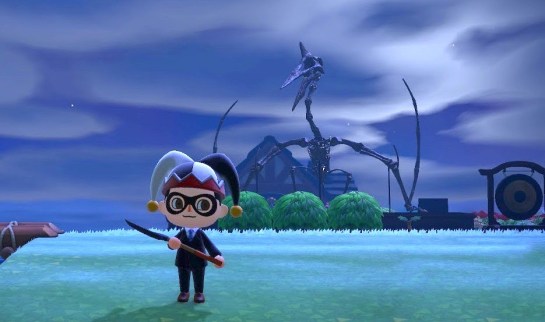
    Me, in jester’s hat, superhero mask, and business suit, with the quetzalcoatlus skeleton that looms over my property.

    Why did I play Animal Crossing for four hours today?

    About a month ago I became one of the bajillions of people of all ages enthralled with Nintendo’s bucolic-drudgery simulator, Animal Crossing: New Horizons. I never expected to be. When the game was announced, having no frame of reference for the previous iterations, I was utterly uninterested. Then I saw the deluge of fawning coverage and player testimonials about how this game, this experience, was keeping people sane during the COVID-19 lockdown, and I decided to give it a shot.

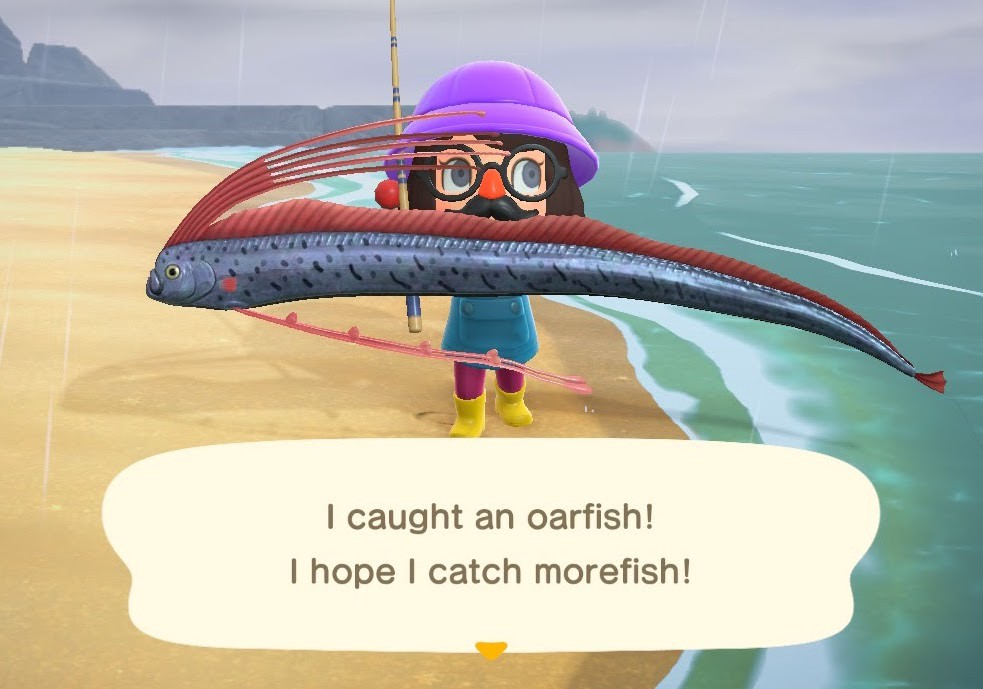
    Now it’s the center of most family activity and interest at my house. My kids can’t stop talking and thinking about the game, and even my partner, who never plays any video games whatsoever, is utterly devoted to it. (She plays more than any of us!) The four of us are constantly dishing about the other island residents and trading gossip about their quirky behaviors (we all just love Zucker), and we cheer each other on for our successes. (“I finally caught an oarfish!”)

    My partner Renée with her big catch. I have a heart attack every time I pull one of these monsters out of the water.

    But, you know, why?

    I do understand the general appeal of the game’s overall shtick. After all, I spent a great deal of time, circa 2000, enriching the lives of my Sims (or making them suffer unthinkably), and more recently I have easily logged around 1500 hours fashioning empires in Civilization VI. And while I’ve never really gotten the hang of Minecraft, I can at least appreciate how its limitless palette for creativity is so engrossing. I’ve even dabbled, rather tepidly, with Second Life. Animal Crossing boasts many of the elements that made Minecraft, Second Life, and the Sims and Civilization franchises appealing. And it’s way cuter.

    But viewed from another angle, playing Animal Crossing can seem a lot like the equivalent of doing manual farm labor for a cult leader. Tom Nook is Joe Exotic and we are all his expendable underlings being paid in fake currency and expired meats.

    For example, I can spend an hourlong game session just pulling weeds.

    Let me slightly rephrase that. I choose to spend an hourlong game session pulling weeds.

    And the crazy part is that I love it. With every clump of vegetation I yank from the ground and stuff into my “pockets,” I have made my little island home (which is called Duckbutt Island) just that much more beautiful, and made a larger canvas for me to do with as I like. The methodical, somewhat rhythmic pulling of the weeds is rather meditative, much like real gardening can be (but without the real dirt or real bugs). Even the sound that comes from each weed-pull, a sort of squirty “yoink,” is weirdly satisfying.

    I’m not kidding here. When I go on a jaunt to a “mystery island” or visit my kids’ domain and I see a lot of weeds, I think, and perhaps shout out loud, “Oh boy! Weeds!”

    Later, I can store all those weed clumps away and wait for Leif to come back to Duckbutt town square and purchase them at a modest markup.

    Planting flowers, shaking trees, whacking away at rocks, collecting seashells — all of it is tedious, and yet it’s the tediousness that’s often the most appealing part for me. I do also enjoy the creative customization, designing one’s avatar and dwelling, and I have fun checking the boxes that qualify Animal Crossing as a “game” by hitting certain milestones, fulfilling necessary tasks, and upgrading life on Duckbutt. Those things all help Animal Crossing feel like it has a “point.”

    But even without those things, it’s remarkably soothing to simply wander one’s island and gently tend to it.

    Me in my red outback hat, dress made of cherries, and recycled boots, livin’ life like it’s golden with the boys — my two giant snapping turtles.

    In this way, Animal Crossing is less a game, and more of a place to go — which is especially valuable at this moment in history. Countless other games offer this kind of escape, of course, from Fortnite to World of Warcraft to, well, name your MMORPG of choice. None of them, however, have appealed to me the way Animal Crossinghas…with perhaps the exception of The Legend of Zelda: Breath of the Wild, which, while not a “sim” by any means, provides so rich and wide of an experience that one can simply wander and putter about delightedly for hours. And believe me, I have.

    Zelda aside, perhaps it’s those other games’ sprawling complexity that suggests to me that the effort to master them wouldn’t be worth the time and energy.

    Animal Crossing has many layers of complexity, but they all feel very optional. One can advance and upgrade at one’s own pace, and in the meantime there is always something to do, harvest, beautify, design, or craft. And, importantly, as you meander and dawdle, no one will be out to get you.

    However, one aspect of Animal Crossing that has really solidified it as a breakout phenomenon at this moment is its social component. Players can visit the islands of friends or anyone on the internet who opens their island to visitors. I’ve played online with my kids while they’re at their mom’s house, but otherwise I have interacted very little with anyone else. What am I missing here?

    I suspect it has more to do with me than the game. My reticence and anxieties over social encounters in meatspace seems to carry over to Animal Crossingin strikingly similar ways. Just like in the real world, I worry over what to say or how to behave around another player, and feel exhausted in advance by whatever expectations they might have of me. I feel pretty confident of my ability to cultivate lasting friendships with Zucker the octopus and Truffles the pig. And Blathers, well, he is my true soulmate. But actual humans are another story.

    At least on a computer generated island, no one expects our avatars to make eye contact.

    May 4, 2020
    animal crossing, nintendo, quarantine, video games
    essays

  • Neurotypicals Keep Feeling Things At Me

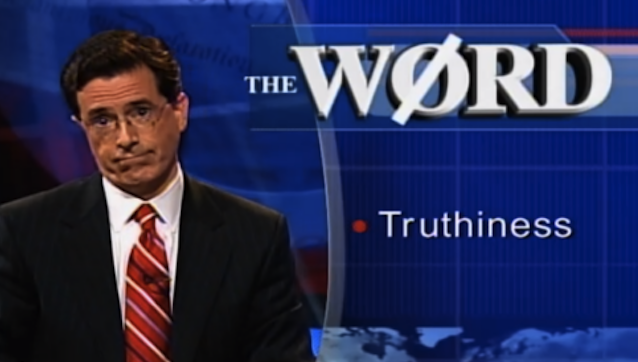
    Here’s how Stephen Colbert helps explain how I, as someone with Asperger’s syndrome, am in a constant state of anxious bewilderment at this current moment.

    The introduction of truthiness to the American lexicon by Stephen Colbert in 2005 was something of a cultural watershed, the moment when we all finally had a way to describe the semi-facts and quasi-reality we experienced consuming political punditry. Overwhelmed as we are today with outright lies and misinformation, the George W. Bush era of truthiness seems almost idyllic.

    But remember that the driving force behind the phenomenon of truthiness was not the relative veracity of a claim, or even the convenient massaging of facts. Truth was not really the point at all. Emotion was. In coining this neologism, I think Colbert may have inadvertently prophesied our current dystopia.

    “Face it, folks,” said Colbert as his “Stephen Colbert” character on The Colbert Report. “We are a divided nation. Not between Democrats and Republicans, or Conservatives and liberals, or tops and bottoms. No. We are divided between those who think with their head, and those who know with their heart.”

    And here’s a kicker.

    “Anyone can read the news to you,” he said. “I promise to feel the news atyou.”

    Remember that.

    I recently happened upon a piece from Psych Central by Ivy Blonwyn about her experience counseling a married couple wherein the wife was neurotypical and the husband was very likely an Aspie. Blonwyn writes:

    We neurotypicals cannot begin to fathom how hard it is for Aspies to exist in a culture we dominate. We set the rules. We design society. We define social norms. Even something as fundamental as the rules for manners and polite conversation are foreign to an Aspie. They may behave ‘normally’ (as NTs [neurotypicals] define it) but that’s because they’ve memorised how to follow our seemingly nonsensical rules by rote. It’s a script for them and a senseless one at that.

    For example, when Dan was breaking eye contact, waving his hands and gasping, I had been talking about a movie that quite interested me. A neurotypical who had not seen that movie as Dan had not would automatically realise the important part of the conversation is not the movie. It is how the speaker felt about it.

    An Aspie on the other hand, cogitates on the movie (they haven’t seen) and having nothing to contribute to the subject of the movie, wants to advance the conversation to something they enjoy talking about. Hence the appearance of impatience and disinterest.

    It never occurred to Dan that I was telling him about my feelings. He thought we were discussing the movie. ‘No, I was telling you about me’, I told Dan.

    ‘Then why didn’t you say that?’ he retorted.

    As a neurotypical, I thought I had. It was implied. So obvious, that it never occurred to me to verbally express it.

    But Aspies don’t make assumptions so hard-wired in NT minds that what we really mean is usually left unspoken.

    I experience this kind of interaction all the time. Someone is telling me something about their day, something they’re going through, or something they experienced, full of details and observations, and I can barely maintain my attention. If what I’m being told has no direct relevance to me, is about something of which I have no experience myself, or is out of my control to do anything about, my brain desperately seeks to abandon it.

    Particularly if the speaker is someone I care about, I make my best effort to be attentive and engaged, and I think I usually succeed. By now I know that to appear to lose interest is hurtful and offensive. I want to be supportive and useful to the people I love, so I do my best.

    But I also don’t quite get it. Why would I want to know about the plot of a TV show you watched? Why would I want to know about a casual conversation you had with your coworker? How can I possibly be a part of a conversation in which I have no frame of reference? What’s the point?

    It’s because the speaker is really telling me about themselves. They are not reading the news to me, they’re feeling the news at me.

    And that’s just what neurotypical people do and it’s perfectly normal. For them, it’s necessary.

    The propagandists of our current informational hellscape, such as Fox News, the president, and the great heaving mass of conspiracy theorists, all of them are feeling at us, and people are responding.

    But even the “good guys” in the reality-based community, such as progressives and the otherwise-sane folks I follow on Twitter, are doing the same thing. They may be working with actual facts that are actually true, but the outrage-tweeting they engage in operates under the same priciple. They, too, are feeling the news at us.

    And that’s why I can’t deal. When opponents of the president shame-tweet his latest outrage, I keep appending the question, “So what do we do?” No one ever answers. Not necessarily because they don’t know what to do (though I suspect they usually don’t), but because that’s not the point. They came to emote, not to cogitate.

    My neurology is ill-suited for this moment. I do not find satisfaction or connection from this mode of communication.

    If someone I love tells me how bad their day at work was, I will likely try and brainstorm solutions to each problem they faced, when that’s not at all what they wanted from me. They were feeling their news at me, not looking for answers.

    I’m looking for answers.

    For those I love, I will try to be better at accepting what they share with me, what they feel at me. I will try to better understand that they are trying to share themselves, their souls, not their raw data.

    For everyone else, I will try to ignore the firehose of feelings, and seek answers elsewhere.

    May 3, 2020
    aspergers, autism, truthiness
    essays

  • I maybe oughta blog more.

    There was a time when I tried to make a point of writing at least one blog post every day. Today that sounds like some trite advice from a self-help article on Medium, but I wasn’t doing it in order to “gain 50,000 followers” or what have you. It was a good habit to keep as a writer, to practice in public like that, and it genuinely felt good to have made something each day. But mostly, I actually felt like I had something to say, all the time.

    These days, it’s remarkable if I write something more frequently than once a month (this is outside of work, of course, where I write all damn day, every day). There’s a long list of contributing factors. Personal reasons include mental exhaustion from work, attention demanded by kids and other family matters, the attraction of less intellectually demanding pastimes like video games (I really don’t watch much TV at all), and a bedtime that seems to seep every-earlier into the evening as I age.

    There are also, I think, broader cultural reasons I don’t blog like I used to. The novelty of the form itself has worn off since its early-aughts hayday. While blogs were once the primary venue for processing and debating the events and issues of the day, they have been largely replaced; for journalists and activists, by Twitter; for everyone else, by Facebook. In those now-hazy before-times, one might be outraged over something some political figure did, compose a four or five-paragraph screed expressing said outrage, and liberally blockquote from some other source for the purpose of bolstering or rebutting one’s argument. Today, the same person will now retweet someone someone else said about said outrage, and maybe add an original line to a tweet in order to keep it within one’s personal brand. Or they’d share an article (probably unread) on Facebook, perhaps adding their own exclamation-marked sentence about the outrageousness of the outrage.

    The author in 2006, with a laptop, possibly blogging. Possibly not.

    The point being, blogs just aren’t where the action is. Blogs were once little islands of thought, from which individuals or small bands of like-minded island-dwellers would cast their prose into the wide ocean of the internet (or, as it was more often characterized back then, the capital-I Internet, like it was a place). Often, that prose might be fashioned into a kind of dinghy and aimed directly at another Internet Island, sometimes carrying supplies, sometimes a warhead.

    It was fun!

    Some of those Internet Islands still exist and thrive, and some have developed into full-blown Outlets, honest-to-goodness nation-states in the online media realm. Some blogs were subsumed into larger entities, or their feudal lords were lured away to more luxurious courts. But I think for most of us who were on the tiniest of those Internet Islands, we saw that no one was reading what we wrote anyway, so we might as well put in as little effort as possible, and be ignored on Twitter instead.

    And good lord, did I love Twitter for a while. I felt like I really got it, and my own brand of everything-is-terrible humor-as-despair shtick felt very well suited to the platform. Today, though, Twitter is like punishment. I check in, I scroll, and I am quickly saturated by anxiety, anger, and despondency. And it doesn’t seem to matter what measures I take to curate my feed. In a time as ugly as this, ugliness is all there is to tweet.

    As for the material I put out on Twitter, no one is seeing it. Even after thirteen years on the platform (Jesus Christ, has it really been thirteen years???) I have managed to attract a measly 4000-some followers, only a tiny fraction of which ever actually see (or care to notice) what I write. If something I tweet does happen to break out a little — usually because a certain friendly atheist has retweeted it to his own massive following — I become deluged with inane replies that are often inexplicably hostile. None of it seems to make things any better, and there’s no feeling of accomplishment.

    And besides, I’m not a “tweeter.” I’m a writer. And while thoughts expressed in 280 characters or less is an absolutely valid and valuable form of writing, it’s not sufficient for me.

    This gets me back to the question about why I don’t write more, or more specifically, why I don’t blog.

    The despondence engendered by Twitter is part of the answer. The ocean of the internet (it’s lowercase-I these days) is already so polluted with opinions, punditry, takes, essays, outrages, and news, it hardly seems useful to throw in more of one’s own trash. Things are bad! Bad people are doing bad things! You don’t need me to tell you that. And while I could write about something else instead, something that has nothing to do with how terrible everything is, my despair has sapped my drive to share my thoughts about anything.

    Another reason for my blog-hesitancy is ego. There seems little point in putting in the effort of writing when I know that no one’s going to read it. And my standards for what constitutes “some folks read it” versus “no one read it” have already been lowered to sub-basement levels. The idea is supposed to be that the good stuff will rise to the top, but I don’t think anyone believes that anymore, and who knows if my stuff would even qualify as “the good stuff” anyway? Sometimes I think it has, but what do I know? I only have 4000 Twitter followers.

    I end this post without an answer, other than the obvious, which is: Do it anyway. What I write — and yes, specifically, blog — should exist for its own sake. For my sake. Because each time I do it, I will have made something. I will have improved my own thinking and come to better know myself. It will, as Vonnegut put it, make my soul grow.

    And maybe, on the off chance that someone else encounters it, maybe it will do something good for them, too. Maybe that person will stand up from where they’re sitting on their Internet Island, look across the sea in my direction, and wave.

    May 2, 2020
    despair, writing
    essays

  • Nothing to be done

    The part of all of this that most fills me with despair is the fact that those with the power to do something simply won’t.

    My experience of Twitter right now is one of being told over and over to be outraged about every offense committed by the president, Republicans, right-wing media, or their followers. And I am! Good lord, I am. Trump constantly lies, promotes self-serving misinformation, and foments civil war. His allies and defenders fall in line. The parade of fanatical ignoramuses react, predictably, with garish displays of jingoist hate. Their cells become food for viruses.

    And so the Important People on social media do their duty and Point it Out.

    Fine. What I’m not seeing, and what I desperately need, is for someone to do more than Point it Out, but to offer a solution. The dead horse I continue to beat comes in the form of quote-retweets in which I ask, “So what do we do?”

    Trump encourages insurrection: “So what do we do?”

    Trump refuses to give aid to states who don’t kiss his ass: “So what do we do?”

    Trump ignored warnings about the pandemic, and now pretends he was always on top of it: “So what do we do?”

    Maybe, in a previous era, reporting on the wrongdoings of a president or other public official would at least get the ball rolling on getting that leader to change course or be held accountable. But, surely, now it must be obvious that this is no longer the case! Everything we all got used to, the idea of “scandals,” exposés of corruption, and various career-ending “-gates,” none of it matters anymore. We can Point Out and Be Outraged over every appalling example of nogoodniks nogoodnicking until we run out of tears and our fingers can no longer tap out our replies and retweets, and none of it will change a thing.

    Those who believe what the president says will believe him until their dying breath, even if it’s a breath gasped without the help of the ventilator they needed but couldn’t get because of the president they loved. If reporting, explaining, and shaming had any impact whatsoever, Trump would already be out of office, Pence would be under investigation, and far, far fewer people would be sick or dead.

    So, I’m asking, what do we do?

    The Senate could have done something. We know how that worked out.

    Pence could do something. He and other members of the cabinet could agree among themselves that the president is a danger to the country, invoke the 25th Amendment, and remove him from power, even if only temporarily. But of course, they won’t.

    Is there something more the news media could do? I honestly don’t know. Again, merely reporting the many crimes of the moment isn’t enough. Jake Tapper and Anderson Cooper can fume into the camera over the president’s lies and the exponentially rising body count, but everyone who is watching already agrees that this is all an outrage.

    Can voters do something? If they can, they have to wait until November, and then you have to assume that they will be able or allowed to vote. And because of how the Electoral College rigs the system in favor of the Candidate of the Fanatical Ignoramuses, it may not matter anyway.

    Could well-intentioned billionaires and business titans do something? I don’t know! Governors? Celebrities? Anyone?

    It’s hard for me to psychologically accept the idea that there’s nothing to be done, that we’re just hostage to the madness of an idiot cult leader, and that’s that.

    I suppose what it comes down to, short of something even more destabilizing or dangerous, is that enough people will have to demand change in any way they can. But by “enough,” I don’t mean an motivated plurality or even 50 percent-plus-one. Overwhelming numbers of Americans will have tell those in power to fix this shit, but do it through some means that doesn’t require them to “take the the streets” like the Fanatical Ignoramuses protesting stay-at-home rules.

    But there isn’t enough of us. This won’t happen.

    So what do we do?

    April 19, 2020
    coronavirus, covid-19, despair, mental health
    essays

  • An Actor, an Introvert, and a Universe of Possibilities

    The author in 2006.

    People tend not to believe me when I tell them I’m severely introverted. It’s understandable, as the persona I put forward is usually that of a quirky, agreeable smart-aleck. I am animated and expressive in conversation, I engage in overtly silly play with my kids, and of course, I’m an actor and musician.

    To many people, my personality simply seems too big to be that of someone who is shy, anxious, or reserved, let alone autistic. Some have even told me they find me intimidating. To me, that’s beyond ridiculous, but there it is.

    When folks have trouble grasping how it is I could have had found any joy in being an actor while finding social interaction to be utterly draining and even painful, I explain that when I’m performing, I’m protected by several layers of metaphorical masks. On stage in a play, I am explicitly not myself. It says so right in the program! Next to my name will be the name of whatever character or characters I’m playing. I’m definitely not playing “Paul Fidalgo.”

    I don’t have to be clever or come up with interesting things to say, because the words have been written for me, hopefully by someone who is well established as being really, really good at writing interesting things for people say, like, for example, William Shakespeare.

    I don’t even have to decode any social signals or read between the lines of what others are saying in order to know when to speak, because it’s all been planned out in advance. I am forbidden from speaking until my own lines are cued. That limitation is indescribably liberating.

    I don’t have to know what to wear. I don’t have to know where to stand or how to behave, because all of that will have been worked out in rehearsal. If the play doesn’t call for my presence in a scene, I don’t even have to exist.

    But there’s another way to explain the apparent incongruity of my personality that flips all of this on its head, and I didn’t even realize it myself until I had it explained to me in an article by a true master of the theatre from several years ago.

    I recently came across an essay published in The Nation in 2011 by the great actor and playwright Wallace Shawn, who most folks will know as Vizzini in The Princess Bride, Grand Nagus Zek on Star Trek: Deep Space Nine, or the voice of the Tyrannosaurus Rex in the Toy Story movies. Maybe you know him from the 1981 film My Dinner with Andre. Oh, and he was just in Marriage Story, so that might help.

    In his essay for The Nation, which is a truly beautiful piece of prose in which he explains how his art leads him to consider himself a socialist, Shawn writes:

    We are not what we seem. We are more than what we seem. The actor knows that. And because the actor knows that hidden inside himself there’s a wizard and a king, he also knows that when he’s playing himself in his daily life, he’s playing a part, he’s performing, just as he’s performing when he plays a part on stage. He knows that when he’s on stage performing, he’s in a sense deceiving his friends in the audience less than he does in daily life, not more, because on stage he’s disclosing the parts of himself that in daily life he struggles to hide. He knows, in fact, that the role of himself is actually a rather small part, and that when he plays that part he must make an enormous effort to conceal the whole universe of possibilities that exists inside him.

    In one version of my explanation for why such a loud, animated performer like me could be such a severe introvert is that I alone am too small and too vulnerable to be comfortable in my own skin in the midst of other humans. But what Shawn helped me to see is that this disconnect also stems from the fact that my singular, real-life self is also near to bursting with thoughts, ideas, fears, ambitions, impulses, and possibilities.

    The potential energy bottled up and pressed down into this small, delicate body is overwhelming. Letting any of its pressure out brings with it the risk of humiliation, regret, misunderstanding, or bewilderment. So a single, inoffensive persona must be adopted, a safe and broadly acceptable packaging must be applied.

    The stage does not solve or sort all of these parts, but it does allow them to manifest in meaningful, productive, and satisfying ways. In this way, an actor’s role is sort of like Mjölnir to Thor.

    In Thor: Ragnarok, the Asgardian Avenger has lost his legendary hammer, Mjölnir, and at the edge of utter defeat, he hears the voice of his late father Odin, who asks him, “Are you the god of hammers?” Odin explains that Mjölnir was not the source of Thor’s power, but merely a means of focusing and controlling it. The real power, the “thunder,” is already inside him, coursing through him.

    That’s what a role in a play is for an actor. It harnesses the lightning and thunder inside us and allows us to wield it. Shakespeare himself even wrote of “youths that thunder at a playhouse.”

    It is true that for me, and I suspect for many actors, taking on a role is a way of protecting ourselves, providing armor for our fragility. But it is also a means to show our strength, to unleash a power within us that in most other circumstances would be too dangerous or destructive.

    As Wallace Shawn says, we have within us a universe of possibilities. The stage allows us to live some of them out.

    February 20, 2020
    acting, shakespeare, theatre
    essays

  • Oh Crap We’re Living in “Final Crisis”

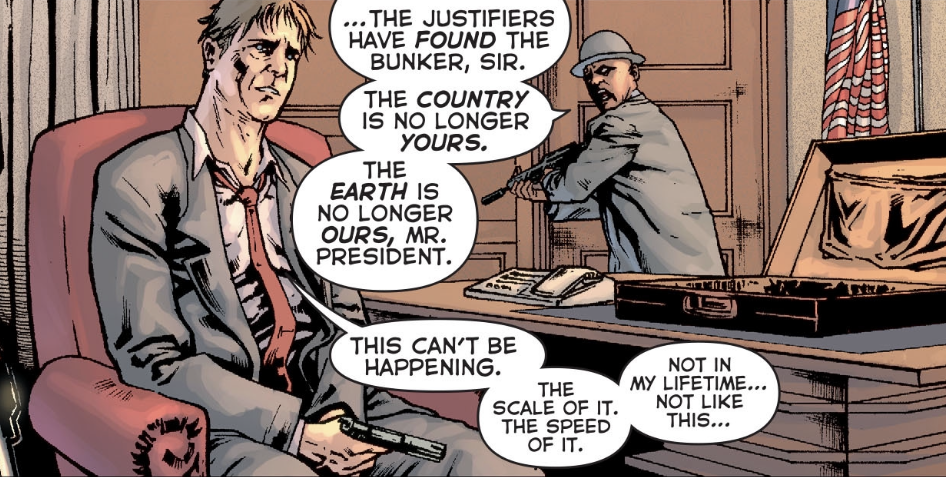
    Here’s a panel from the big DC Comics event, Final Crisis, in which a fictional President of the United States laments his state of affairs. You see, a god-like alien, Darkseid, has begun reprogramming the minds of the Earth’s population, causing them to submit to utter subjugation.

    In this scene, a man with the president (for some reason wearing a fedora in the 2000s), warns that Darkseid’s forces, brainwashed humans and superheroes called “justifiers,” are about to wipe them out.

    The haggard president, dejectedly clutching a gun, says, “This can’t be happening. The scale of it. The speed of it. Not in my lifetime…not like this…”

    Well, of course it happened quickly! It’s a superhero comic book crossover event with an antagonist whose home planet is literally called Apokolips! Darkseid doesn’t do gradual.

    But there was something about this particular comic book armageddon scenario that struck a chord with me. Cosmic-level supervillains usually achieve their aims through overwhelming destruction and death. Palpatine will rule the galaxy with the might of his fleet and the power of the Dark Side of the Force. We will all become children of Thanos once he murders half of all life forms. Etcetera.

    With Darkseid, however, while there’s plenty of death and destruction, his plan for intergalactic domination was to turn humanity into a hyper-materialist cult.

    What?

    “Anti-Life justifies my ignorance!”

    Okay, here’s a quick summary of this particular branch of the rather dizzying plot of Final Crisis: An evil prophet-type character, Libra, who sort of looks like a cheerier Doctor Doom, recruits supervillains to help him infect people’s minds with the “Anti-Life Equation,” a sort of mathematical “proof” that leads a person exposed to the equation to reject all the values they once held dear and choose to serve Darkseid. But not just “serve” in the sense of bowing down before his greatness or what have you, but becoming willing cogs in a sort of empty-headed, ultra-fascist state.

    (Here’s where I must point out that I provided the voice for Libra and a couple other characters in the audiobook version of Final Crisis. Cool, right?)

    We get a taste of what’s coming when, in a very strange part of the story, Superman deals with various alternate-universe Supermans for reasons that are frankly too esoteric to explain here. (These Crisis-themed series can be very confusing.) One such Superman variant is Ultraman, and he’s not a truth-and-justice kind of guy.

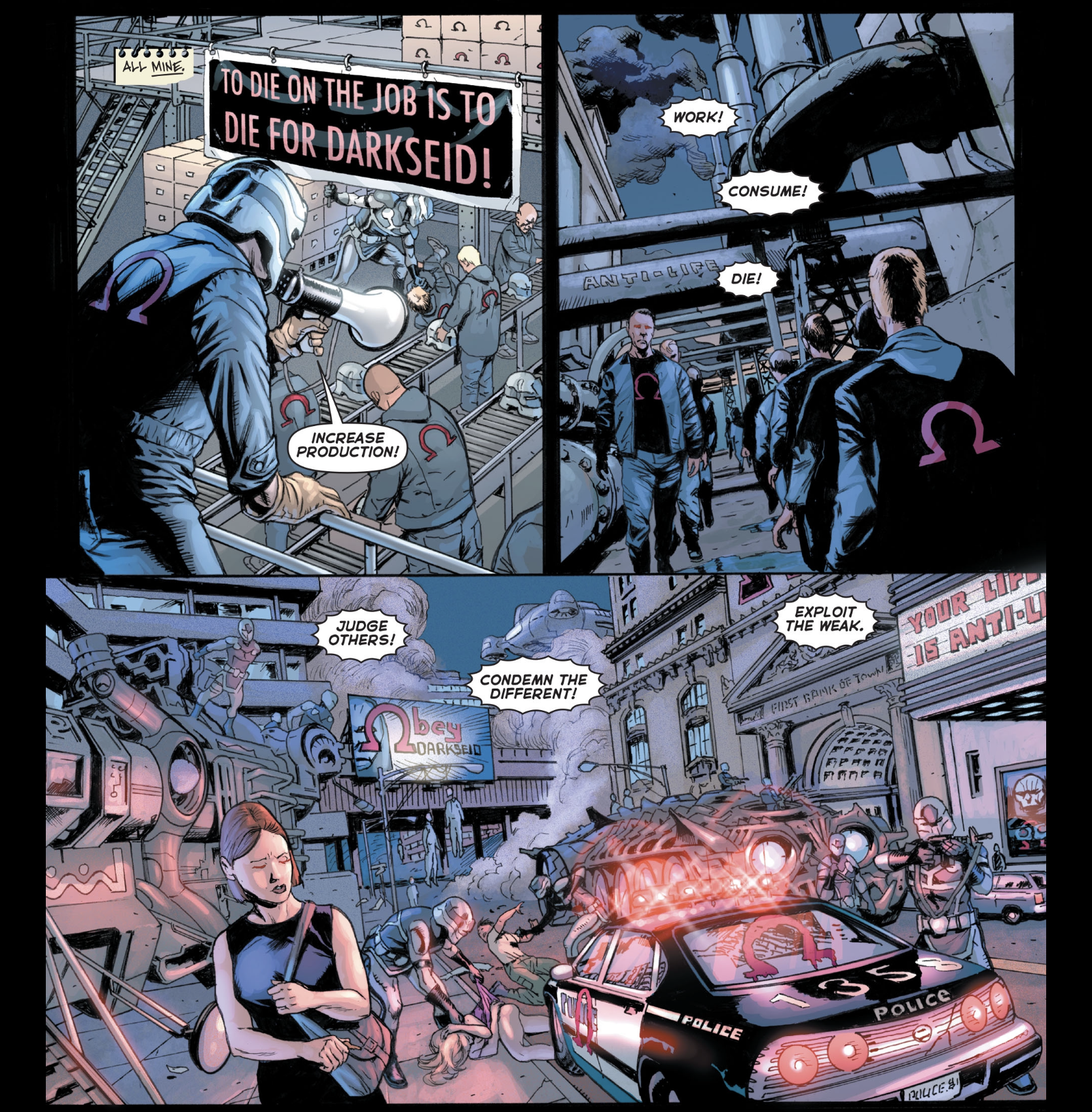
    “We value material wealth above everything,” he says through gritted teeth to the nicer Superfellows. His declaration is a kind of foreshadow for what Darkseid is bringing to Earth. Here’s a taste of what life under Darkseid looks like:

    “Increase production!” shouts a justifier to the brainwashed drones that had once been everyday folks. And then shit gets real.

    “Work! Consume! Die!” he shouts. Whoa, I’m thinking. Darkseid is creating a consumerist dystopia! Which sounds pretty close to the world as it is anyway!

    And then the kicker. The justifier shouts, “Judge others! Condemn the different! Exploit the weak!”

    It’s here I’m thinking, okay, Darkseid just built a Republican dream world. It’s Trumpism from space.

    Don’t think so? Look how a justifier reacts to finding a copy of Darwin’s On the Origin of Species:

    “What disagrees with Darkseid is heresy.” The book is burned, and echoing what other justifiers have said at the commission of horrifying acts, “Anti-Life justifies my ignorance!”

    Take away the space-gods, and the attitude is exactly what is demanded by the cult of Trumpism. The facts are only what the cult leader says they are. They can change moment to moment, at his whim. Nothing he does can be bad, because it’s done by him. Any crimes committed by others are justified if they are done in his name.

    This is the position of the United States’ ruling faction right now. And like the fictional comic book president observed, it happened so quickly.

    Attempting to rescue some folks from the devastation, and from becoming Anti-Life zombies, the hero Black Lightning says, “Darkseid is remaking the world in his image, using our technology, our people as building blocks.”

    For about a generation, the advent of the internet and social media were seen as means to enlightenment. And then the bad guys figured out how to use that technology to bring out our worst selves, minute after minute. Now countless “dimensions” and “alternate realities” are mainlined to us by Facebook through our individually-optimized Anti-Life Equation Feed, and the resulting state of chaos and confusion is the perfect breeding ground for the lies, the ignorance, the disenfranchisement, the demonization, and the many other forms of supervillainy we are witnessing right now.

    Trump and his cult are remaking the world in their image. Like Black Lightning says, “This won’t be over until each and every one of us chooses to resist.” That’s true for us, too. But Superman’s not coming.

    February 10, 2020
    comic books, dc comics, science fiction, superman
    essays

  • The Unexpected Plausibility of Mike Bloomberg

    “I am getting really sick of all these Bloomberg ads!”

    This was spoken by my 10-year-old son who watches shows on Hulu with his mom and has therefore been exposed, repeatedly, to ads for the presidential campaign of Mike Bloomberg.

    When Bloomberg formally entered the race for the Democratic nomination last year, I railed to the heavens (you couldn’t hear me, but trust me, I railed), “WHY?” I don’t have any major objections to Bloomberg as a candidate or potential president, though he’s certainly not one of my top choices. But I simply couldn’t understand what he thought his path to the nomination could possibly be.

    I know what the pundits have said, and what the line of the campaign is: Bloomberg can afford (both in terms of money and political capital) to skip the early states, use his wealth to blanket the later states with ads, and eventually squeeze past a muddled field of candidates currently lacking an overwhelming frontrunner, with the promise that his business acumen and aura of competence would seal the deal.

    But, you know. Come on.

    While technically possible, there is nothing plausible about Bloomberg’s prospects. Polls showed for months that the Democratic electorate was plenty satisfied with its existing options, and that the top four or five candidates regularly bested Trump in head-to-head general election polls, particularly Joe Biden — who Bloomberg would have to totally neutralize to even have a shot at the nomination.

    How many times have we seen a late entrance into a presidential primary contest go on to win a party nomination? As we learned from would-be party saviors Wesley Clark, Rick Perry, and Fred Thompson (and eventually Deval Patrick), pretty much never. The fashionably late just don’t get to be president.

    But let’s say none of this is the case. Let’s sat a latecomer could in fact ride in and shake everything up and that the Democrats are utterly despondent over their choices. Even then, in what universe does this imply that what progressives really want is the stop-and-frisk, former-Republican, Bush-endorsing, women-belittling, 80-pushing one-tenth-of-one-percenter? Perhaps there was some alternate dimension in which this made sense before the Crisis on Infinite Earths, but not on this Prime Material Plane.

    Mike Bloomberg knows all of this. So my only explanations for his decision to run anyway are, one, that he is surrounded by advisors and consultants on his payroll who have a vested interest in convincing him that he will be president, and two, perhaps most importantly, he just really, really wants to be president, and at age 77, this is his last chance.

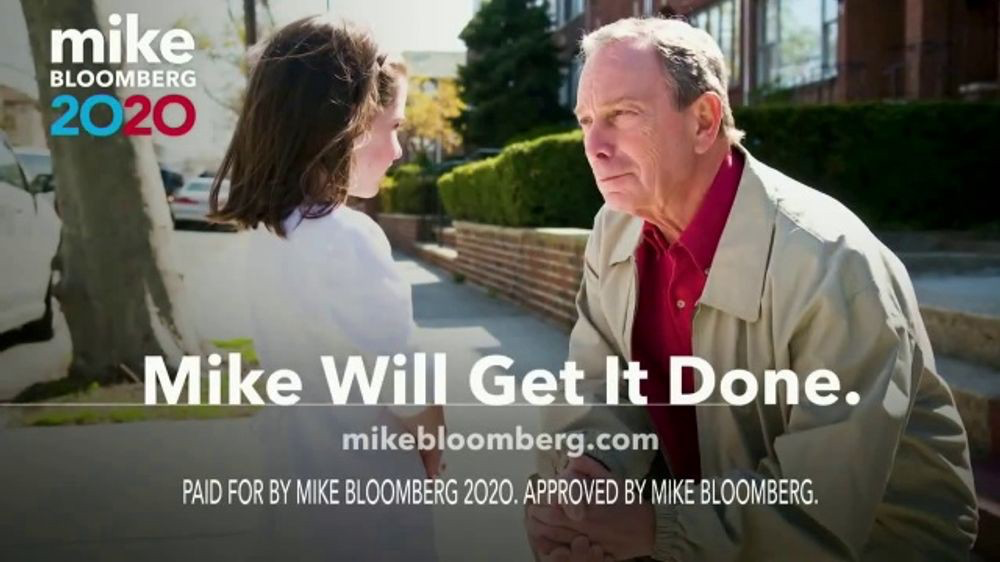
    In recent weeks I’ve finally started to see some of those Bloomberg ads myself, either on social media or, yes, on Hulu. They’re really quite good. They’re not blockbuster, knock-your-socks-off, windsurfing-swiftboat ads that blow up the race, but they’re good. Perhaps the most effective thing about them is how reassuring they are. In general, his ads lightly contrast Bloomberg with a reckless Trump by highlighting Bloomberg’s competence and, well, normalness. They send a message that’s similar to Biden’s, in that they tell you that the country would be back in sane hands under this candidate, only Bloomberg’s ads layer on an actual record of governance. Twelve years as mayor of the city at the center of the universe can provide that kind of record.

    Biden, for all his decades in public office, has never really been an executive in the way a mayor or a governor would be, and no one would mistake his role as vice president for that of a buck-stopping decision maker. So his ads rely on character; he’s got it, Trump doesn’t. He’s not wrong.

    But without saying it, Bloomberg’s ads communicate that same message, that same feeling. Maybe it’s because I have been so skeptical about Bloomberg’s campaign that my reaction is disproportionate to their actual effect, but I have been very surprised to see how invested he appears in the people he’s shown listening to, how convicted he appears in the candidate-with-voters B-roll that are the standard filling for every political ad.

    “That’s a good ad,” I find myself saying out loud. Hmm, I find myself thinking, the field of candidates is still pretty muddled. Hmm, I think, Bloomberg is often polling third and fourth nationally.

    Nah. I mean, come on.

    But then Iowa happened.

    Put aside the procedural shitshow of the caucus tabulation debacle. What the Iowa caucuses showed us was that the race is a mess. Nationally, Sanders and Biden are wrestling for a small plurality to claim the top spot, with an undulating rotation of Elizabeth Warren, Bloomberg, Pete Buttigieg, Amy Klobuchar, and Andrew Yang in the next few slots. Sanders people will always be Sanders people no matter what, but the rest of the field has not been sufficiently winnowed to clarify who Sanders’ prime challengers are. Maybe it’s Joe Biden, maybe it’s eventually Pete Buttigieg, but it’s no clearer today than it was a week ago.

    By the looks of the final alignment results, as I type this on February 4, Joe Biden wound up with a pretty bad fourth place showing in Iowa. He was never banking on an Iowa win, but a distant fourth-place finish is pretty damned embarrassing for the erstwhile national frontrunner and former vice president.

    Pete Buttigieg’s showing was the breakout of the night, for whether or not he “won,” he certainly wrestled Sanders to a functional tie. But he’s polling in single digits nationally. Unless Iowa has an impact on voters that is even more outsized than usual, I don’t see how he turns a tied-for-first-but-technically-second-place showing into meteoric rise. And I suspect there’s not going to be a lot of bounce to be had out of this particular Iowa caucus.

    I don’t really get what’s happening with Elizabeth Warren. It seems like the voters all really like her a lot, but too few of them are willing to cast their lot with her. I think that’s a huge shame and a big loss for all of us.

    This is all to say that where I once did not see an opening for Mike Bloomberg, now I think I might. Skipping Iowa certainly seems to have proven to have been a net plus for his campaign, though also missing New Hampshire seems like an unforced error. That’s a whole other week of coverage in which he won’t be part of the conversation about who will be the next president.

    But maybe it doesn’t matter, and if so, that’s largely because of his money. (It’s also because of his name recognition, as everyone knows who Mike Bloomberg is, and hardly anyone recognizes Tom Steyer, the other billionaire.) For all the media that Bloomberg won’t earn, he’ll buy, ten-fold. He’s already run a Superbowl ad and is reportedly planning to double his already gargantuan ad spending in the coming weeks. If his polls go up soon, he’ll qualify for the debates after New Hampshire, and I suspect that even after New Hampshire votes, we won’t be much closer to knowing who Bernie Sanders’ real competition is. That’s a good spot for Bloomberg to find himself in.

    And here’s what might be the biggest thing. Bloomberg obviously wants to be president badly. Those other late-arrival candidates I mentioned earlier were largely ushered into the race by draft campaigns and twitchy party insiders. They didn’t jump in because of an insatiable desire to become President of the United States. Bloomberg’s got that desire, and one should never underestimate the guy who just wants it more.

    It remains the case that Bloomberg’s chances at being the Democratic candidate to take on President Trump are incredibly slim, requiring a near-perfect falling-domino execution to create the circumstances for his ultimate nomination. But for the first time, I can see it.

    I personally support Elizabeth Warren. My 7-year-old daughter agrees, and even more strongly, often screaming “WOOOOO ELIZABETH!!!!” when the election comes up in conversation — which it does a lot in my house. My 10-year-old son has found a lot to like about several candidates, and I think he misses Beto O’Rourke and Kamala Harris. But the other day, as I’m driving him home from a lesson, he started asking me to tell him about Mike Bloomberg.

    Those are some good ads.

    February 5, 2020
    essays

  • Suicides Are Not Car Accidents

    When trying to make a point about the troubling rise of suicide rates in America, the statistics are often compared to other modes of fatalities, and understandably so. In order to understand the scale of the problem, it helps to compare it quantitatively to undesirable things we feel more familiar with. But in the case of suicide, I think it diminishes the scope and seriousness of the issue.

    I’ll pick on Arthur C. Brooks’s column at the Washington Post, because that’s what got me thinking about this. Brooks rightfully urges a serious confrontation of the undeniably sharp and steady rise in suicide rates, and to convey just how bad things have gotten, he draws comparisons to homicides and motor vehicle accidents. According to his cited statistics, there are now two suicides for every homicide in America, and there are 17 percent more deaths per year by suicide than by car accidents.

    While these numbers do help to communicate the scale of the problem, these kinds of comparisons, to my mind, oversimplify the issue to an unacceptable degree and make some morally false equivalencies between only somewhat related actions and phenomena.

    Let’s start with the homicide-suicide comparison, and take as granted that twice as many people die by suicide than by homicide. Put aside for the moment the rise in suicide rates. Is the fact that more people take their own lives than have their lives taken from them in itself an obviously bad thing? In every instance? Could it not be a sign that perhaps we are now less eager to murder each other, and that if we must die by someone’s hands, at least it’s more likely to happen by our own choice and volition rather than someone else’s?

    Of course it’s not “a good thing” that people want to kill themselves, but what does it actually mean to point out that there are more suicides than homicides? One is a death without choice, the other, at least in the broadest sense, is. What this numerical comparison ignores is what drives a person to make that choice. Would we feel better if those numbers were reversed? I don’t think I’d feel very safe if I was told that I was twice as likely to die by murder versus suicide.

    Now let’s look at the comparison to death by motor vehicle accidents. It’s similarly problematic, in that it is not at all clear to me that we’d be pleased to see the statistics in reverse, in which car accident fatalities overtake suicide deaths. In that case, we’d all be wondering what is up with all the careless driving and poorly-made vehicles?

    More to the point, Brooks points to the campaigns of a generation ago to improve car safety and how they eventually led to laws and regulations that made cars and driving much safer than they had ever been, and says, essentially, let’s do that, but for suicide.

    This makes little sense to me. Absolutely increase public awareness of the issue. Countless people might be helped if more Americans were better educated and empathetic about suicide. But what else are we really talking about? There’s no suicide equivalent to seat belt laws, speed limits, or air bags.

    Auto accidents, and to a lesser extent homicides, are more or less binary. They are bad things that result in unwanted deaths, but they can be prevented and mitigated by a fairly straightforward collection of measures. Make cars safer, make guns scarcer, and so on. Homicide is somewhat different in that, like suicide, its tendrils reach much deeper into other societal ills, and I’ll address that in a moment. But both auto accidents and homicides boil down to one thing: They kill people who don’t want to be dead.

    Suicide is something else entirely. Let us grant for the sake of simplicity that no one’s starting position is “I want to be dead, and I want it badly enough that I will end my own life myself.” Something has to push a person into that place. Several somethings, both apparent and invisible. Whatever those factors are, they are different for everyone. I’m not even slightly qualified to list them or assign them relative values. But you know some of them; depression, fear, hopelessness, self-loathing, brought on because of abuse, joblessness, loss, addiction, and so on.

    The point is that while murders and car crashes steal a person’s life from them, in the case of suicide, something else has stolen a person’s desire to live, and, importantly, driven them to the point that they have concluded that ending their life would be preferable to living it. Even if we could install some sort of air-bag-for-suicides and prevent the vast majority of them from succeeding, we’d certainly bring the suicide numbers down, but we’d have done nothing to address what brought on the choice to try in the first place. There’d be fewer deaths, but just as many miserable people.

    So the question can’t be — must not be — “how do we bring down the number of suicides?” The real question is about how we change society so that tens of thousands of people every year do not become so overwhelmed by existential despair that suicide even becomes an option worth considering. Yes, that means laws, but not just preventative laws focused on the act of suicide itself. If that’s all we’re thinking about, then we’re too late anyway. But we will need laws that address poverty, economic anxieties, addiction, basic health and nutrition, mental illness, education, and much, much more.

    But we’ll also need to change our culture, heart by heart. We’ll need to call ourselves to become kinder to each other, more sensitive to the pain of our fellow humans, and more willing to be a friend. We’ll need to stamp out those ideologies that thrive on the marginalization of other groups, and teach each other not to fear or resent equality. We have to decide, on an individual basis, to celebrate and embrace each single person’s differences and idiosyncrasies, and rather than seek uniformity, consider our species blessed by its infinite variety of neurologies, talents, flaws, ideas, histories, gifts, and limitations.

    When we start to assign value to each and every one of us, then, maybe, we’ll see those suicide numbers go down. Not because we managed to stop more folks from pulling triggers or popping pills, but because far more of us have decided that this world is worth living in for as long as we can.

    January 25, 2020
    mental health, suicide
    essays

  • Forty-Two

    Listen: There are things we are supposed to want out of life, and there are the means by which we are supposed to attain them. There are cultural events, life milestones, rites of passage, and personal interactions which we are supposed to eagerly anticipate, and those we are supposed to bemoan. There are standards of comportment we are supposed to uphold, degrees of amiability we are supposed to project, and durations of eye contact we are supposed to maintain.

    We are supposed to know when to laugh and when not to laugh. We are supposed to stand a certain way and sit in a certain way, and ways in which we are not supposed to stand or sit. We are supposed to have street smarts, as opposed to book smarts, but we should have enough street smarts to know how to attain those book smarts. We are supposed to be honest, except when we aren’t supposed to be. We are supposed to be careful and we are supposed to take big risks.

    We are supposed to have jobs and we are supposed to seek to advance in both position and compensation in these jobs. We are supposed to look forward to lunch. We are supposed to care a great deal about food and eating and sporting events and and acts of geographical transit and the weather. We are supposed to care a great deal about many, many things, and we are supposed to know what those are without being informed in advance.

    I have lived my life riven by “suppostas.” From the very first moment I realized that the world had expectations of me beyond the routine of elementary school classrooms, I was in a state of near constant bewilderment as to how I should go about my existence. All rules were unspoken and yet somehow universally understood and viciously enforced. I never received instructions, only penalties for failing to follow them.

    So I flailed about in search of guidance; examples to follow and role models to emulate. But I never found any templates that I could build upon, no maps I could interpret, no ciphers I could even attempt to break. In day-to-day moments, there were ways to sit, to stand, to walk, to move, or not move, and I coudn’t make sense of them, which often meant defaulting to keeping very still. In my education, there were crucial tasks to accomplish that had nothing to do with that was in the syllubus, and yet were somehow clear to my peers. In the professional world, the litany of unwritten rules, agendas, rites, and rituals were so perplexing and numerous that it caused a kind of paralysis.

    From the quotidian to the global, I simply could not figure out how to be. How I was supposed to be.

    The problem may already be obvious to you. My error has been to seek meaning and validation through my perceptions of what other people value. I don’t know how I could have known any better. To observe other humans is to see them behave based on some combination of motivations that are invisible to me, guided by some set of rules that is equally inaccessible. Existing, as I do, as a single individual with no way to read the contents of anyone else’s thoughts, all I can do is look and guess, like trying to describe the constellations in the night sky by looking through a paper towel tube.

    I would be 38 by the time I realized why the behavior of my fellow humans baffled me so, and why I was so lost navigating this ocean of “suppostas,” for that’s when I was diagnosed with Asperger’s syndrome, when I found out I am autistic. One aspect of this neurological difference is difficulty with ascribing agency to other people. Another is difficulty deciphering, or even perceiving, nonverbal communication. There are many more parts to being among the neurodivergent, but it all boils down to this: I don’t think or behave the way everyone else does, and I have a lot of trouble understanding what is happening around me if it’s not being explicitly stated. I have a neurological supposta deficit.

    But forget that. Placing too much value on external validation is not solely the burden of autistics. Being baffled by the motivations and behavior of other people isn’t exclusive to the neurodivergent. We austistics are more likely to face these kinds of difficulties, often to greater degrees of severity, but feeling misunderstood or alienated is part of being human. We all fear being lost or alienated.

    We can’t just dismiss this phenomenon as an error in thinking and move along, though. Whether or not we’ve identified the error, we still have the underlying problem, which is, really, how are we supposed to have meaning in our lives? How are we supposed to matter?

    I think I have looked to others to tell me what is meaningful because I couldn’t work it out for myself analytically. When I think about the whole life-cycle trip we’re all taking down this mortal coil, it looks like this: We’re born ignorant and helpless, and starting from absolute zero we then spend twenty-odd years learning how to be a human in the world, and then spend what time we have left deteriorating until we eventually expire and utterly cease to exist at all. Good lord, what, I ask you, is the point?

    Given that it looks so plainly like there is no point, and that existence has no meaning, the anxious young mind eagerly looks to the example of others. What’s meaningful to them? To what ends to they direct their finite time and energy? What do they celebrate and what do they revile? In short, what do they value? I hoped that by aping the moves of the humans around me, I would know what I was supposed to value.

    This was never going to work.

    Of course, society at large will always, at the least, set up the guardrails for what we find meaningful about life. We all learn by example from our family, our peers, and our broader culture. None of us find meaning in a vacuum.

    What I didn’t realize, and what I think many people don’t realize, is that there is no meaning there to be found. Those expectations that society places on us, or that we place on ourselves, those “suppostas,” can nudge us in one direction or another or, hopefully, keep us from finding meaning in the grotesque or destructive.

    Meaning itself, however, is not something that anyone or anything can provide or even define. In The Hitchhiker’s Guide to the Galaxy, the supercomputer Deep Thought is built in order to answer the great question of Life, the Universe, and Everything. Famously, after millions of years of calculations, Deep Thought declares the answer to be 42, which of course makes no sense to its egregiously disappointed audience. Obviously, the Answer is supposed to have a Question, so it builds another, even more unfathomably advanced computer to figure out what the question is that would spit out the cryptic answer 42. More hilarity ensues.

    The first (several) times I read that book, I took it as I suspect most people did, as a wonderful example of humor, literary cleverness, misdirection, and a great poke in the eye to know-it-alls everywhere. And it is all of those things. But only now, at this point in my life, do I actually get it.

    As a miserable, alienated, and frightened pre-adolescent, terrified of each new school day, I would have given anything to have a Deep Thought of my own to tell me What The Hell It Was All About. Throughout my adulthood, even with whatever wisdom I had accumulated, I would have no less welcomed an algorithmic answer to Life, the Universe, and Everything. But it doesn’t exist. It can’t exist.

    In recent years, coming closer to terms with who I am has allowed me the psychic space to better appreciate those things that do not fit into a formula for optimal meaning generation. An atheist and skeptic through and through, I have yet developed warmer feelings toward practices and frames of mind that are usually the domain of religion. I don’t need to believe in the literal existence of supernatural beings in order to find peace, connection, or motivation through ritual and story. I am developing a love for the numinous and the immeasurable.

    Ritual, for me, can come in the form of artistic creation. Writing essays like this is a kind of prayer or meditation, allowing me to have a conversation with myself, to interrogate and beseach my own mind for insight. Making theatre is not unlike having a church, where great stories are told by a congregation of participants in order to be shared and experienced by the community. Indeed, theatre and religion are siblings, both born from the stories told by our earliest ancestors around the fire.

    These things are not, in and of themselves, meaning. Theatre may have an effect on me that is akin to “spiritual,” and I might just really like doing it, but that’s not what makes it meaningful. It’s not even enough to say that something in my life has meaning because I have chosen to bestow meaning upon it. Really, it’s the fact that I’m not at all sure that it has any meaning at all. Or that anything does.

    For our lives to matter, and for what we do to have meaning, we have to endow it with meaning ourselves. But, remember, in the sense of some core, cosmic truth, meaning does not exist. So for me to bestow meaning on something is the same as my granting myself a knighthood. I can do all the bestowing I want, but it doesn’t make it so.

    The point, then, is not to discover meaning. The point is to look for it. It’s the search, the investigation, and yes, the agonizing doubt. There are precious few creatures living, that we know of, that are blessed, or cursed, with the ability to even engage in this kind of inquiry. It is a quest to satisfy a yearning for that which can never truly be had.

    And there is no single way one is supposed to go about it. “Suppostas” are meaning-repellents.

    I was about 10 years old when I realized I was something of an alien among other humans. After college, a dear friend of mine told me I’d figure myself out by age 27, and that didn’t happen. At age 41, still fresh off of an autism diagnosis and a divorce, I looked at an actuarial table that showed that I was at the precise midpoint of my lifespan. Barring unfortunate events, I had lived the first half of my life. A few weeks ago, I stepped into the second half.

    Maybe it’s age. Maybe I’m just too old at this point in my life to care anymore what people think of me. Maybe it’s not the result of personal enlightenment, but that I simply no longer have the energy to care. Or maybe being fatigued by all the pretending, all the masking, all the passing as “normal,” maybe that very exhaustion is what has allowed for clarity. I just know that my life is likely more than half over, and I’m tired of the suppostas.

    I no longer want to fit in. I want everyone else to make room.

    So now I actively combat my old instinct to worry about what it is I’m supposed to be like. It is a daily battle, but at least now I’m waging it. Now I am more interested in that yearning, the endless inquiry into meaning and mystery. And I often feel frustrated by the lack of solid answers and despairing of my failures, but I can also accept that the frustration and despair are themselves part of the story, as much as anything else.

    It turns out the question was always the answer. And it just so happened that I would arrive at this understanding at this particular time in my life. So, in a way, the answer was, in fact, 42.

    December 30, 2019
    essays

  • A New World Without Loss

    Arthur C. Brooks writes about how Ludwig van Beethoven dealt with his gradual hearing loss, which, while crushing to a genius composer, ultimately lead him to new heights of greatness.

    It seems a mystery that Beethoven became more original and brilliant as a composer in inverse proportion to his ability to hear his own — and others’ — music. But maybe it isn’t so surprising. As his hearing deteriorated, he was less influenced by the prevailing compositional fashions, and more by the musical structures forming inside his own head. His early work is pleasantly reminiscent of his early instructor, the hugely popular Josef Haydn. Beethoven’s later work became so original that he was, and is, regarded as the father of music’s romantic period. “He opened up a new world in music,” said French romantic master Hector Berlioz. “Beethoven is not human.”

    Brooks takes this as a lesson in loss. He says that here Beethoven shows us how losing something precious can open up new possibilities and ideas, and all of that is true. But that’s not the lesson I take.

    When Beethoven lost his hearing, he could no longer be aware of what others in his field were doing. Whatever music was being lauded or pilloried at the time, Beethoven had no way to know what it sounded like. He had no way to compare his work to anyone else’s. All he had were his memories of what had come before.

    To me, the lesson isn’t how Beethoven turned the tables on fortune and made something beautiful out of loss. (And I do have my own, albeit far less severe, experience of hearing loss to draw from here.) The lesson is that his loss meant that he was no longer burdened with his own perception of what great music is supposed to be. Beyond what he could still hear in his own mind from his musical memory banks, there was nothing for Beethoven to compare himself to. The energy spent and wasted on anxiety and self-doubt brought on by the desire to suit the tastes of the time, his genius was liberated, freeing him to make the best music he was capable of at that moment.

    Before I sat down to write this, I caught myself wondering whether the traditional early-2000s-era blog format was still viable, whether anyone would want to read a post by a relative nobody responding to an article by a relative somebody about an indisputably significant somebody. I worried whether the format would make me seem unhip. I worried that whatever I wrote might better suit a magazine essay, which would never be written (nor published if it were), or if it might be best to simply tweet a condensed version of my thoughts, and leave it at that. In other words, I wasted time and energy on anxiety about what my writing is “supposed” to look like.

    Imagine that I came to this piece with no preconceived notions of the form my thoughts should take. Imagine I had no respectable essays, eye-catching blog posts, or pithy tweets to compare myself to. Imagine that all I had were my thoughts and my skills as a writer, whatever they happened to be at this moment.

    Beethoven’s loss forced him into a position of ignorance. His deafness gave him no choice, but that ignorance freed him. His earlier work sounded like somebody else’s, the work of people he thought were “doing it right.” When he could hear no one else, “doing it right” meant only what was right to him in his own mind.

    I, and we, do not have to wait for loss. We do not have to be forced into a kind of ignorance. We can choose to learn from what others have done, build on what we have already accomplished ourselves, and then let everything go. Then we can be free, and we can know it, too. We can open up a new world without loss.

    Beethoven is not human, and neither am I. Thank god.

    December 17, 2019
    essays

Previous Page Next Page


Loading Comments...
 

    • Subscribe Subscribed
      • Near-Earth Object
      • Join 114 other subscribers
      • Already have a WordPress.com account? Log in now.
      • Near-Earth Object
      • Subscribe Subscribed
      • Sign up
      • Log in
      • Report this content
      • View site in Reader
      • Manage subscriptions
      • Collapse this bar