“Running Gag” An original song by me, Paul Fidalgo.
Lyrics:
Alright, you know, how on Saturday Night Live they tell a Joke, a lot, until it isn’t funny anymore Well that’s as good a way as any to tell You about myself and how I manage to Relate to those unfortunate enough to find Themselves involved in intimate relations with a Man who can’t assemble a coherent personality I guess that what I’m sayin’ is I’m a
Punchline A solid bit An easy laugh I can be your running gag
Hold on, I think that I just caught you crack a Smile, a ray of hope that tells me that you might look Past the crap and understand the little boy who Had a lot of trouble making friends, okay I’ll stop, you’re right, it’s probably too early to Begin to dump the bullshit that I put up with when I was twelve, but it’s kind of important if you Want to know more about me than that I’m just a
Punchline A solid bit An easy laugh I can be your running gag I’ll slay the crowds I’ll impress your mom I can be your stand-up man
And I promise not to cry In front of you
Refresh my brain, what is it we were just talking About? Oh yeah, I was going on about how I can use self-deprecating humor as a Way to hide, but we can change the subject but Before we do I just want to be clear that I am Not a nut; a little on the spectrum but I Swear it’s not something you need to be concerned About. Just keep on telling yourself that I’m just a
Punchline A solid bit An easy laugh I can be your running gag I’ll slay the crowds I’ll impress your mom I can be your stand-up man
An original song, written and performed by me, Paul.
Lyrics:
Back when I was lonely oh I could not comprehend Why my species had decided that I was not one of them Got my diagnosis and I wrestled with my pain I made friends with my weirdness, now I’m lonely just the same
But perhaps I only serve as a reminder of the truth That not everyone is beautiful or revels in their youth And while no one will admit it we all feel it in our guts That while all the pieces fit so nicely All I do is jut
I don’t know who to talk to and I don’t know who to trust Though I’ve tried to imitate the moves the TV said I must The glow from my small candle tells the world what I’m about But its light reflects and redirects to something sticking out
Now I try to take into account my old proclivity To presume that anybody’s given any thought to me And I know that to all thoughts of hope my mind has long since shut But that filthy fucking fact remains that All I do is jut
Like a sore thumb
Now I’m a tolerable person, by now I’m sure you’ve found And you can have a beer with me when there’s no one else around But I will understand it when your real friends arrive If you excuse yourself politely and pretend I’m not alive
I could be a great companion, and a true friend to you all But no one responds to questions or will answer when I call Oh how much I’d love to reach out and pull myself out of this rut But your averted gaze confirms that All I do is jut
An original song, written and performed by me, Paul.
Lyrics:
Nearsight unseen Our vitals had been phoned in When you chose me and I chose you
Tonight it seems I’m down to my last moment Before this dream Resolves into a dew
Negotiating terms in our parlay You’ve taken all my crimes into account I strain my ears in hopes I’ll hear you say You’ll measure out our days by keeping count By the beat of my irregular heart
A swarm of souls But you stand out like a statue It’s hard to spot the cracks within the stone
The storm, it swells But I’m too small to catch you And now you lie in pieces there alone
But I am here to make it all okay Your fragments I will bring in from the cold And when you’re reassembled, will you stay? You’re not the same, at least now you are whole With my irregular heart
The time signature is wrong Maestro breaks his baton Phrases as frenetic as a moth’s flight
The pattern’s hard to see But soft, and listen patiently To a love so true That you Could set your watch by
You caught me flinch When you were standing right here The kind of clue you prayed you’d never see
You took an inch But I offered you a light-year You’ll be damned before you let me in that deep
I know you don’t want me to get this way But I sense your affections moving on I must believe this love is still in play It’s your heartbeat that makes this sound a song With my irregular heart
There was a thing I noticed when I absent-mindedly opened Twitter on my phone the other day. I say absent-mindedly because if I’m not using Twitter for work, I’m almost certainly doing it out of habit, not because I have something to say or am experiencing a sudden hunger for tweets. Anyway, the thing I noticed was how my anxiety level went up almost immediately.
Hold on, Paul, I can hear you thinking. That’s not some novel insight. Everyone knows that Twitter makes us all crazy. Yes, yes, but before you so rudely interrupted me, I was going to say that I noticed why I became so much more anxious (compared to my normal slow-boil-anxiety that is ever-present).
Yes, Paul, you’re butting in with again. We know why: because everything is terrible and there’s nothing to be done. You’ve already written this essay, Paul. Well, that’s what you think, know-it-all imaginary reader! I’m still one step ahead of you.
What I noticed—and no more interrupting, please—was that my surge of stress had less to do with the particulars of each individual example of things-being-terrible, and more to do with the dizzying variety of topics of concern to which I was being exposed, and about which I was implicitly expected to feel something. Strongly.
And I just wouldn’t.
Now, I almost typed “couldn’t,” but in fact the whole point of me even telling you about this (assuming you haven’t already left because I made you mad earlier in this piece) was because I realized that I had a kind of agency here. I realized, or at least remembered, that I could choose my areas of concern. I actually don’t have to have Big Feelings about everything.
Think of this. In another era, before the internet was a thing, there was only so much we were likely to be exposed to in our day-to-day lives. Assuming a moderate degree of cultural literacy and interest in affairs beyond oneself, a person might have Big Feelings about things in their own lives, in things going on in their families and communities, and in the broader sweeps of current events (in other words, what was in the newspapers or on the evening news).
In addition to these more universal areas of concern, a person might have particular interests in one or more subject matters of some social relevance; the environment, business, homelessness, racism, naughty words in popular music, whatever. You’d probably have your ways of keeping up with the developments in those areas and have corresponding Big Feelings about things that happened within them.
If you cared a lot about, say, environmentalism to the exclusion of most other things, you might not have any idea what was going on in the fight for racial justice. Or maybe you would! If you did, it was because you sought that information out, proactively. You chose to add that area of concern to your plate. And good for you!
But here’s what wouldn’t happen. You probably wouldn’t be aware of what was happening in, say, evangelical Christianity, or computer programming, or crime and policing. Maybe you did! But it would be because you chose to. Unless you sought out information about those topics, you probably didn’t know a lot about what was happening within those spheres of concern, and therefore were spared having Big Feelings about things that happened within those spheres.
You were also likely spared the expectation of having Big Feelings about them.
Hell, if you were someone whose primary area of concern was environmentalism, it could be that you were really focused on, say, the preservation of forests in New England, and maybe had little idea what air pollution was doing to people in China. You might have no idea how neglected infrastructure caused water to be undrinkable in American minority communities. It’s all environmentalism, but there existed no firehose of information that would force ideas upon you that came from branches of a larger topic (air pollution in China), or interconnected with others (systemic racism leading to the neglect of a community’s water supply).
Today, because of the internet, there is a much better chance that we can be made aware of all these other areas of concern. Far, far too many important issues have gone unaddressed for ages, in large part because most folks simply never encountered them. They didn’t know what was happening outside their existing areas of concern. The fact that those of us who care a lot about climate change are now acutely aware of how global warming will harm the global poor, for example, is really good. In an earlier age, we might not have known that, or not really understood it.
A single human, however, cannot carry the weight of the world on their shoulders. There is a fine line between being well-informed and overwhelmed. The well-intentioned person who cares about those New England forests should also know what smog does to the lungs of people in Beijing, and how a broken system can allow Black people in Flint to be sickened by lead in their water.
But the lava-flow of information from social media makes the implicit demand that our naïve environmentalist also be aware of, concerned over, and have Big Feelings about, say, every crazy thing a Fox News personality says, every shady dealing by business executives, every hint of hurtful cultural stereotyping or appropriation in popular media, every lie told by a politician, every new statistic about job loss and poverty, every wasteful expenditure by the federal government, every idiotic and backward bill introduced in a state legislature, every abuse of authority by police, every example of neglect of military servicemembers, every instance of unfair preferential treatment, every poorly conceived public musing on unfamiliar topics, every foot inserted into every mouth, every head inserted into every ass.
It’s good that we know what’s going on in spheres to which we once did not have had access. It’s good that gross injustices are now being put squarely before the eyes of people who would otherwise have looked away. It is a blessing. We can do more to make more things better because we know more.
An individual, however, can only do so much. They have a finite store of emotion and processing power. Yet the social media universe demands Big Feelings about almost literally everything.
So what I figured out was, hey, I don’t have to do that. I can allocate my anxiety. I can decide how much of my concern will be distributed among a set of issues. I can choose the issues into which I will dive deeply, and which ones I will merely wade into. And I can choose to keep my eyes and mind open to new areas of concern as they cross my awareness, and from those, decide which I will allocate my emotional and intellectual resources, and which ones I will leave to others better suited to do something about them.
This is not about assigning absolute value to one issue or another, to say that environmental issue X is more or less important than racial-justice issue Y or corporate-ethics issue Z. It is about deciding, of my own volition, where my particular talents, experience, interests, and skills are best directed. I can care very much about corporate ethics, but good lord I know nothing about business. I can choose to learn more about it, of course, or I can choose to offer my support to those who know what the hell they’re doing. If I were to writhe and churn over every wrongdoing by a CEO, I would merely make myself ill, and do nothing to further the cause of reform. I can support good efforts without accepting a personal emotional stake.
The idea isn’t that we shouldn’t care, or that we care too much, but that we, as individual human animals, can’t live in that feeling, that concern, that outrage for such heightened frequencies, intensities, and durations. We can genuinely and deeply care about a wide array of issues without taking each new infraction, offense, or horror as an emergency for which we are responsible to witness, demand redress, and emotionally digest. We aren’t built for it.
Whatever your bag is, whatever gets you passionate about making the world less shitty than it is, go and dig deeply into it. Take advantage of the many tendrils of the Information Superhighway and expose yourself to the secondary and tertiary issues that overlap with yours. Follow the intellectual paths that speak to you and make it a point to keep learning more. Let your moral circle widen, and as Vonnegut said, let your soul grow.
But a widened moral circle needn’t contain a porous heart. Be intentional about the frequency, volume, and quality of the information you allow into your sphere of concern; resist the expectation that you voluntarily convert each piece of information into shrapnel to be lodged in your chest. You can care without rending yourself asunder. I know it’s possible.
And of course, there’s plenty we can just stop caring so much about altogether. Moments ago, the twitterverse demanded I have Very Strong Feelings about a rude word emblazoned on a ring worn by a U.S. senator.
I declined.
Photo by Aarón Blanco Tejedor.If you find this newsletter or anything else I produce useful or pleasing, perhaps you’d consider tossing some currency my way.
About a year ago, I announced my intention to complete a major writing project that I had begun, and subsequently abandoned, two and a half years before. Publicly declaring my intention to finish this piece, “The Big Thing,” was a way to hold myself accountable. I was generously granted two weeks at a writers’ retreat and the necessary time off work to bring this project into being, and my failure to actually make something out of it, no matter how well justified, was a stain on my sense of self that all great Neptune’s ocean could not wash clean.
And besides, it was about stuff that’s really important to me.
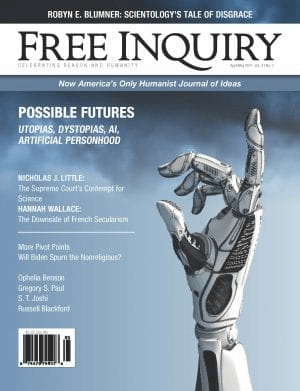
Long story short, I buckled down and finished the damn thing, and it’s now the cover story for the April-May 2021 issue of Free Inquiry magazine. It’s 11,300 words-and-change comparing and weighing two views of humanity’s future: transhumanism (we’ll all be saved and improved by technology) and “collapsitarianism” (we’ve blown it and civilization will crumble).
Why these two? Because I feel pulled toward both so strongly, despite their disparate outlooks. It’s the longest piece ever published by Free Inquiry (for which I am immensely grateful) and its editor, Tom Flynn, says it “just might be one of the most profound” (for which I am immensely humbled).
In this post, I offer an excerpt from the main article, its opening “chapter,” as it were. I do ask that you’ll take some time and read the whole thing. It’s been made free to non-subscribers of Free Inquiry, so you are welcome to simply click over, read it in your browser, or add it to whatever read-it-later service you prefer (but please do actually read it later, don’t let it just be another link you totally intend to get to someday).
It begins like this:
Not too long ago, humans believed that the stars determined their fate. Some still do. It was a belief born of naïveté, misunderstanding the nature of those diamonds in the night sky. But it was also a sign of our hubris, to presume that those lights in the firmament could have any interest in us.
Rather than feel controlled by them, we now understand that the stars are not gods or arbiters of fate but places we now aspire to explore. The knowledge of what stars actually are, and how insignificant we are in comparison to the vastness of the cosmos, has humbled us. And yet we are brash enough to speculate that one day we will be determining the destinies of stars, not the other way around.
Today it’s pretty hard to see those stars. Pollution from smog and the spillage of light from our cities obscures our view of the heavens. The haze through which we must squint to glimpse the constellations reminds us, or reminds me anyway, that humanity’s upward trajectory is not a destiny but a story. A wish.
I am torn. I am stubbornly attached to the idea that one day we’ll all be living on starships, exploring the cosmos free of hunger, disease, poverty, and tribalistic conflict. Looking around at the pace of technological advances today, it still feels possible. I want it to be true.
But one only has to consider the speed and breadth of humanity’s destructiveness to have those dreams thoroughly dashed. Whether we look to the exhausted vitality of the natural world or the buckling integrity of our modern, enlightened societies, we can no longer deny the obvious. The world we made is crumbling.
I dread a global, systemic collapse for my own selfish reasons, of course. As much as I sometimes crave the solace and remoteness of a more rustic, pastoral life, I know that when the shit hits the fan, I’ll be one of the first to die of starvation or disease or be murdered by wandering marauders. I’m very much attached to, and a person of, the current age.
I dread it for my children even more. While they’re growing up faster than I can replace their socks, I can’t quite escape the guilt I feel for even bringing them into being when things are so dicey for the civilization they will have to make their way in. I desperately want them to thrive, not merely struggle to survive in a world their parents couldn’t keep.
Vacillating between hope and despair, I have somewhat paradoxically found myself captivated by two starkly divergent lines of thought, two seemingly opposing prophecies about the fate of humanity that at different times have seemed to me equally persuasive. One camp posits that human civilization is ripe for collapse and that industry, governments, society, and much of the ecology that sustains us will soon run aground, leaving the remainder of our species to cope with a blighted aftermath. The other proposes that despite the enormous challenges before us, human ingenuity will find solutions through technology and biological enhancement, defeating not just climate change but perhaps even death itself. I deeply yearn for the latter to be true. I am anguished that the former is much more likely.
In a more hopeful time, I was drawn to the optimism of transhumanism, the PhD-riddled intellectual movement that once excited my Star Trek–saturated imagination with its often-rapturous predictions of a humanity augmented with unimaginably sophisticated technology.
More recently, however, I have leaned away from utopian thoughts and into a palpable despondency. I have since recognized this feeling for what it is: grief. I am grieving for the world I once believed existed and the future I know never will.
Just as I was beginning to acknowledge this grief, I discovered a movement known as Dark Mountain. Not a formal association or ideology, Dark Mountain is a sort of cultural banner under which those who await the fall can gather. For me, it has served as a way to process what has become increasingly obvious: collapse is coming.
And yet, all the while I have been holding onto the wish that we are mourning prematurely and that there is still something better coming.
We might very well be capable of transcending our biological and corporeal limits and achieving wonders not yet dreamed of. Or we might soon be forced to reckon with all we have wrought upon this world and then struggle to find some way to atone and survive.
Transhumanist utopianism and collapsitarian despair. They may appear fundamentally at odds, but I think what attracts me to them both is their implications of inevitability. Both presume their vision of the future is inescapable, and their adherents suggest we not waste energy fighting that future; we should instead start preparing ourselves for it. It is the overlap of “the end is nigh” and “resistance is futile.”
What I need right now is clarity. I need an honest appraisal of where we are and where we are headed. Maybe you need it too. Are we doomed? If so, let’s face that hard truth and decide what to do from there. Are we going to save ourselves? If so, how will we do it and at what cost?
In either case, collapse or transcendence, who and what will we be when we come out on the other side? To answer that, we probably have to figure out who we are right now.
This is about more than trying to guess how things will look a century from now. This is about what it means to be human and deciding whether that, in itself, matters at all.
It’s freezing. I can’t stop shivering. I’m in the middle of a snow-blighted wasteland, and everything is white, and it would be hard to tell day from night if not for the fact that night is much colder. My only source of heat is some threadbare clothing recently issued to me, that at least includes a hood. I’m exhausted, badly needing sleep, and starving, but carrying precious little food. There’s a school—my school, actually—that’s really not all that far off, but the last time I tried to take shelter there, a mob of criminals tried to kill me. I barely escaped with my life. I know they’re waiting for me back there. There is a world of other places I could go—safe places, warm places—but I am on foot in this blizzard, and I don’t think I would survive the walk.
It doesn’t help matters that we reptilians are especially sensitive to cold.
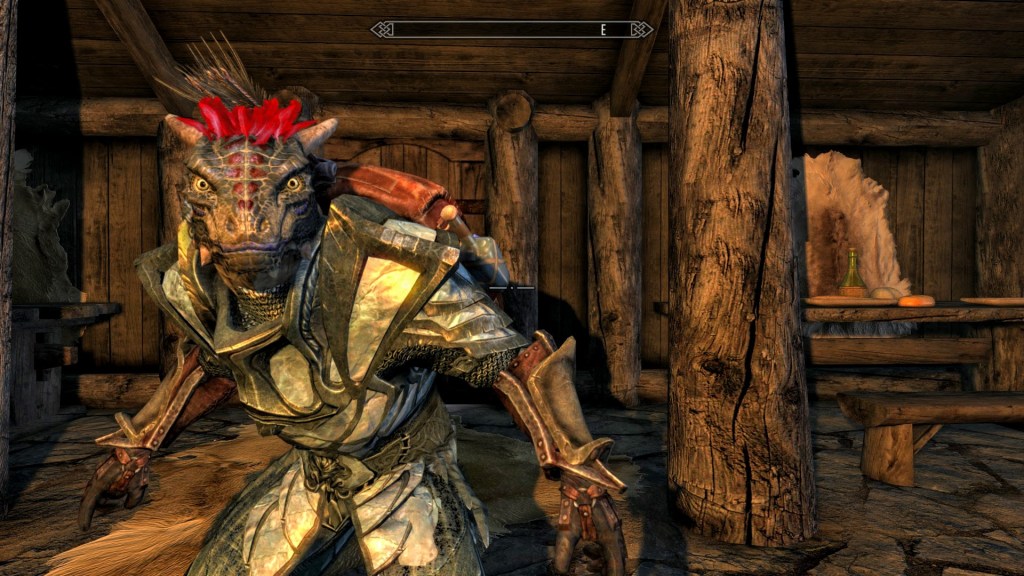
I’m obviously not describing real life, but a scenario from a video game. I’m playing The Elder Scrolls V: Skyrim, but with a twist: I’ve activated its official “survival mode,” which adds a slew of extra hinderances to the normal game experience. My character can not only be hurt by the usual melee blows, magic attacks, and dragon bites, but by much more banal forces: hunger, fatigue, and extreme temperatures. Skyrim’s survival mode requires one’s would-be dragonslaying adventurer to eat at regular intervals, keep cold and heat at bay, and sleep—in fact, leveling up actually requires getting shuteye.
Okay, fine, so you carry a lot of food, bundle up, and rest whenever you can. Except that survival mode also significantly reduces your character’s maximum carrying capacity, so inventory management becomes an even bigger headache than it normally is. And one can only sleep in specially designated places that are not owned by somebody else. You can’t just plop down on the ground and sleep, you have to find an inn or a friendly house or eventually learn how to craft camping supplies—supplies which, of course, have weight.
And honestly, one’s Skyrim character is supposed to be the Dragonborn, the prophesied savior of all Tamriel (the major continent and empire of the Elder Scrolls franchise). You’d think they’d be a little more, you know, hardy.
I am not usually a fan of survival type games; keeping myself alive seems difficult enough without having to worry about a fictional self. And I definitely don’t go out of my way to make difficult games even more difficult. But I have been playing so much Skyrim over the last year, and I kept finding myself to be too powerful, too easily defeating even the toughest enemies, sometimes to a laughable extent. (My sneaking abilities were apparently so refined that professional murderers couldn’t see me as I stood directly in front of them, turning their faces into pincushions for arrows fired point-blank. Dude, I‘m right here. I’m the guy stuffing you with arrows.)
Watching Twitch streamer LucindaTTV a few weeks ago (I’ve started streaming on Twitch myself, so you should come and follow me there), I heard her talk about playing the game on survival mode without any other character-enhancing modifications (or “mods”), and how she found it a very satisfying challenge. Well, I wasn’t prepared to abandon my favorite game (and favorite alternate reality), so I decided to give it a shot. I fired up a new Skyrim game, set it to its highest difficulty setting (“Legendary”), and clicked on survival mode.
And then, the freezing, the starving, and the getting killed over and over and over.
Here’s the thing, though. As maddening as it’s been, Lucinda was right. Having the game layered with these additional impediments has been oddly illuminating, and my victories—now much fewer and farther between—are all the sweeter. They are also usually by the skin of my teeth.
Along with the heightened difficulty of the game, survival mode also brings a heavy helping of tedium. I already mentioned the many frustrations of inventory and carrying-capacity management. But there’s also the raw consumption of real-world time taken up by simply going from point A to point B in the game, as, I think I forgot to mention, survival mode also disables “fast travel.” Normally, once the Dragonborn has visited a location, they can essentially teleport back there at any time. You want to start working on a quest based in far-eastern Windhelm, but you’re mucking about in Markarth in the west? No problem. As long as you’re outdoors, you just, as the Muppets put it, “travel by map.”
No more of that in survival mode. If you want to go from one major metropolis (or “hold”) to the other, you have to either walk or get a horse. There are some carriages and boats for hire in some places, but they are rare, and they don’t go everywhere. I started my game, like a genius, in a town called Winterhold, where there are no forms of transportation at all. And it’s always cold there. And I’m a lizard-person (or, in the game lore, an Argonian or a Saxhleel). Smart move, me.
This all means that there’s a good deal of planning that goes into every task you set out to complete. Let’s say the local jarl (sort of a duke or governor) wants me to go to such-and-such dungeon to fetch some artifact or other, which, successfully done, will see me rewarded with gold and maybe even a fancy title of nobility. Normally, you’d just stock up on your healing potions and head out. If you’ve already been to a location sort of near the destination, you zap yourself there and hoof it the rest of the way.
Not so now. In survival mode, you need to consider your current levels of fatigue, and decide whether to sleep first, and then take a guess at whether you might be able to find places to stop on the way to get more sleep and perhaps restock on food and supplies. How cold will it be? Maybe your best fighting gear isn’t sufficient to hold back the elements, but you can only carry so much, so you have to choose. Bring a wide variety of weapons? My heavy armor? A barrel’s worth of potions? If I own them, but can’t take them with me, there’s nowhere for me to store them in the meantime (at least until I’ve advanced enough to purchase property, but even then, it would all be stored in that location, which I’d have to travel back to the hard way in order to make any use of it.)
It’s like planning road trips for every time you play, charting out stops for food and overnight stays. Except you’re not driving. And you’re probably going to get killed by something called a Deathlord.
And I’m a lizard.
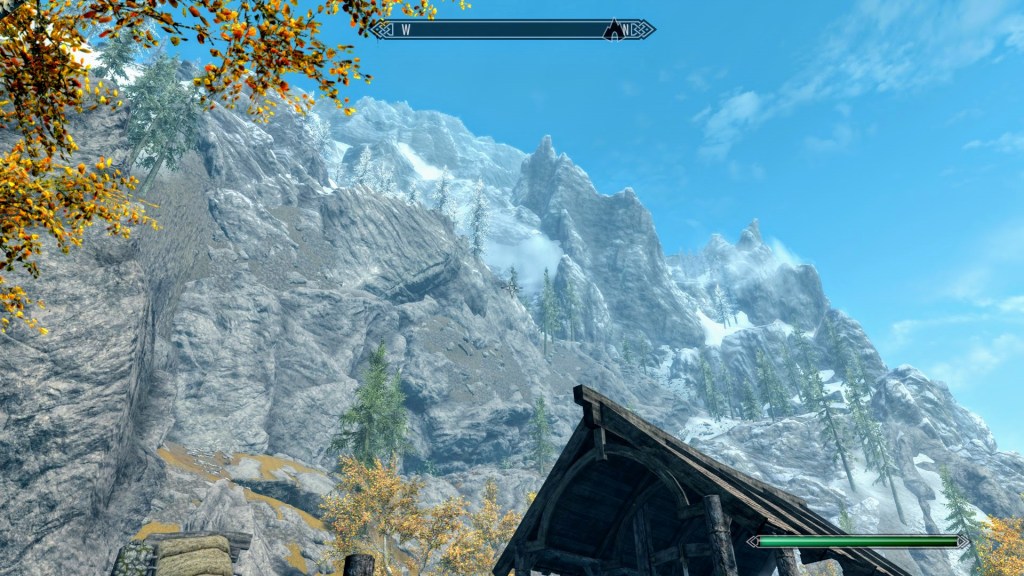
You want me to go…up there?
But because of the additional drudgery imposed by survival mode, I’ve found that I’ve done much more exploring than I had in previous games, when I was much more powerful and less apt to get killed. Indeed, forced foot travel in Skyrim necessitates exploration, trudging one’s way across vast expanses of a fantasy world that has been littered with surprises and mysteries, many I had missed when playing under normal circumstances. Very early in my survival mode playthrough, desperately trying to make my way to some kind of safe harbor in the blinding winter of Skyrim’s northeast, I happened upon a lighthouse I had no idea was there. It was pitch dark outside, and my character’s vision was blurred with exhaustion, hunger, and hypothermia. With my last ounce of strength, I made it to the door of the lighthouse and entered, delightedly warming up from the fireplace in the next room.
Seconds later, of course, I found that beside the hearth was a recently-murdered body splayed on the floor with an axe in its chest. Despite the clicking sound of nearby monsters that reminded me of A Quiet Place, my weary reptilian gratefully ate the food that had been strewn about the floor in the preceding struggle, and slept happily in the bed of the recently departed.
The discovery of the lighthouse of course kicked off an entire quest, a quest that I was utterly unable to make headway in because of all the limitations I’d placed on myself. So I had to abandon it halfway through, and once again cast myself out into the freezing cold to find the next oasis, and having no idea where it might be. (I had some idea, as I have played the game a lot, but as anyone who knows me will tell you, “direction” and “understanding my orientation in space” are not my strong suits.)
And I knew that at some point, lord help me, I’d have to come back. Ugh!
And I did! Much later, of course, when my character was strong enough to stand a chance against the enemies lurking in the tunnels beneath the lighthouse. But even then, it was crushingly difficult, requiring innumerable do-overs.
But even these seemingly impossible quests have been deeply satisfying, in that they have asked much more of me as a strategist. No more can I trust in my character’s durability to withstand an onslaught of enemies as I hack and slash my way to victory. These guys were killing me in one or two strokes. I couldn’t count on supernatural levels of stealth to save me; not only were enemies far more keen to my whereabouts, but because they could now take much more punishment on Legendary difficulty, I’d find myself constantly running out of arrows, my only projectile weapons. Skyrim became more and more similar to Metal Gear Solid and Bushido Blade…but in good ways, I mean.
In other words, I could no longer simply think, well, I’m at level X, and I have these weapons and spells, so can safely assume that I can fight my way though any quest. No, I’d have to take each chamber, each corridor, each corner as its own quest, every turn was a new battle that required new tactics, and always mitigated by my constantly-dwindling resources.
It sounds cliché to say it, but playing Skyrim on survival mode has helped me appreciate what’s required of all of us when we want to accomplish anything meaningful. We don’t have unlimited resources, we don’t have unlimited energy, and so we need to plan. We need to make difficult choices; choices about what we will keep and what we will leave behind; what we will dare to attempt, and what we must wait to pursue; what ideals we will hold fast to, and which ones we will have to abandon.
(I steal a lot more in this playthrough than I ever have before, and keep singing to myself “Gotta eat to live, gotta steal to eat…”)
I’m not entirely sure I’ll stick with survival mode for my entire playthrough as Luap-Keshu of the Black Marsh. Sometimes the tedium does overwhelm the fun, and the last thing I ever want is for my precious video game free time to feel like work. But then I find a new location I’d never known about, or overcome some challenge I never thought I could, and I think of how much more meaningful those victories are. And if my lizard-guy ever gets far enough to own a home, adopt a child, marry, earn a lordship or several—and maybe save the world—I’ll know that for each of those triumphs, he’ll have truly earned it.
A long time ago, I began to take a serious interest in music; that is, listening to it, singing along with it, and indulging in fantasies about being a musician. I was about 8 years old when Nickelodeon started running old episodes of The Monkees (a sitcom featuring a prefabricated band about the misadventures of a fictional version of said prefabricated band), and I just loved it. I didn’t own any Monkees records, and had no means of going and purchasing any, and it never really occurred to me that one could buy a Monkees record; I think I assumed they simply didn’t exist for some reason. I mean, I was 8.
So to satisfy this need, I took what was already at the time a gravely outdated cassette recorder, and when The Monkees aired on cable, I held the device up to the TV and hit record when a song played on the show. I did this over the course of a few episodes and soon had a decent collection of Monkees songs on my crappy little tape deck with a single mono speaker—not that this mattered, because of course I was recording from the TV’s speaker. I listened to it all the time.
When my dad realized I had been doing this, he said, “You know, we can buy you a Monkees tape.” That was really nice of him, but in my 8-year-old brain, it was kind of silly. I already had all the songs, dad!
I did eventually acquire The Monkees’ Greatest Hits on audio cassette, and I was very glad to have it. The songs were way longer on the album than on the TV show! The theme song even had a second verse! And there were a bunch of songs that weren’t even on the show! And wow, “Listen to the Band,” that one was weird!
While I also noticed that I could hear more of the instrumentation on the album than on my tape of TV audio, it wasn’t all that much different to me. I mean, it was still the same crummy old tape deck with the mono speaker. It didn’t seem crummy at all to me, as I had little to compare it to. So it was fine! When I eventually got other tapes—“Weird Al” Yankovic, the soundtracks to Ghostbusters and Transformers: The Movie, and so on—it was the same. I was just happy to have them.
I wasn’t done recording music straight from the TV, either. Over the next couple of years I would also start recording music from my video games (good lord did I love the music from Mega Man II), other kinds of music I was growing to like from MTV and VH1, and even sketches from Nick at Nite’s reruns of SCTV. These were the crappiest possible ways to get this kind of audio, but I didn’t know, and therefore didn’t care. I could now listen to those SCTV sketches over and over, memorizing them without intending to, and reenacting them on my own recordings. And I could listen to my Phil Collins and Genesis songs all I wanted, pulled right from the tinny sound coming out of the tiny TV set in my room.
At some point, I was given a portable cassette player (what I would call a Walkman, but of course wasn’t). I’d still listen to the same stuff, poorly recorded by me, totally unaware that “audio production” was a thing that mattered a lot to people who made and listened to music.
And yes, my family thought it was very weird. Especially the TV-recorded video game music. My grandfather couldn’t even fathom it. My dad summarily dismissed the music itself as “probably written by a computer.” Whatever, dad! You’ll never understand me!
As my music tastes matured, I started digging through my dad’s collection of tapes, most of which were themselves copies from vinyl LPs. Dad, himself a savant of a musician, had an extensive (and today, one would definitely say quality) record collection, and I began to avail myself of the stuff I thought I might be into. I already knew I liked the Beatles—every car ride with few exceptions was an extended Beatles session—but I had never really listened to them on my own. They were a good place to start.
At some point I had also gotten a better tape deck, one that actually had two speakers for stereo. I had no idea what difference that made because, again, most of what I was listening to was recorded from the TV speaker and into a tape deck’s built-in microphone. Also, I think around this time the “Walkman” had probably stopped working. One evening, I decided to listen to a Beatles tape—a real “dub” from a real record—through a set of cheap earbud headphones plugged into the tape deck. I don’t remember which album, but I would guess it was one that had some collection of songs I already knew; “Eight Days a Week” rings a bell, so it may have been Beatles for Sale, but so does and “Drive My Car” and “Nowhere Man,” so maybe it was Rubber Soul. But it could also just have been a mix.
I was probably 10 years old, and I still remember the sensation of hearing different instruments and different voices seeming to come from different locations around my ears. The boys sounded like they were singing into one ear, and the drums and guitar sounded like they were coming into the other ear! It wasn’t all just a mush of sounds. It was like a tapestry. Or a stage play, where you see every actor, every prop, every set piece. It was utterly transporting.
(Apparently, I was also singing along and doing a poor job of harmonizing, as my little brother would later complain, “You sounded terrible.”)
I was certainly going to raid my dad’s collection for more music. And I wasn’t going back to sounds recorded from a TV speaker.
This is not the origin story of an audiophile. But by my late twenties and early thirties, when I had a real job and enjoyed a living wage, I did begin to care much more about maximizing the quality of the means by which my ears received the air vibrations of music. I had several agonizing crises over what headphones to buy, which only became more fraught when I’d go into a store and sample headphones well outside my price range. Holy shit, I didn’t know music could sound this good!!! Every uptick in audio quality I experienced spoiled whatever I had previously enjoyed. Hell, just knowing that there were better things out there made it difficult to be happy with whatever I had.
This comes up in countless other ways. When Apple introduced “Retina displays” with the iPhone 4, screens with sufficiently high resolution that individual pixels became indistinguishable in normal use, it ruined me for all other displays. Reading text on a non-Retina screen, something I had been doing for some thirty years without complaint or problem, now felt like having my eyeballs scraped by jagged text.
At least that came from actual lived experience, wherein a demonstrably superior execution of a particular kind of product makes previous iterations look worse, because they are, in fact, worse. But I also bought the iPhone 12 when it came out while I already owned an iPhone 11. Why? Did I have direct experience with the new model, and thereby knew that my current phone was now teetering on obsolescence? Of course not. It was just new, it looked a little cooler, and the marketing all said it was better. You will not be surprised to know that a few months into owning the iPhone 12, it has not provided me a meaningfully better smartphone experience than the iPhone 11. Nor whatever phone I owned before that. But just being aware of new things, by comparing what I have to what might be, often convinces me, with great conviction, that I must acquire it. I had been fine before. The curse of new knowledge, however, robbed me of that contentment. Or, more accurately, I let it myself be robbed. I invited the burglar in and offered him a sandwich.
I recently bought a new laptop. Or, rather, I should say I recently bought three laptops, because the first two, since returned, had flaws on their displays. Since this was intended for gaming, I had made peace with needing to settle for an eye-scratching, non-Retina display, something years of Macs, iPhones, iPads, and Galaxies had ruined me for.
But the first laptop had what seemed to me to be a lot of what is called IPS glow, the light haze around the borders of the screen. This is apparently fairly normal for these kinds of machines, but I had now been conditioned by Retina displays and quad-HD OLEDs, so it seemed unacceptable. The next laptop had a slight blemish of light bleed in the center of the display (I think that one was a reasonable rejection). The last one, the one I’m using now to type this, was just fine. More expensive, of course. It does have a tiny bit of light bleed at the very bottom corner, but I am trying to be okay with it.
This will seem like a divergence, but it’s not. I have spent a lot less time on social media in the last few weeks. Like many folks, this is in part because the world seems less on fire than it did a few weeks ago, and doomscrolling the news feels less necessary. It never was necessary, of course.
Apart from lowering my overall anxiety levels about the state of civilization (which, for the record, remain high), social media distancing has also made me feel less compelled to produce. Longtime readers of mine (all six of you) will know that I am gripped by a feeling of obligation to make myself relevant through my creative work, be it my writing, music, or other endeavors. I often feel that in order to justify my existence, in order to atone for all the things I never accomplished when I was younger, and in order to feel that I have somehow mattered, I must Become Known and cross some threshold of relevance and significance.
In recent weeks, though, I have felt this pang much less sharply than usual. It could merely be the fact that I feel very wrapped up in my gaming, which is a new thing for me. It could also have something to do with the changing political reality.
But I think that it’s mainly because I’m looking at Twitter way less.
Think back to the beginning of the pandemic. Suddenly everyone (it seemed) was part of this renaissance-of-the-remote, people writing novels and cooking and painting and performing and streaming and Tik-Tokking, and I’d be damned if I was going to be left in the creative dust. I started a newsletter. I revived my blog. I recorded some music. I made videos. I was going to matter.
I felt like I had to matter. It was a kind of race, one I had already been losing, when suddenly a lot more runners appeared on the track. Hey! Slow down up there! I was trying to matter first!
I was comparing myself and my output to what I saw from social media. But of course, what I see on social media will always tend to be stuff from those who have already broken through. Of course I was seeing things from people who were already in a position to create. Of course I would see things from people who already had the freedom to churn out content.
Yet I compared. I compared and found myself lacking. And as Dogberry says in Much Ado about Nothing, “Comparisons are odorous.”
When I was listening to the Monkees on my old mono tape deck from sounds recorded from a cable TV rerun, I had no idea what I was missing. Comparing my tapes to the stereo sounds of a professionally produced album out of actual headphones, I learned there was a deeper, more meaningful experience of music to be had. It was good that I compared one to the other. But I was also happy before.
Just because something is better (in fact or in perception) doesn’t make it necessary. And it definitely doesn’t make it necessarily good for me. Or you, I bet.
As an awkward, neurotic, bespectacled smartypants, one might stereotypically presume that I am a fan of superheroes. And so I am! But only fairly recently.
When I was a kid, I liked the cartoons and toys associated with characters like Spider-Man and Superman, but no more than I liked any other inescapable franchise at the time. My prime action figure playing years were much more focused on Transformers, He-Man, Ghostbusters, and, just as I was becoming a little too old for such things, Teenage Mutant Ninja Turtles. Once I had grown out of toys, the Star Trek universe became my obsession. Superheroes didn’t capture my imagination the way they have for so many other kids who later go on to become true fans and indulge in superhero geekdom.
I think part of the reason is their roots in comic books, and when I say “comic books,” I mean the byzantine lattice of comic book culture and lore; the dizzying array of characters, story threads, reboots, crossovers, and timelines. Whenever I would dip my toes into a given title, I would inevitably run into that asterisk in some panel, in which a major piece of information would be hinted at in a character’s passing comment, only to be directed to a footnote telling me, “SEE [COMPLETELY DIFFERENT SERIES] #657!” Well, I haven’t seen whats-its-whatever issue 657, so I guess I’m just going to be lost.
Despite my compulsion for completionism, I’m now mostly at peace with that aspect of superhero comics (mostly). My latter-day enthusiasm for superheroes, along with some help from digital comic book all-you-can-eat subscription services, have made it so that I can now dive into comics with a much reduced sense of cultural intimidation.
I think the other reason I didn’t take to superheroes earlier was that they often seemed to me to be sort of dopey. This is no doubt in large part because my first frames of reference were shows like Spider-Man and His Amazing Friends and Super Friends, which were really, really dopey. As I grew up, the idea that folks with superpowers would dress up in colorful, tight-fitting costumes, beat up bank robbers, and fight evil clowns and superintelligent gorillas just seemed kind of silly. Superheroes seemed like a form of escapism that was dated and irrelevant. Star Trek, by contrast, was all about the future and what we might be capable of in the coming centuries (and was also sometimes dopey, but different-dopey). Superheroes were essentially cops with absurd outfits who could fly or punch really hard.
Now I’m in my 40s, and I absolutely love superheroes. What happened?
I suppose like a lot of people, I got bitten by the radioactive superhero bug in large part due to the Marvel Cinematic Universe films of the past decade-plus, as well as the Christopher Nolan Dark Knight films. Previously, a lot of superhero shows and films I’d seen could sort of be summed up with a pretty basic template: Regular person becomes endowed with powers, an evil force threatens the status quo, hero fights this evil by using their superpowers.
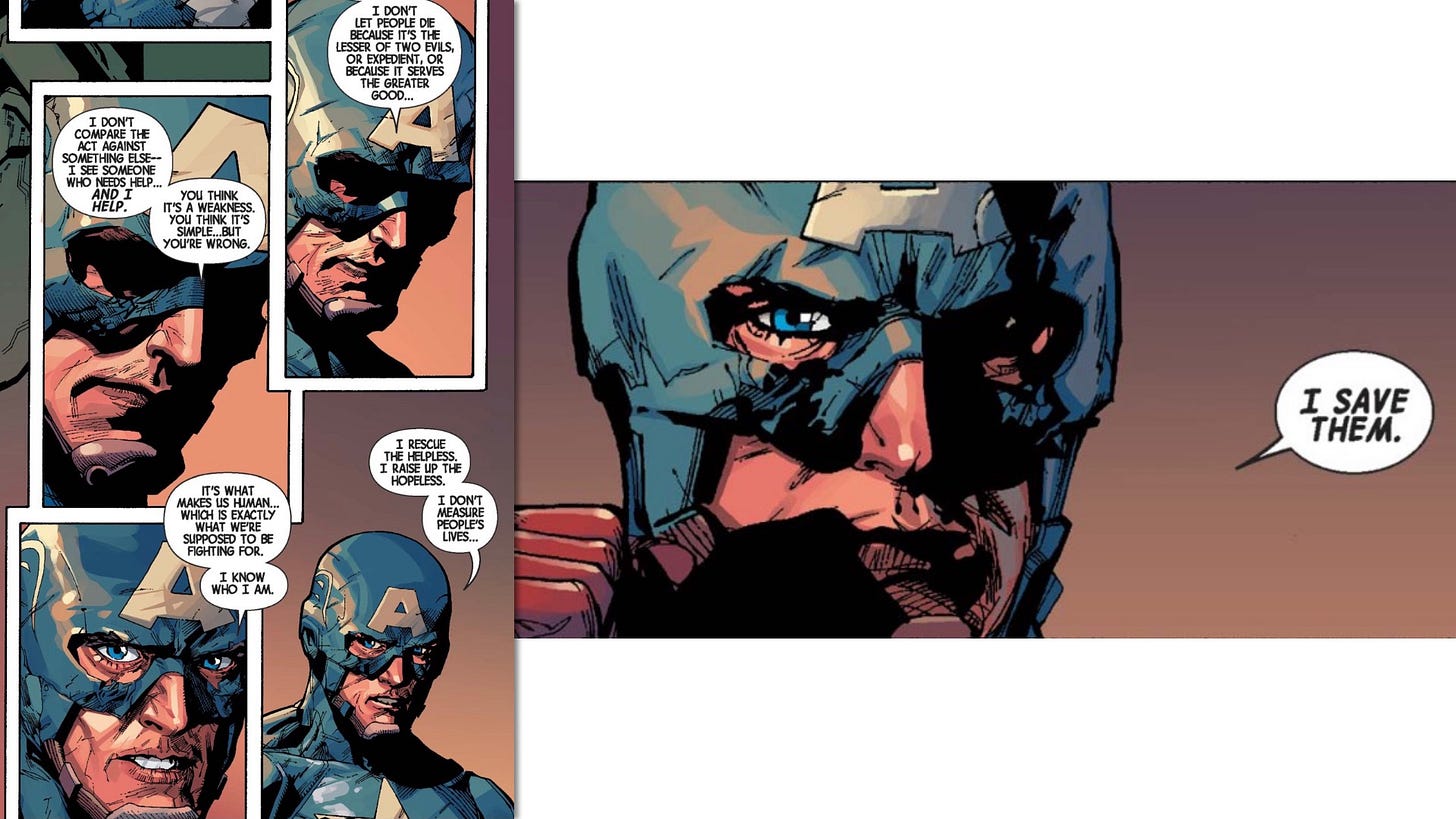
The Marvel and Dark Knight movies, however, gave me more to chew on. Tony Stark, Bruce Wayne, and Steve Rogers were never just fighting an evil nemesis. They were also struggling with themselves and with a society that either created them, marginalized them, created their enemies, or any combination thereof.
Steve Rogers didn’t get his powers by accident of birth or extraordinary circumstances, and he wasn’t worthy of becoming Captain America because he was the best soldier. He was a superhero because he was a good man, the guy who was most willing to give every ounce of himself to save others. Tony Stark was forced to contend with his destructive legacy as a plundering industrialist, as well as his mammoth ego. Bruce Wayne was consumed by his own darkness, and struggled to harness his inner demons so that he could stop outer demons from bringing darkness to others.
And these were just the first handful of those movies. Mostly, they kept getting better.
These stories had a different kind of template, something like this: Protagonist witnesses unacceptable injustices or perceives a grave threat. They discover the possibility of having extraordinary powers, but must then become worthy of those powers through some struggle with themselves or other malign force, and then give everything of themselves—including, if necessary, their lives—in order to right that injustice or defeat that threat. And often victory raises new questions and perhaps creates new problems.
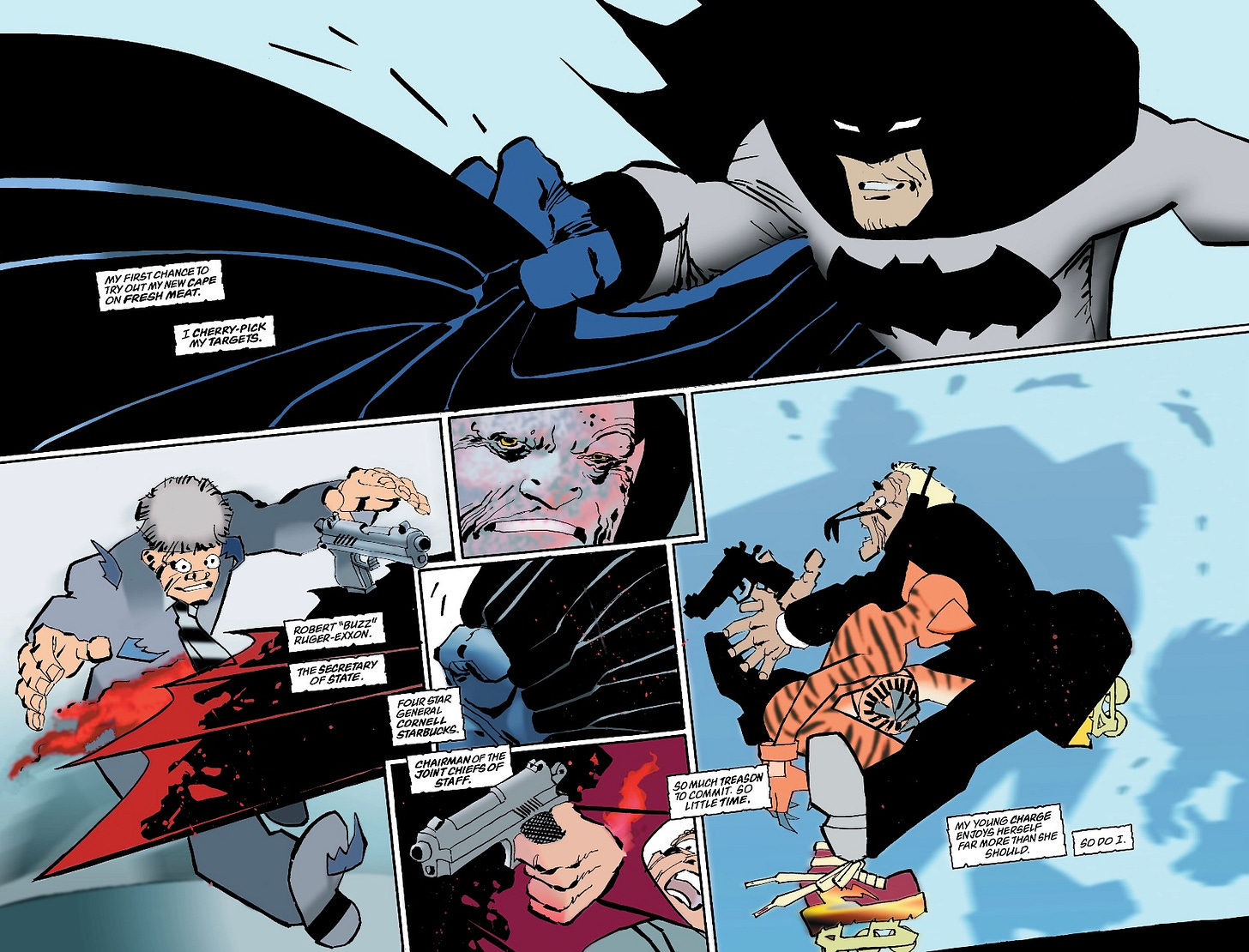
The Nolan Dark Knight films, and the Frank Miller graphic novels that inspired them, are a little different, in that they tell a story of a world so terrible that it creates ever-more terrible villains, which then requires a response from heroes that must become ever-more terrible themselves. But the struggle of those heroes is still central to the story and, for me, their appeal. And even the Avengers films acknowledge the arms-race dynamic of increasingly existential dangers requiring ever more extreme reactions from the good guys, which, as Vision says in Captain America: Civil War, “invites challenge” from even more powerful villains, and the ensuing conflict “breeds catastrophe.”
At the core, I suppose, is that courage—that of the hero and perhaps others in the story—must be cultivated and achieved. It isn’t presumed. And that is something that moves me at a very deep level.
Because of course the central problem for a good superhero story is how to offer a superpowered person a genuine challenge. An almost all-powerful being like Kal-El (Superman) isn’t courageous because he saves the passengers on a runaway train about to fall into an abyss. He knows he’ll be fine whether he carries the train to safety or lays down to have his body serve as the track. He needs to have adversaries thrown at him that equal and exceed him in strength (Zod, Doomsday, etc.), and he needs to be faced with enemies that can’t be defeated with brute force: finding purpose, finding belonging among an alien species, grieving the loss of a family and a world he never got the chance to know, using his powers responsibly, balancing freedom and security, and so on.
While I am very much delighted by a good old fashioned Superman vs. Zod smackdown, I’m captivated by the choices Superman will have to make in order to defeat Zod and protect the world he’s adopted without becoming Zod himself.
You can apply this across the board of superhero stories. It works for “street-level” heroes like Bruce Wayne (Batman), Kamala Khan (Ms. Marvel), Matt Murdock (Daredevil), or Oliver Queen (Green Arrow), and it works for more “cosmic” heroes like Thor, Carol Danvers (Captain Marvel), or Diana of Themyscira (Wonder Woman). What are they willing to do to defeat evil-doers? Are they willing to do evil themselves? What and who are they willing to sacrifice? Their extraordinary abilities are a given, the status quo of the world of the story. The power of their stories is not only what they choose to do with those powers, but how they arrive at those decisions; what must they give of their own lives, their beliefs, their souls?
Alright, well, this is all very highfalutin and whatnot, but my enthusiasm for superhero stories has another equally important factor: Fantasy escapism.
You don’t need me to tell you how the world is going to hell right now, and that our assumptions about what is good and what is evil have been muddied. Our illusions about who and what we can trust have been shattered. For all the struggles with moral ambiguity in good superhero storytelling, it’s no wonder that I find it incredibly appealing that, at the very least, choices are made and executed on. Whereas in the real world, it feels like all we can do is tread moral waters and examine our failures into infinity, but superheroes eventually make a choice and act on it.
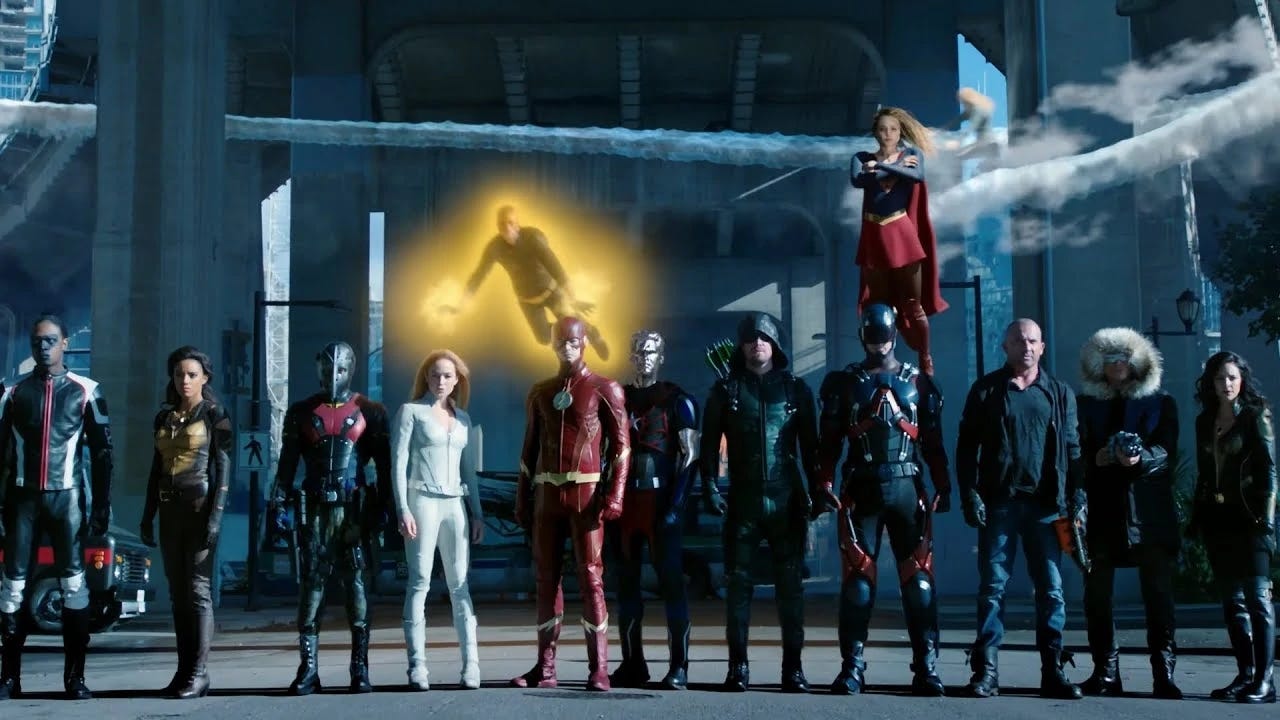
If done well, they do so with awe-inspiring spectacle, suspense, wit, and heart. I have been delighting in the full lineup of CW’s DC “Arrowverse” superhero series, from the faux-gritty Arrow to the more explicitly-comedic Legends of Tomorrow (working my way up to the big “Crisis on Infinite Earths” crossover event), and part of their appeal for me is that they are a little, well, dopey. But whereas the superhero cartoons of my childhood were dopey in the sense of being shoddy products, the DC shows embrace their campiness.
They are not satire by any means. They are not mocking the genre, but embracing its quirks. When something outlandish happens (Felicity Smoak’s paralysis is technologically cured in the middle of a couple’s spat with Oliver Queen! Barry Allen altered everyone’s lives when he time-traveled too much! Former supervillain Mick Rory became best friends with George Washington!), the event is acknowledged as outlandish, and then promptly folded into the story and taken as seriously as anything else. And it works.
And I also think part of why these shows work for me is that they operate more or less like comic books. Each scene feels like a page of panels, and any rush-through of complicated plot points feels justified by the succinctness demanded by the format. And like the comic books, they come with complicated backstories and lore that enriches the experience for those who are immersed in it, but doesn’t totally alienate those who are tuning in for the first time. Of course, I am making a point of going through the entire “Arrowverse,” episode by episode, because I’m just like that.
I guess what it all comes down to is this: In a time when things feel so dark, I’m glad I’ve made the choice to spend time with stories in which people with extraordinary powers or abilities make the choice to use those abilities for something other than personal gain. They choose to save the world.
Sunlight is the best disinfectant, so they say. Wicked deeds and ideas can be defeated by offering them up to public scrutiny, exposing them as morally unacceptable and shaming them out of the mainstream and out of power.
There are times when this has been true, when the public has been exposed to some gross injustice, rejected it, and appealed to authorities to make a change.
Cable news and social media are fueled by these kinds of appeals. During the Obama years, I had to stop watching cable news because I could no longer stomach the hours of broadcast dedicated to telling me how racism, religious zealotry, and plutocratic criminality were taking over the country. To save my own sanity during the Trump era, I tried to prune my social media feeds of accounts that shared primarily political content, because nearly everything I saw was dedicated to making me angry about every single morally repugnant whim expressed by malicious actors. And it was all terrible and morally repugnant!
But my attempts to lessen the amount of political outrage in my feed were futile, for in the era of Trump, it feels like it’s all there was to talk about. I began the (also futile) practice of replying to or quoting tweets about the latest horror by appending, “So what do we do?” I wanted more than tattling. I wanted marching orders. They never came.
Because it’s not just regular folks tweeting out their outrage. It’s politicians, prominent media personalities, major cultural figures, renowned academics—people in positions of real, genuine power. If all they could do was point to bad things happening to say, “You see???” then what were we of the unwashed masses supposed to do about it?
Other than vote. I get it. And we did, and it mostly worked out for the better, but it wasn’t nearly enough. And the horrors will, and do, just continue. And we will continue to go “you see???“
But who are we talking to when we do that? Every time we stoke our collective ire and give attention to the genuinely destructive torrent of moral and ethical horrors, whether they come from presidents, media figures, local politicians, or everyday despicable people, we are pointing it out for a reason. We are asking for someone to do something about it.
We are aggrieved customers in the marketplace of ideas, and we are demanding to speak to the manager. We are all Karens now.
Here’s the problem I think most of us have yet to acknowledge: There is no manager. Our emails to customer support are bouncing back. We are dialing a complaint hotline to nowhere.
There are elections, of course, in which the customers can, in effect, hire and fire the managers of the store’s government and policy department, but this has little to no impact on the store’s other aisles. The racism section is still being stocked, the science-denial section is getting novel new products in every day, and the theocracy department just opened up an outlet store. Business is booming.
It doesn’t matter how much we complain about what are objectively abysmal things being done and the abysmal people doing them. Those managers don’t hear our complaints because we’re not their customers.
One such abysmal human with abysmal ideas is Jordan Peterson, and you may have heard that employees at Penguin Press are disgusted that they are publishing Peterson’s latest book, as I would be if I worked there. Fredrik deBoer, whose post on this subject helped clarify my thinking for this piece, says this is an example of a poor tactic on the part of progressives: appealing to authorities to protect them from people with harmful ideas:
What if there is no authority to which you can appeal to make Jordan Peterson go away? What if Jordan Peterson is a fact of life? Let’s set aside God for a moment. What is the authority that could shut Peterson up? A Canadian citizen with tenure, a large network of conservative admirers, the ability to broadcast directly to his fans, and a talent for encoding reactionary ideas without the out-and-out hateful trappings of many of his contemporaries, he simply does not strike me as someone you can silence even if you wanted to.
Now, that doesn’t change the fact that Penguin Press could make the moral choice not to be part of the machinery that helps Peterson spread and profit off of his message, even knowing that someone else will gladly do it instead. But the larger point holds: Peterson will get his captive audience regardless of any complaints to the manager.
DeBoer says the only real solution to the problem of Peterson and what he represents is to persuade people he’s wrong and make a convincing case for something better. “I get that this is more complicated, and less emotionally fulfilling, than running to the teacher to get him in trouble,” writes deBoer. “But what’s the alternative? … There is no authority which will simply remove Jordan Peterson from public life for you.”
For public officeholders, usually the best we can do is to know who we’re dealing with and vote accordingly. But at some point we have to acknowledge that all the things that horrify us about politicians like Trump, Louie Gohmert, Ted Cruz, Ron DeSantis, Matt Gaetz, or any other garbage officeholders and candidates, are the very things that give them their power. For their market, their vileness is their primary selling feature. Pointing it out over and over mostly serves as free advertising.
Instead, we have to be better. We have to build movements, support candidates, make arguments, develop ideas, and produce media that are better than theirs. We have to be more than aggrieved, we must be active. We must do more than point out the bad things, we must, ourselves, be the sources of good things.





 Near-Earth Object