You really have to watch this video of this mystical guy who really seems to know things he could not possibly know about the people he’s giving readings to. Watch to the end to have your mind blown.
http://www.youtube.com/watch?feature=player_embedded&v=F7pYHN9iC9I
Tag: science
-
It Apparently Doesn’t Take a Psychic
-
Near-Earth Object, Too Close for Comfort
From the NYT report on the Siberia meteor:
“I opened the window from surprise — there was such heat coming in, as if it were summer in the yard, and then I watched as the flash flew by and turned into a dot somewhere over the forest,” wrote Darya Frenn, a blogger. “And in several seconds there was an explosion of such force that the window flew in along with its frame, the monitor fell, and everything that was on the desk.”
“God forbid you should ever have to experience anything like this,” she wrote.
[ . . . ]
Valentina Nikolayeva, a teacher in Chelyabinsk, described it as “an unreal light” that filled all the classrooms on one side of School No. 15.
“It was a light which never happens in life, it happens probably only in the end of the world,” she said in a clip posted on a news portal, LifeNews.ru. She said she saw a vapor trail, like one that appears after an airplane, only dozens of times bigger. “The light was coming from there. Then the light went out and the trail began to change. The changes were taking place within it, like in the clouds, because of the wind. It began to shrink and then, a minute later, an explosion.”
“A shock wave,” she said. “It was not clear what it was but we were deafened at that moment. The window glass flew.”
I can’t imagine witnessing something like this. If I had seen this with my own eyes where I live, particularly when I was living in DC, I believe I would have immediately assumed it was a weapon, that we were being attacked, that we may be about to die.
I almost can’t believe there wasn’t total panic in Chelyabinsk. Those Russians are made of stern stuff.
-
Is Not the Truth the Truth? – Galileo as Falstaff
Go ahead and let this passage from a wonderful piece on Galileo by Adam Gropnik in The New Yorker blow your mind.
What would Shakespeare’s Galileo have been, one wonders, had he ever written him? Well, in a sense, he had written him, as Falstaff, the man of appetite and wit who sees through the game of honor and fidelity. Galileo’s myth is not unlike the fat knight’s, the story of a medieval ethic of courage and honor supplanted by the modern one of cunning, wit, and self-knowledge. Martyrdom is the test of faith, but the test of truth is truth. Once the book was published, who cared what transparent lies you had to tell to save your life? The best reason we have to believe in miracles is the miracle that people are prepared to die for them. But the best reason that we have to believe in the moons of Jupiter is that no one has to be prepared to die for them in order for them to be real.
Indeed:
What is honour? a word. What is in that word honour? what is that honour? air.
-
Deep Riffs: Bussard Collector
A song of mine from 2006 that’s ostensibly about a plausible spaceship, but really about caring a whole lot about something bigger than yourself.
BONUS: This song, though having a sci-fi bent, does not sound like filk. If you don’t know what filk is, just trust me, you’re welcome.
Appears on my album Evidence of Absence.
-
A Rap for Euparkeria
 It can’t be helped. When you have a household with a 3-year-old obsessed with dinosaurs and a daddy with a weird sense of humor and desperate need for validation, silly songs emerge.
A late addition to Toby’s Netflix repertoire is Walking with Monsters, a Branagh-narrated spinoff of Walking with Dinosaurs that features pre-dinosaur creatures in a faux-documentary.As noted in an earlier post, the original show led to my little ditty about Eustreptospondylus. Well, now we have a protodinosaurian rhyme. It’s a rap of sorts for the Euparkeria (pronounced “you-par-care-ee-uh”), a small-ish reptile with particularly-shaped hip bones that allowed it to go bipedal with great agility when necessary, and served as an evolutionary foundation for the dinosaurs. Or so says Kenneth Branagh.
The rhyme is done in a style reminiscent of “Rapper’s Delight,” with a meter similar to Strong Bad’s “fhqwhgads.”
I bring you “Euparkeria.”
Eu! Par! Ker-i-a!
He’s gonna catch a dragonfly
Eu! Par! Ker-i-a
YOU are my fav-o-rite guy!
(Come on now)
Eu! Par! Ker-i-a
He dunna need to go on all fours
Eu! Par! Ker-i-a
Ancestor to the dinosaurs!Toby was loving the first two lines, and was hopping up and down on the couch this morning reciting it. The addition of the second two lines, however, seemed to greatly upset him at first, for some reason inducing a toddler spinal-fluctuation tantrum. But he’s come around on it.
-
Internet Comments vs. Knowledge
Apparently, I’m not the only one who doesn’t like Internet comment sections. Neither does science. From the Milwaukee Journal-Sentinel:
In an experiment . . . about 2,000 people were asked to read a balanced news report about nanotechnology followed by a group of invented comments. All saw the same report but some read a group of comments that were uncivil, including name-calling. Others saw more civil comments.
“Disturbingly, readers’ interpretations of potential risks associated with the technology described in the news article differed significantly depending only on the tone of the manipulated reader comments posted with the story,” wrote authors Dominique Brossard and Dietram A. Scheufele.
And as though to echo the previous post’s title, “Comments. Boy, I Don’t Know”:
“I hope you’re not going to ask me, ‘What should we do?’” she said, laughing. “Because I don’t know.”
I think I do. Don’t have comments sections.
-
A Song for Eustreptospondylus

You know what dinosaur has a musical sounding name? Eustreptospondylus. Just say it out loud. I mean, if you can. It's pronounced “you strepped a SPON dull us,” which, coincidentally, is also how you say “My hovercraft is full of eels” in Hungarian.
My boy Toby, who just turned 3 last week, is obsessed with dinosaurs. Not like, he's really into dinosaurs, I mean obsessed. He plays exclusively with dinosaur toys, and these dinosaurs not only fight each other (or, as Toby, says, “dey're fighting to-gedder!”), but they have entire social lives with each other. Usually this means they visit each other's houses to watch movies and eat hot dogs (the herbivores, too), and when one of them gets too aggressive, well that's it, they get a time out. When we play outside, we pretend to be dinosaurs (lately we're Allosauruses a lot, and sometimes we use our jackets as wings to be Quetzaoatluses, which I know, aren't actually dinosaurs), and when we had his birthday party with all the relatives, every time I'd present him with a new gift to unwrap, he'd look at me with a mad kind of sparkle in his eye and ask, “Is it dinosaurs?”
So he really likes them. He watches the cartoon Dinosaur Train a lot (we don't have cable, so we do Netflix on the Apple TV), and now he's completely invested in repeated viewings of the BBC faux documentary series Walking with Dinosaurs (and its various offshoots), narrated by Kenneth Branaugh. Toby even loves Branaugh's voice, and repeats much of the narration in a baritone English accent, which you have ot hear to believe.
One of the dinosaurs profiled ever so briefly on Walking with Dinosaurs (or, as Toby believes it to be called, Rarring with Dinosaurs) is, you guessed it, Eustreptospondylus. And something about that word spoken in Kenneth Branaugh's sincere-yet-grave voice gave it, to my ear, a kind of classical meter, and I couldn't help but presume it was one of those dinosaur names that Mr. Branaugh probably had to work on a bit before he could say it without laughing (like my other favorite that he says, “Muttaburrasaurus”).
And long story made a little less long, Eustreptospondylus sounded like it shoud be in a song. So I started singing this around the house, much to the dismay of all who share this home with me.
To the tune of “Ta-Ra-Ra-Boom-De-Ay”:
Eustreptospondylus!
He's such a blunderbuss
Hope he don't fondle us!
Eustreptospondylus
Eustreptospondylus
Suffers from wanderlust
So he rides gondalas
Eustreptospondylus!
I hope this little ditty infects your brain as it has the one from which it first spawned. You're welcome!
-
Best Newspaper Correction in the Universe
From the New York Times on the declining birthrate of stars:
An earlier version of this article misstated the sound made by a black hole in the galaxy NGC 1275. It is that of a B flat 57 octaves below middle C, not 27.
-
Science Can Be Even More Awesome When Everything is Wrong
The IceCube Neutrino Observatory just figured out that gamma bursts have nothing to do with cosmic rays, and that means no one knows where they come from. Via io9:
…the telescope was able to conclusively contradict 15 years worth of previous predictions while still under construction, and now it’s pretty much demolished one of the leading theories of extra-galactic physics. Really, all the IceCube data serve as a good reminder of how much science relies on disappointing non-results just as much as major breakthroughs – without the former to show the limits of our current understanding, we’d risk finding ourselves awash in a sea of indistinguishable false positives.
Oh snap! Science was wrong! How do we fix it?
That’s right. More science.
And I didn’t even have to use my AK.
-
The Age of Wonder: Science as a Means to Emancipation
 Richard Holmes’ 2009 tome is aptly titled. It’s a wonder, and it takes an age to read it. Right. I wanted to get that out of the way, as the fact of its lengthiness weighs on me as I consider penning a reaction to its substance. It feels really long.
But, as with many efforts, it is worth it. The Age of Wonder is an exhaustive chronicle of the Romantic era of science — indeed, the dawn of the very term. It focuses primarily on a small cluster of main “characters,” beginning with the intrepid Joseph Banks (and his utterly fascinating adventures in Tahiti) all the way through the Herschel lineage (William, his sister Caroline, and William’s son John) — and just before Charles Darwin takes his voyage on the Beagle. It is a tale of presumptions shattered, egos inflated and exploded, and orthodoxies forever upended — and not just those of stodgy religionists, but of even the most open-minded of explorers and philosophers. As Humphrey Davy, perhaps the most prominent of Holmes’ subjects, said, “The first step towards the attainment of real discovery was the humiliating confession of ignorance.” There is a lot of that documented here.
Perhaps the most prominent theme throughout the book, with all of its detailed (often to a fault) recountings of experiments, arguments, and internal struggles, is that of the development of a professional discipline whose aim is more than the sum of its parts. What would eventually be known as science would become a practice not simply of confirming or denying the veracity of hypotheses, but it would perhaps be the one great force that ushers humanity beyond its terrestrial and provincial understanding of itself. Holmes summarizes the thinking of Samuel Taylor Coleridge on this subject:
… Coleridge was defending the intellectual discipline of science as a force for clarity and good. He then added one of his most inspired perceptions. He thought that science, as a human activity, ‘being necessarily performed with the passion of Hope, it was poetical’. Science, like poetry, was not merely ‘progressive’. It directed a particular kind of moral energy and imaginative longing into the future. It enshrined the implicit belief that mankind could achieve a better, happier world.
This was not so simple, of course. Even the previously noted Davy faced his own crisis on conscience as reason as a force behind a moral, and not just practical, philosophy challenged even the least superstitious of minds. In 1828 Davy wrote,
The art of living happy is, I believe, the art of being agreeably deluded; and faith in all things is superior to Reason, which, after all, is but a dead weight in advanced life, though as the pendulum to the clock in youth.
But “living happy” is not the same as living well, not the same as progress, not the same as advancing overall well-being.
There were those of this time who began to see something more than a happy illusion being stripped away, but rather a means to liberation of the species, a new reigniting of the the Enlightenment’s flame. Holmes offers the words of Percy Shelley as the technology of ballooning had become the center of international awe and controversy.
Yet it ought not to be altogether condemned. It promises prodigious faculties for locomotion, and will allow us to traverse vast tracts with ease and rapidity, and to explore unknown countries without difficulty. Why are we so ignorant of the interior of Africa? — Why do we not despatch intrepid aeronauts to cross it in every direction, and to survey the whole peninsula in a few weeks? The shadow of the first balloon, which a vertical sun would project precisely underneath it, as it glided over that hitherto unhappy country, would virtually emancipate every slave, and would annihilate slavery forever.
This did not happen literally, of course, but it reminds us that within genuine understanding of all things lies the potential to transcend them.
Side note:
Also rife within The Age of Wonder are examples of the seemingly timeless wars between religion and science, and science’s struggle to be seen as something other than raw atheism. Holmes tells of the profession’s coming to terms, as it were, with its own moniker, and the old demons are ever-present:
There was no general term by which these gentlemen could describe themselves with reference to their pursuits.
‘Philosophers’ was felt to be too wide and lofty a term, and was very properly forbidden them by Mr. Coleridge, both in his capacity as philologer and metaphysician. ‘Savans’ was rather assuming and besides too French; but some ingenious gentleman [in fact Whewell himself] proposed that, by analogy with ‘artist’, they might form ‘scientist’ — and added that there could be no scruple to this term since we already have such words as ‘economist’ and ‘atheist’ — but this was not generally palatable.The analogy with ‘atheist’ was of course fatal. Adam Sedgwick exploded: ‘Better die of this want [of a term] than bestialize our tongue by such a barbarism.’ But in fact ‘scientist’ came rapidly into general use from this date, and was recognised in the OED by 1840. Sedgwick later reflected more calmly, and made up for his outburst by producing a memorable image. ‘Such a coinage has always taken place at the great epochs of discovery: like the medals that are struck at the beginning of a new reign.’
This argument over a single word — ‘scientists’ — gave a clue to the much larger debate that was steadily surfacing in Britain at this crucial period of transition 1830-34. Lurking beneath the semantics lay the whole question of whether the new generation of professional ‘scientists’ would promote safe religious belief or a dangerous secular materialism.
Same as it ever was.
-
My Atheism Will Not Save the World
After working professionally in the atheist movement, something about my passion for the cause dwindled. This happens a lot to me — I take on a given subject as my profession, and I subsequently grow disillusioned in said subject. Something about a thing becoming one’s job can spoil it.
But after putting aside theatre a few years ago, I rediscovered my love for it, and now I find all the opportunities to return to it that I can. I once worked on behalf of electoral reform, and though I eventually felt saturated by it, I now recall why it was so important to me, and my desire to see major reforms to our electoral system has been rekindled. Etcetera.
But this has not happened yet with the atheist/secularist movement. I still feel very strongly that theism and superstition are dangerous and silly, but I can’t live and breathe the atheist culture like I once did. I never visit the major blogs anymore, I rarely blog on the subject myself, and on the whole I find myself rolling my eyes at 90 percent of the online content generated in the atheist/skeptic genre. Yes, yes, I get it, a literalist interpretation of the Bible is stupid. Agreed.
Don’t we have anything to talk about after that?
Not much, it seems sometimes. The last time the atheist culture crept back into my attention was during the risible “elevator-gate” hubbub, and that was mainly because it included some unforgivable bile-throwing at my Bespectacled Blog Twin. This was not what I had signed up for.
What had I signed up for, then? As with almost any field I dive into, it is usually with the quixotic hope that it will save the world. Fix elections, give people the gift of great art, elect progressive candidates, etc. In this case, I wanted to save the world from dangerous beliefs, from the imposition of those beliefs in every corner of our lives.
But we aren’t getting anywhere.
So this has forced me to reexamine what I really believe to be the core issue. Is it really that theism and adherence to astrology is the problem? Of course not. It’s the mindset that brings so many people to those belief systems, whatever it is about our civilization that makes it fertile for a kind of foolishness that is nearly universal within the species.
Sam Harris is perhaps the only figure of which I’m aware who is beginning to get to that core, and that’s why he continues to be cited on this blog despite my waning interest in the greater atheist movement. He may have captured my feelings in his infamous speech to the Atheist Alliance International conference a few years ago, in which he admonished the movement’s members to stop referring to themselves as atheists, and to simply devote themselves to “destroying bad ideas” wherever they appear.
But that’s not quite enough. Bad ideas need to be destroyed, but we also need to do something about whatever it is about us that allows those bad ideas to flourish to begin with. I don’t want to say that the point is to eradicate all “irrationality,” because I feel it implies a doing-away with explorations and indulgences in intuition, feelings, and art in their appropriate contexts. It’s something deeper than bad ideas. It’s about our brains and our culture, nature and nurture, and how they create the conditions for these bad ideas.
The bad ideas? Sexism, racism, xenophobia, bigotry, unfettered capitalism, the celebration of ignorance, and any institution, philosophy, or myths that form the foundations for oppression and suppression. How do we stop whatever makes those?
Getting the word “God” out of our national motto isn’t going to do it, as embarrassing, excluding, and absurd as that fact is.
I desperately, passionately want to see atheists treated as equally valued members of our society. But even if we get there, I don’t know what to do about the rest. Not yet. But that would be a movement I could join, that would be a blog I’d keep up with.
-
Save Science by Not Talking about Science, Ctd.
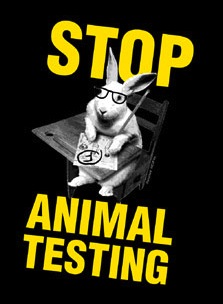 Side note: My dad actually bought me this shirt. I love it, and my wife hates it when I wear it. She just thinks it makes me look stupid. I don’t think she cares about the rabbit.
John Timmer at Ars Technica places a plague o’ both your houses when it comes to the convenient rejection of scientific fact. And he’s right.
For many in the US, expertise has taken on a negative cultural value; experts are part of an elite that thinks it knows better than the average citizen. (This is accurate, for what it’s worth.) Very few object to that sort of expertise when it comes time to, say, put the space shuttle into orbit, but expertise can become a problem when the experts have reached a consensus that runs against cultural values.
And, for many in our society, scientific expertise has done just that. Abstinence-only sex education has been largely ineffective. Carbon emissions are creating a risk of climate change. Humanity originated via an evolutionary process. All of these findings have threatened various aspects of people’s cultural identity. By rejecting both the science and the expertise behind it, candidates can essentially send a signal that says, “I’m one of you, and I’m with you where it counts.”
This is not some purely partisan phenomenon. On other issues, rejection of scientific information tends to be associated with the political left—the need for animal research and the safety of genetically modified foods spring to mind. These positions, however, are anything but mainstream within the Democratic Party, so candidates have not felt compelled to pander to (or even discuss) them, in most cases. That’s created an awkward asymmetry, one where a single party has a monopoly on public rejection of scientific information and certain kinds expertise.
It’s not really symmetrical; there can be little doubt that the right’s repudiation of reality is far worse than that of the left’s. That said, most of the false panic about vaccinations causing autism, for example, is fomented on the left (and sometimes even aided by left-leaning publications like the Huffington Post). And when nonbelievers who tend toward the Democratic Party make their views known, they often accused not of being too left-wing, but too right-wing, as though their confidence in the nonexistence of a magic super-being (which is based on science, fact, and reality) is somehow equivalent to the right’s zealous insistence of the opposite (which is not); it goes against the more mainstream left wing value of tolerance and diversity for their own sakes.
But to Timmer’s point, a lot of this organized willful ignorance is abetted by a general American distrust of experts and intelligence. It seems to threaten people when it’s not fully graspable immediately. (Note the different attitudes to expertise in athletics or business, which I think doesn’t seem as arcane to the general public.) Which is why, politically, I think these arguments for now need to be framed not in terms of which academics agree with what proposition, but what is simply true, like gravity makes things come down, like fire burns and ice is cold. It’s probably our only shot.
-
Save Science By Not Talking about Science
 ”At last! I have discovered the formula for making the uneducated feel even MORE inadequate!”
I almost wasn’t going to read the recent Paul Krugman column on the proud anti-science stance of mainstream Republican thought. You know, “this also just in: Fire is hot.”
But it got so much attention in my social media circles, that I decided to read it anyway, and I’m glad I did, if only for the closing paragraph:
Now, we don’t know who will win next year’s presidential election. But the odds are that one of these years the world’s greatest nation will find itself ruled by a party that is aggressively anti-science, indeed anti-knowledge. And, in a time of severe challenges — environmental, economic, and more — that’s a terrifying prospect.
“Anti-knowledge” is the key. I’m going to put my political communications hat on here, and dissect what may be one reason why this issue doesn’t get as much traction as it ought to.
To folks who are into science or are a part of the secularist/atheist movement, the word “science” means something big, important, and fundamental about human knowledge. We (usually) understand that when we talk about science, we’re not necessarily talking about the products of science, but the act of science: exploring questions, testing hypotheses, developing theories, all based on observable data. We know that to be “anti-science” means what Krugman says it means, to be anti-knowledge.
But I think that when the general public hears the word “science,” something different is evoked. They think of dudes in lab coats, robots, medicine, eggheaded professors pontificating with polysyllabic words. And that’s the best case scenario. Cassini scientist Carolyn Porco has addressed the strong cultural bias against science and its practitioners, and I reported on her address to the 2009 Atheist Alliance International convention thusly:
The hurdle, according to her, was the deeply ingrained image of scientists and technology as negative, the near-universal portrayal of scientists and intellectuals as villains, as cold, or as socially inept. Often set up as archetypes to be ridiculed, hated, or feared, Porco said that popular culture usually associates science with disasters, “Frankensteins”, and people who are “too brilliant for their own good.”
“It is not uncommon for people to respond [to scientists and science] with ambivalence,” she said. “To see the evil scientist receive his or her comeuppance is soothing.”
In other words, the term “science,” and all of its associations, carry far too much baggage to be politically useful. For too many Americans, the notion of being hostile to science is not only acceptable, but validating of one’s own ignorance.
This is why we in the reality-based community should, for now, abandon the term when dealing with deniers of climate change and evolution, and the conspiracists who foment anti-medicine paranoia (such as those opposed to vaccinations). Instead, we should talk about folks like Rick Perry and Michele Bachmann as anti-knowledge, anti-progress, anti-reality. (We should not bother calling them “anti-intellectual,” because if the general public is uneasy about scientists, imagine how hostile they feel toward “intellectuals.”) These fools and frauds should be called out for living in a fantasy world, for hawking nonsense that would get snake oil salesmen run out of town, and for dragging our society back to the Bronze Age.
But at this time in our rhetorical history, we should stop talking about “science.” As the hubbub over Sam Harris’s The Moral Landscape shows us, even we skeptics and allegedly pro-knowledge folks can misunderstand what the word “science” means in certain contexts.
Given all this, let’s surrender the word for now in this political debate. Let’s talk about being against facts, against the truth. Science itself will be better off for it in the long run.
-
Trojan Asteroid Follows Earth, Reinforces My Insecurities
It turns out that our fair planet has been tailed by a shy asteroid for perhaps thousands of years. This “Trojan asteroid” is caught between the gravitational tugs of Earth and the Sun, and is doomed to follow us around in our orbit, and there may be others like it. Per the LA Times:
“This is pretty cool,” said Amy Mainzer, a scientist at the Jet Propulsion Laboratory … “It’s a new class of near-Earth object that’s been hypothesized to exist.”
That’s right, folks. Just like this blog, it’s a near-Earth object. And the similarities don’t end there. For one thing, it’s stuck in between two worlds, but never quite joining either. Its origin is alien as it strives for a more permanent home with one of the larger bodies, but will never quite catch up. It lives in the shadow of an Earth that has only now taken notice, while the Sun shines so bright, that it’s impossible for anyone to really look at — forever invisible.
And much like my readership levels, this asteroid is unlikely to see any human contact:
… if more Trojan asteroids can be found, researchers said, they could be ideal for astronaut visits and the mining of precious resources. (This particular asteroid is too tilted with respect to the solar system to make a good candidate, Mainzer said.)
Ouch. That one really hits home…
…like an asteroid!!!
-
Darwin’s Mischief, Through Antebellum Eyes
In 1860, botanist Asa Gray reviewed the brand new book, On the Origin of Species by Charles Darwin, for the Atlantic Monthly, and it is a fascinating read. Not least of all for what about it induces cringing to modern liberal eyes:
The prospect of the future, accordingly, is on the whole pleasant and encouraging. It is only the backward glance, the gaze up the long vista of the past, that reveals anything alarming. Here the lines converge as they recede into the geological ages, and point to conclusions which, upon the theory, are inevitable, but by no means welcome. The very first step backwards makes the Negro and the Hottentot our blood-relations; — not that reason or Scripture objects to that, though pride may.
At the very least, Gray is willing to accept, if grudgingly, that those of African descent are actually the same species as he. Indeed, Gray only concedes that they share a “blood relation,” as if they are as closely related to, say, species of bird are to each other. And note the use of the anarchic “Hottentot,” a derogatory term for a particular tribe of African, the Khoikhoi (as though “Negro” was not itself derogatory, or, for that matter, the whole passage).
Gray’s antebellum racism is not all that causes wincing, particularly when one considers that he is reviewing for an educated audience the book that serves as the cornerstone for modern biology and (one could argue) modern cultural atheism.
The next [step backward] suggests a closer association of our ancestors of the olden time with “our poor relations” of the quadrumanous [“four-handed,” meaning primates with hand-like feet] family than we like to acknowledge. Fortunately, however,— even if we must account for him scientifically,-man with his two feet stands upon a foundation of his own. Intermediate links between the Bimana and the Quadrumana are lacking altogether; so that, put the genealogy of the brutes upon what footing you will, the four-handed races will not serve for our forerunners;— at least, not until some monkey, live or fossil, is producible with great-toes, instead of thumbs, upon his nether extremities; or until some lucky ‘geologist turns up the bones of his ancestor and prototype in France or England … and until these men of the olden time are shown to have worn their great-toes in a divergent and thumblike fashion. That would be evidence indeed: but until some testimony of the sort is produced, we must needs believe in the separate and special creation of man, however it may have been with the lower animals and with plants.
Don’t you just love how he only allows for the scientific accounting of human origins — as opposed to the supernatural account — for the sake of argument, as though it’s something that could only be done in a weird hypothetical fantasy?
Gray is eager throughout his review to brush aside the notion that humans are themselves a product of the evolutionary processes Darwin describes. While he does true to give Darwin his due for his far-reaching and thorough theory, the mainly goes to great pains to explain that it makes perfect sense that humans would be unique among animals to appear out of nothing. He chidingly declares, “the author speaks disrespectfully of spontaneous generation” and posits:
Several features of the theory have an uncanny look. They may prove to be innocent: but their first aspect is suspicious, and high authorities pronounce the whole thing to be positively mischievous.
Well, that’s one way to look at it.
Even more fascinating, Gray was instrumental in getting Darwin’s book published in the U.S. — which, of course, makes one question the ethics of the folks at the 1860 Atlantic for allowing him to review a book he had such a personal stake in. Isn’t history amazing?



 Near-Earth Object